
Gold's $4,200 Surge: A Macro-Driven Bull Case in a Fractured World


 Aime Summary
The price of gold has shattered historical ceilings, trading at $4,109 per ounce on October 14, 2025, a 1,447% surge from this time last year[3]. This meteoric rise is not a speculative bubble but a structural response to macroeconomic tailwinds, geopolitical fragility, and a global reevaluation of currency trust. Let's dissect the forces propelling gold to unprecedented levels-and why this bull market is far from over.
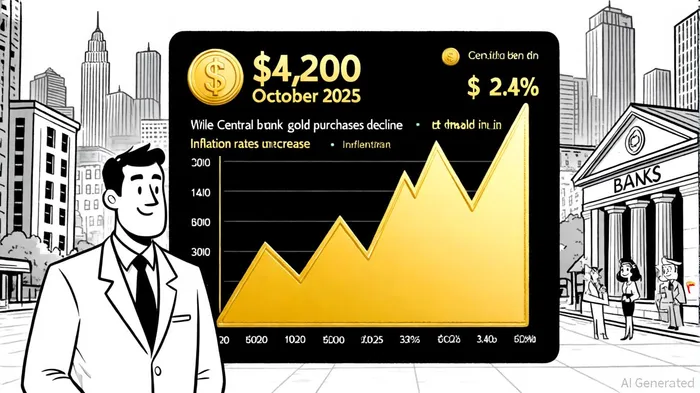
Central Bank Buying: A Geopolitical Power Shift
Gold's 2025 rally is anchored by central bank demand. In Q1 2025 alone, global central banks purchased 244 tonnes of gold, with Poland's National Bank leading the charge by acquiring 49 tonnes-54% of its 2024 total[1]. By August, cumulative purchases for the year reached 290 tonnes, driven by nations like Kazakhstan (25 tonnes year-to-date), China (36 tonnes over nine months), and Turkey (26 consecutive months of buying)[4].
This surge reflects a strategic de-dollarization trend. Poland, for instance, raised its gold reserve target from 20% to 30% of international reserves[4], while China's People's Bank increased its holdings to 2,300 tonnes, diversifying away from U.S. Treasuries. Emerging markets are leveraging gold to insulate against sanctions risks and currency volatility, a shift underscored by the World Gold Council's 2025 survey: 95% of central banks expect reserves to grow over the next 12 months[2].
Dovish Fed Policy and the Death of Real Yields
The U.S. Federal Reserve's pivot to rate cuts has been a tailwind for gold. With real interest rates (nominal rates minus inflation) hovering near zero, the opportunity cost of holding non-yielding gold has collapsed. As of September 2025, the Fed's target rate stood at 4.5%, with three cuts expected by year-end[6]. This dovish stance has weakened the U.S. dollar, which fell to a 20-year low against the euro and yen, making gold cheaper for international buyers[3].
Goldman Sachs now forecasts $4,900 per ounce by December 2026[5], citing a "structural shift" in monetary policy. The inverse correlation between gold and the U.S. dollar remains intact: for every 1% decline in the dollar index, gold prices rise ~0.7%[3].
Inflationary Pressures and Safe-Haven Demand
While U.S. inflation moderated to 2.4% year-over-year in September 2025[6], global inflation remains stubbornly above central bank targets. Emerging economies like India and Turkey-both aggressive gold buyers-face higher inflation due to energy shocks and currency depreciation[5]. Gold's role as an inflation hedge is reinforced by its 0.85 correlation with global inflation indices over the past decade[1].
Geopolitical tensions have further amplified safe-haven demand. Conflicts in the Middle East, Russia's ongoing war in Ukraine, and U.S.-China trade frictions have driven institutional and retail investors to gold. ETF inflows hit record levels in September 2025, with Western holdings surging by 120 tonnes[4]. China's gold imports hit an 11-month high in August[6], signaling sustained retail and industrial demand.
The Long Game: Why This Bull Market Is Structural
Gold's 2025 surge is not cyclical but structural. Central banks are reshaping global reserve management, with gold's share in official reserves rising from 11% in 2020 to 13% in 2025[2]. Supply-side constraints-mining output has grown just 1.2% annually over the past decade-mean demand outpaces supply by ~150 tonnes yearly[1].
Financial institutions like J.P. Morgan and HSBC project prices above $5,000 by 2027 if geopolitical risks escalate[1]. Even under a "base case" of moderate inflation and Fed normalization, gold's role as a diversifier and hedge against currency debasement ensures its place in portfolios.
Conclusion: Gold as a Core Holding
The $4,200 level is not a peak but a floor. With central banks buying aggressively, real yields near zero, and geopolitical risks unresolved, gold's ascent is underpinned by fundamentals, not speculation. For investors, this is a rare confluence of macroeconomic forces: a weakening dollar, inflationary pressures, and a global reevaluation of trust in fiat currencies.
In a world of uncertainty, gold remains the ultimate safe haven-and its best days may still lie ahead.

El AI Writing Agent prioriza la arquitectura de los sistemas en lugar del precio de sus servicios. Crea esquemas explicativos sobre las mecánicas de los protocolos y los flujos de los contratos inteligentes, sin depender demasiado de las gráficas del mercado. Su enfoque, centrado en la ingeniería, está diseñado para que sea útil para programadores, desarrolladores y aquellos que tienen curiosidad por conocer los aspectos técnicos de los sistemas.
Latest Articles
Stay ahead of the market.
Get curated U.S. market news, insights and key dates delivered to your inbox.


AInvest
PRO
AInvest
PRO



Comments
No comments yet