
Golar LNG's Strategic De-Risking and Enhanced Earnings Visibility
Golar LNG's Strategic De-Risking and Enhanced Earnings Visibility
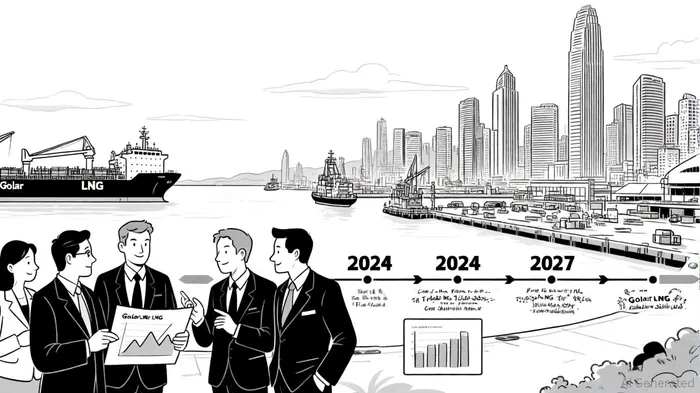
Golar LNG has emerged as a standout player in the floating liquefied natural gas (FLNG) sector, leveraging strategic de-risking and operational optimization to transform its earnings visibility. By securing long-term contracts, divesting non-core assets, and prioritizing capital discipline, the company has created a cash flow profile that balances near-term resilience with long-term growth.
Operational Optimization: Locking in Long-Term Revenue
Golar's focus on FLNG as a service has been a cornerstone of its de-risking strategy. In Q2 2025, the company secured two transformative 20-year charters for its FLNG Hilli and the future MKII FLNG vessel with Southern Energy S.A. in Argentina, adding an estimated $13.7 billion in Adjusted EBITDA backlog over two decades before inflationary adjustments and commodity-linked upside, according to a Panabee Q2 2025 note. This follows the Commercial Operations Date (COD) for FLNG Gimi in Q2 2025, which unlocked approximately $3 billion in Adjusted EBITDA backlog for Golar's share, according to Panabee.
These developments underscore Golar's shift from cyclical energy markets to a predictable, infrastructure-like revenue model. By aligning with long-term charter partners and leveraging commodity-linked tariffs, the company mitigates exposure to short-term price volatility while capturing upside from natural gas demand growth. As stated by the CEO in the Q2 2025 earnings call, GolarGLNG-- is now the "only proven provider of FLNG as a service," a positioning that strengthens its competitive moat.
Financial Resilience: Strengthening the Balance Sheet
Golar's operational gains are matched by robust financial discipline. The company increased its cash position to nearly $900 million in Q2 2025 through a $575 million convertible bond issuance, while fulfilling key conditions precedent (CPs) and final investment decisions (FIDs) for the FLNG Hilli and MKII projects, according to a MarketBeat earnings report. This liquidity, combined with a $17 billion total EBITDA backlog, provides a strong foundation for capital-intensive projects and shareholder returns.
Notably, Golar's strategic divestments-such as the sale of the Golar Arctic and Avenir LNG stake-have streamlined its portfolio, focusing resources on FLNG infrastructure, as noted by Panabee. These moves have reduced operational complexity and redirected capital toward high-margin, long-term assets. According to the Q2 2025 earnings call transcript, Golar's Q2 2025 EBITDA of $49 million marked a significant improvement, with full-year EBITDA expected to quadruple by 2028 upon the delivery of the Mark II FLNG.
Challenges and Mitigations
Despite its progress, Golar faces headwinds. Delays in the $1.2 billion Chinese sale leaseback refinancing for FLNG Gimi and regulatory hurdles for the MKII FLNG charter remain unresolved, according to GuruFocus highlights. However, the company's strong balance sheet and diversified backlog provide flexibility to navigate these challenges. For instance, the 20-year charters with Southern Energy include commodity-linked tariff components, which could offset inflationary pressures and enhance returns, as noted in the MarketBeat earnings report.
Future Outlook: Scaling the FLNG Model
Looking ahead, Golar is poised to capitalize on the global shift toward flexible LNG supply. The company has already ordered its third FLNG unit, MKII, which will increase liquefaction capacity by 70% and is slated for delivery by Q4 2027, per the MarketBeat earnings report. Plans to order a fourth FLNG unit within months further highlight its confidence in the sector's growth, as discussed on the Q2 2025 earnings call. With Q3 2025 results scheduled for November 5, 2025, investors will closely watch how the company executes its capital allocation and project timelines, according to Panabee.
Conclusion
Golar LNG's strategic de-risking-through long-term contracts, asset optimization, and disciplined financing-has created a resilient cash flow profile. By transforming into a dedicated FLNG infrastructure provider, the company is positioning itself to deliver consistent returns in an increasingly volatile energy landscape. While near-term challenges persist, the scale of its backlog and the durability of its contracts suggest a compelling long-term investment thesis.
Historical backtesting of GLNG's earnings events from 2022 to 2025 reveals a -4.3% cumulative abnormal return by day 30, with declining outperformance over time. This pattern suggests that long-only investors may consider trimming exposure within the first week after results, while short-biased strategies could find historical edge in the 8–30 day window.

The AInvest News Editorial Team consists of experienced financial journalists and editors who oversee all published content. While our newsroom leverages advanced AI tools to assist in data gathering and draft generation, every article is reviewed, fact-checked, and approved by human editors to ensure accuracy, clarity, and transparency.
Latest Articles
Stay ahead of the market.
Get curated U.S. market news, insights and key dates delivered to your inbox.




Comments
No comments yet