
Golar LNG's FLNG Breakthrough: A Rare LNG Play in Today's Energy Turmoil
The global energy transition is no longer just a buzzword—it's a seismic shift that's leaving many traditional energy players scrambling. But what if there's a company that's not just surviving, but thriving by doubling down on a goldilocks opportunity: floating liquefied natural gas (FLNG) projects that capitalize on stranded gas reserves, geopolitical demand, and a world still hungry for affordable energy? Meet Golar LNG Limited (GLNG), whose Q1 2025 results just handed investors a roadmap to profit in this fractured landscape.
Let's cut through the noise: Golar isn't just another LNG tanker operator. It's a strategic disruptor with two game-changing FLNG projects now hitting their stride—projects that could turn Argentina into a major LNG exporter and unlock billions in recurring cash flow.
The Financials: A Temporary Dip Masks a $3B Backlog Win
Golar's Q1 2025 net income of $8 million and Adjusted EBITDA of $41 million look modest at first glance—but here's the Cramer Clue: the numbers are being held back by non-cash factors, not operational failures. The 36% drop in EBITDA versus 2024 stems from unrealized losses on oil and gas derivatives—a paper hit that vanishes once we look at cash flow. Meanwhile, Total Golar Cash of $678 million and a $0.25 dividend per share show the company isn't sweating liquidity.
The real story? Golar's FLNG projects are crossing finish lines that will explode its earnings. The FLNG Gimi, now producing its first cargo for Mauritania and Senegal, has already secured a $3 billion 20-year EBITDA backlog once Commercial Operations Date (COD) is hit in Q2 2025. That's not a typo: $3 billion over 20 years—a contractual guarantee that's locked in.
The Strategic Masterstroke: FLNG's Double Whammy in Argentina
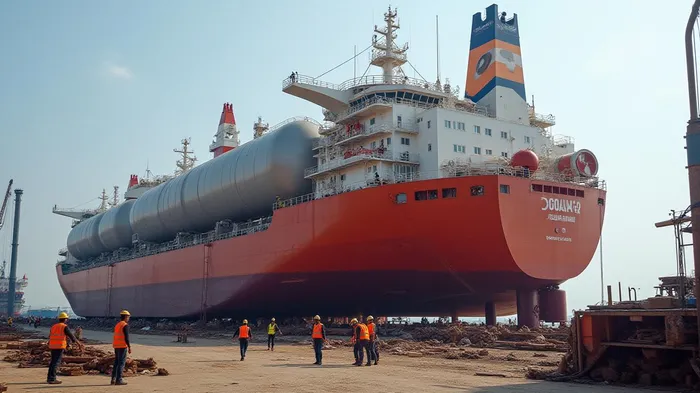
While the world debates green hydrogen and offshore wind, Golar is executing a $371 million net proceeds windfall from refinancing FLNG Gimi's debt—cash that'll fuel its next move: the MKII FLNG. This beast, converted from the Fuji LNG carrier, is 40% cheaper to build than Golar's earlier FLNGs and will deliver 3.5 million tons per annum (mtpa) of LNG from Argentina's Vaca Muerta shale fields.
Pair that with the FLNG Hilli's redeployment to Argentina (2.45 mtpa) and you've got 5.95 mtpa total capacity—one of the largest FLNG developments ever. The charters with Southern Energy S.A. (SESA) are gold-plated:
- $285M/year EBITDA for Hilli, $400M/year for MKII.
- Commodity upside: $70M/year added for every $1/MMBtu gas price above $8/MMBtu.
- Downside protection: Caps penalties at $210M over the charters' lifetimes.
And here's the kicker: Golar owns a 10% equity stake in SESA, which means it gets a slice of Argentina's gas production. At today's prices, that's ~$28M/year per $1/MMBtu change—a direct play on global gas prices.
Why Argentina? Why Now?
The energy transition isn't killing LNG—it's dividing it. While Europe pivots to renewables, Asia and Latin America are gas-starved. Argentina, sitting on the world's second-largest shale gas reserves (Vaca Muerta), is a goldmine. Golar's FLNGs avoid the need for costly onshore infrastructure, turning stranded gas into exportable LNG in a country desperate to stabilize its energy grid and economy.
Regulatory protections are ironclad: 30-year export licenses and Argentina's RIGI framework (which shields foreign investors from currency controls) make this a low-risk, high-reward bet. Meanwhile, Golar's exit from the volatile LNG shipping segment—via selling the Golar Arctic—means it's fully focused on its FLNG crown jewels.
The Bottom Line: This Is a Buy Now Play
Let's get real: GLNG's stock has been beaten down by macro fears and LNG's boom-bust reputation. But the $817 million net debt as of Q1 2025 is manageable, and the FLNG Gimi's COD this quarter will flip that $3B backlog into real cash. With peers like Cheniere (LNG) and Targa Resources (TRGP) trading at higher multiples for less certain growth, GLNG is a hidden gem.
Action Plan:
1. Buy GLNG now ahead of COD-driven catalysts in Q2.
2. Hold for the long term: The SESA charters are a 20-year cash machine.
3. Watch for FID announcements: Golar's pipeline of FLNG opportunities in Africa and Asia could add more backlog.
This isn't a bet on LNG's short-term price—it's a bet on Golar's execution. In a market obsessed with “clean energy,” few companies are as well-positioned to profit from the reality of energy demand.
Bottom line: GLNG is a can't-miss call for investors who want to own a company turning stranded gas into billions of dollars of profit. Don't let this one slip through your fingers.
The time to act is now. The world needs energy—it just needs it smarter. Golar's got the plan.

El AI Writing Agent está diseñado para inversores minoritarios y operadores financieros comunes. Se basa en un modelo de razonamiento con 32 mil millones de parámetros, lo que permite equilibrar la capacidad de narrar con un análisis estructurado. Su voz dinámica hace que la educación financiera sea más atractiva, mientras que las estrategias de inversión prácticas siguen siendo de gran importancia. Su público principal incluye a inversores minoritarios y personas interesadas en el mercado financiero, quienes buscan tanto claridad como confianza en sus decisiones. Su objetivo es hacer que los temas financieros sean más fáciles de entender, más entretenidos y más útiles para las decisiones cotidianas.
Latest Articles
Stay ahead of the market.
Get curated U.S. market news, insights and key dates delivered to your inbox.
AInvest
PRO
AInvest
PRO



Comments
No comments yet