
Gogo (GOGO.O) Sharp Intraday Drop: Technical, Order Flow, and Peer Analysis
 Aime Summary
Understanding the Sharp Move in GogoGOGO-- (GOGO.O) on a Volatile Day
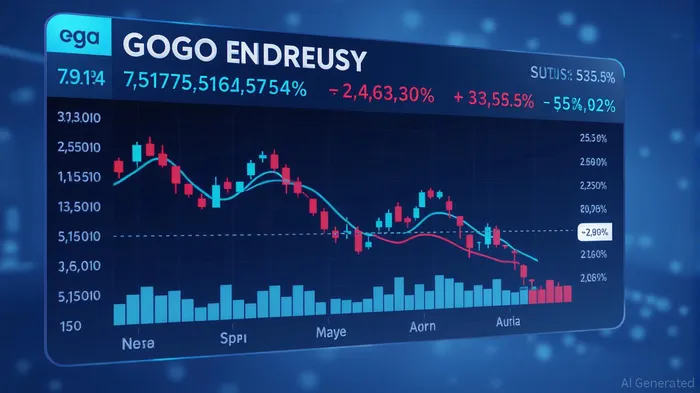
On a day marked by significant intraday swings in the market, Gogo (GOGO.O) closed down approximately 7.61%, with trading volume reaching 2.41 million shares, well above its average. Interestingly, no significant fundamental news was released, making the move more of a technical or order-flow driven event. Let's break down the key elements that could explain the sharp drop.
Technical Signals: RSI Oversold Condition Fails to Trigger Buy-the-Dip
Among the technical indicators analyzed, the only signal that was triggered was the RSI Oversold level. Typically, this suggests a potential buying opportunity as prices may rebound off extreme bearish levels. However, the market failed to respond in the usual fashion, and the price continued lower. Other classic reversal patterns like Head & Shoulders, Double Top, or Double Bottom were not triggered, nor was there a KDJ Golden or Death Cross.
The absence of a strong bearish confirmation pattern and the lack of a bullish rebound from RSI suggests that either the oversold bounce failed, or a deeper selloff was already in progress.
Order-Flow Silence: No Clear Block Trades or Clusters
Despite the large volume and sharp move, no block trading data was reported for GOGO.O. This absence of large institutional orders or concentrated bid/ask imbalances means that the drop was likely driven by retail sentiment, algorithmic trading, or market rotation rather than institutional selling. The lack of clear order-flow data makes it harder to pinpoint a precise trigger, but it supports the idea of a broader market shift rather than a stock-specific catalyst.
Peer Stocks Show Mixed Signals
The performance of related stocks tells an interesting story. While some of Gogo’s peers like BH and BH.A were up over 2.7%, others like AAP and BEEM fell sharply. This divergence indicates sector rotation or thematic shifts, but not a broad-based sell-off in the group that Gogo belongs to.
The mixed performance of peer stocks suggests that Gogo’s decline may not be representative of the entire sector, but rather a result of specific market pressures or internal order flow, such as short-term profit-taking or algorithmic pressure.
Hypotheses: What’s Driving the Move?
Based on the data, we can form two leading hypotheses:
- Algorithmic Pressure and Short-Liquidity Drying Up: Gogo is a low-cap stock with high retail interest, making it susceptible to short-term algorithmic or liquidity-driven moves. The RSI oversold trigger could have activated sell-side algorithms or prompted short-covering, which failed to reverse the downward momentum.
- Market Rotation and Thematic Divergence: Broader market rotation into more defensive or high-momentum sectors could have caused Gogo to underperform its peers. The lack of a clear bearish pattern and the divergence in peer performance suggests a broader shift rather than a stock-specific event.
Conclusion
Gogo’s sharp intraday decline appears to be the result of a combination of algorithmic pressure, lack of order-flow support, and market rotation rather than any fundamental news or clear technical bearish signals. While the RSI oversold condition failed to reverse the downtrend, the broader market context and peer divergence suggest that this is a short-term correction rather than a long-term bearish signal.
Traders may want to watch for a potential bounce off the RSI oversold level or a retesting of key support levels. Until more clarity emerges on the direction of the broader market, caution is warranted.

Stay ahead of the market.
Get curated U.S. market news, insights and key dates delivered to your inbox.




Comments
No comments yet