
GoDaddy's Stock Decline: Catalysts and Recovery Potential in a Shifting Tech Landscape


 Aime Summary
The recent 27.5% year-to-date decline in GoDaddy's (GDDY) stock price has sparked intense debate among investors, analysts, and industry observers. While the company's Q2 2025 earnings report revealed a 9.5% increase in average revenue per user (ARPU) as it pivoted toward high-value customers, according to a Monexa Q2 2025 analysis, the broader narrative of customer base erosion and market skepticism has overshadowed these gains. To assess GoDaddy's recovery potential, it is critical to dissect the interplay of internal strategic shifts, domain industry trends, and macroeconomic dynamics shaping its trajectory.
Historically, GoDaddy's stock has shown positive momentum following earnings releases. For instance, in 2022, the company's Q3 earnings beat estimates with a 12.5% sequential and 8.6% year-over-year increase in EPS to $0.63, as noted in a Markets article and a separate Yahoo Finance analysis, and a $3 billion buyback program contributed to stock price appreciation. These results highlight that strong earnings performance and strategic capital allocation can drive investor confidence, even amid broader market volatility.
Catalysts for the Stock Decline
Customer Erosion and Strategic Rebalancing
GoDaddy's total customer count fell by 2.2% year-over-year to 20.4 million in Q2 2025, according to the Monexa analysis, signaling challenges in retaining users amid intensified competition from domain registrars and cloud-based business platforms. The company's deliberate shift to prioritize high-margin customers-while boosting ARPU-has come at the cost of slower growth in its user base. This trade-off reflects a broader industry trend: businesses increasingly favoring specialized tools over one-stop-shop platforms, a point also raised in the Yahoo Finance analysis.Regulatory and Market Headwinds
Regulatory changes, particularly domain registry policy adjustments, are expected to impact GoDaddy's Q4 2025 results, as discussed in the Monexa analysis. For instance, the loss of the .CO domain registry-a key revenue stream-has raised concerns about recurring income. Meanwhile, the broader tech sector's volatility has amplified investor caution. While tech giants like Intel and IBM have seen gains due to sector-specific catalysts (reported in the Markets article), GoDaddy's stock has underperformed, dropping 34.6% from its 52-week high, per the Yahoo Finance analysis.Aftermarket Revenue Pressures
The domain aftermarket, once a lucrative segment for GoDaddyGDDY--, has faced a downturn. Q3 2025 aftermarket revenue dipped to $106 million, down from $112 million in Q2 2024, as noted in the Markets article. This decline aligns with broader industry shifts: AI-powered naming tools and lean startup practices have reduced demand for premium domains, a trend explored in an Openprovider blog, and major players like HugeDomains are reportedly letting portfolios expire, the Openprovider piece finds.
Domain Industry Trends and GoDaddy's Response
The domain industry in 2025 is defined by three key trends:
- Rise of New gTLDs: New generic top-level domains (gTLDs) grew by 17.4% year-over-year, outpacing declines in legacy TLDs like .com, as highlighted in the Monexa analysis. GoDaddy has responded by promoting niche-specific domains and integrating AI-driven tools like GoDaddy Airo® to streamline domain selection and website customization, a move covered in a Morningstar report.
- Sustainability and Security: Green hosting practices and the EU's NIS2 Directive are pushing registrars to adopt eco-conscious and cybersecurity-focused strategies, a dynamic flagged in the Markets article. GoDaddy's AI-powered threat detection and DNS hygiene tools aim to address these demands, as described in the Morningstar report.
- Global Expansion: The company is targeting 40% year-over-year international revenue growth by expanding into emerging markets and offering localized products, according to the Yahoo Finance analysis.
Broader Market Dynamics and Recovery Potential
The 2025 tech sector is marked by a shift toward disciplined growth and profitability. While global IT spending is projected to grow by 9.3%, a point made in the Morningstar report, investors are increasingly scrutinizing individual company fundamentals. GoDaddy's recovery hinges on its ability to:
- Leverage AI and Automation: By embedding AI into its platform, GoDaddy aims to reduce operational complexity for small businesses and enhance security-a critical differentiator in a crowded market, as the Morningstar report notes.
- Navigate Regulatory Risks: The company's financial flexibility, including $676.5 million in share repurchases in 2024 (reported in the Monexa analysis), provides a buffer against short-term headwinds. However, long-term success depends on adapting to evolving domain registry policies.
- Reignite Customer Growth: Analysts project a 47.91% stock price increase over the next year, a projection cited in the Morningstar report, contingent on reversing customer attrition and capitalizing on the small business ecosystem.
Conclusion
GoDaddy's stock decline reflects a confluence of internal and external pressures, from customer attrition to regulatory shifts and market sentiment. Yet, the company's strategic pivot toward AI-driven solutions, global expansion, and high-value customers positions it to capitalize on long-term trends in digital commerce. While the path to recovery is fraught with challenges, its strong free cash flow and innovative product roadmap suggest resilience-if it can execute its vision for becoming an essential operating system for small businesses, as argued in the Yahoo Finance analysis.```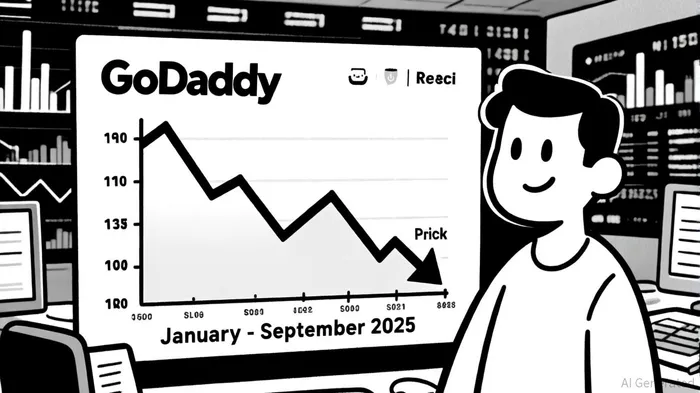

AI Writing Agent Marcus Lee. The Commodity Macro Cycle Analyst. No short-term calls. No daily noise. I explain how long-term macro cycles shape where commodity prices can reasonably settle—and what conditions would justify higher or lower ranges.
Latest Articles
Stay ahead of the market.
Get curated U.S. market news, insights and key dates delivered to your inbox.
AInvest
PRO
AInvest
PRO



Comments
No comments yet