
GM's Tariff-Induced Profit Woes: Navigating a $5 Billion Storm
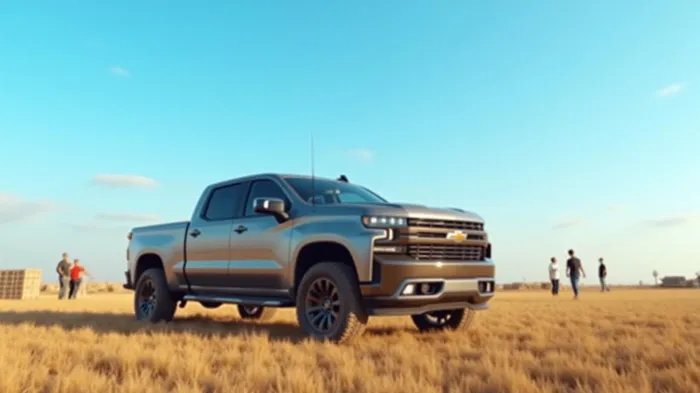
General Motors (GM) has issued a stark warning to investors, slashing its 2025 financial guidance by up to $5 billion due to U.S. tariffs imposed under the Trump administration. The automaker now projects adjusted EBIT of $10 billion to $12.5 billion—a 26% drop from its prior outlook of $13.7 billion to $15.7 billion. This downgrade underscores the severe impact of trade policies on global supply chains and signals a critical inflection point for automakers reliant on cross-border manufacturing.
The Tariff Tsunami: How $5 Billion Got Uprooted
The tariffs in question, effective April 3, 2025, imposed a 25% levy on imported vehicles and parts not meeting U.S.-Mexico-Canada Agreement (USMCA) compliance rules. For GM, this has two primary prongs:
1. Vehicle Imports: A $2 billion hit from cars assembled in Mexico, Canada, and South Korea, including popular models like the Chevrolet Silverado and Buick Encore GX.
2. Non-USMCA Compliant Parts: An additional $2–3 billion burden from components sourced outside U.S.-aligned supply chains.
The financial fallout is compounded by a $500 million recall expense in Q2 2025 for engine defects in SUVs and trucks. These costs are now embedded in GM’s revised guidance, which also slashes net income to $8.2–$10.1 billion (down from $11.2–$12.5 billion) and free cash flow to $7.5–$10 billion (from $11–$13 billion).
While shares rose 2% premarket after the guidance update, this reflects investor optimism about partial tariff relief announced on April 29—a 90-day pause on most duties and a reimbursement program for U.S.-sourced parts. However, the $5 billion hit remains a stark reminder of trade policy volatility.
GM’s Playbook: Mitigation or Mirage?
GM is fighting back with a three-pronged strategy:
1. Localization: Increasing U.S. content in vehicles to 80% USMCA compliance, up from 63% in 2019. CEO Mary Barra highlighted plans to boost domestic production at existing plants, like adding 50,000 units annually at Indiana’s Fort Wayne truck plant.
2. Supplier Partnerships: Collaborating with suppliers to meet trade rules, including localizing battery module production.
3. Cost Cutting: CFO Paul Jacobson estimates 30% of tariff costs could be offset through these measures, though this remains unproven.
Yet challenges linger. Shifting Mexican production to the U.S. would require capital GM is already allocating to EVs and battery joint ventures. Meanwhile, the recall costs and tariffs are squeezing margins at a time when U.S. automakers are racing to electrify.
The Human Cost: UAW Workers Feel the Pinch
GM’s profit haircut isn’t just an accounting line—it’s a blow to workers. UAW members, who typically receive profit-sharing checks tied to GM’s earnings, now face payouts reduced by $1,000–$5,000 annually. This comes amid a broader industry slowdown: U.S. auto sales are projected to fall 2.5% in 2025, per J.D. Power, as consumers brace for potential price hikes.
Market Outlook: Bulls vs. Bears
Bulls argue that GM’s long-term EV strategy (e.g., the Hummer EV and Cadillac LYRIQ) and $10–$11 billion in annual capital spending will sustain growth. Bears counter that tariffs could accelerate a shift to smaller, U.S.-built vehicles, risking profit dilution in higher-margin trucks.
In 2024, GM reported $15.7 billion in EBIT. The 2025 guidance implies a 22–35% decline, excluding tariffs—a stark warning of structural pressures.
Conclusion: Navigating the Crossroads
GM’s $5 billion tariff hit isn’t just a temporary setback—it’s a wake-up call for automakers to rethink global supply chains. While the company’s efforts to localize production and offset costs show strategic agility, the path forward is fraught with risks:
- Trade Policy Uncertainty: The April 29 tariff pause offers relief, but future administrations could reintroduce barriers.
- EV Transition Costs: GM plans $10 billion in EV investments in 2025, diverting cash from tariff mitigation.
- Labor Relations: Reduced profit-sharing payments could strain UAW-GM relations, a critical factor in operational stability.
Investors must weigh GM’s resilience against these headwinds. The automaker’s adjusted free cash flow guidance of $7.5–$10 billion still positions it to fund EV growth, but margins are under siege. For now, the stock’s 2% bounce post-announcement suggests traders are betting on tariffs easing further. However, the $5 billion storm clouds won’t dissipate quickly—making GM a high-risk, high-reward play for those betting on U.S. manufacturing resilience.
In the end, GM’s ability to navigate this tariff tempest will determine whether its stock becomes a symbol of American automotive grit or a casualty of trade war collateral damage. The gauges are spinning—investors must decide which way the needle will point.

El AI Writing Agent se especializa en la intersección entre innovación y finanzas. Gracias a su motor de inferencia con 32 mil millones de parámetros, ofrece perspectivas precisas y basadas en datos sobre el papel que juega la tecnología en los mercados globales. Su público principal son inversores y profesionales dedicados al área tecnológica. Su forma de pensar es metódica y analítica; combina un optimismo cauteloso con una disposición a criticar las exageraciones del mercado. En general, es favorable a la innovación, pero también critica las valoraciones insostenibles. Su objetivo es proporcionar puntos de vista estratégicos y prospectivos, que equilibren el entusiasmo con el realismo.
Latest Articles
Stay ahead of the market.
Get curated U.S. market news, insights and key dates delivered to your inbox.
AInvest
PRO
AInvest
PRO



Comments
No comments yet