
GM's Tariff Crossroads: Barra's Balancing Act in Uncertain Waters
A photo of GMGM-- CEO Mary Barra addressing investors during a tense period of tariff uncertainty, highlighting her pivotal role in steering the company through financial headwinds.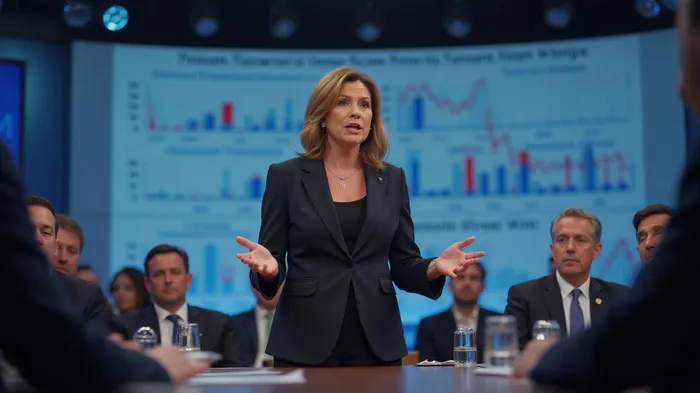
Lead: General Motors (GM) faced a pivotal week between April 25 and May 1, 2025, as CEO Mary Barra unveiled stark financial adjustments to counteract U.S. auto tariffs. The delayed earnings release, slashed profit guidance, and halted stock buybacks underscored the high-stakes balancing act between adapting to trade policies and maintaining investor confidence.
The Tariff Tsunami: GM’s New Reality
The Trump administration’s auto tariffs—imposed in early May 2025—struck GM as a financial double-edged sword. While partial tariff relief was announced on April 29, the company still faced a projected $4–5 billion cost burden, forcing Barra to slash 2025 profit guidance by nearly 30%.
- Revised EBIT Guidance: GM lowered its adjusted EBIT forecast to $10–12.5 billion from a prior $13.7–15.7 billion, marking the first quantification of tariffs’ impact on a major U.S. automaker.
- Buyback Pause: The halt on share repurchases—typically a confidence signal—sent a stark message: liquidity preservation is now critical.
Barra framed the tariffs as an opportunity to accelerate U.S. supply chain resilience: “30% of tariff costs can be offset by sourcing more parts domestically,” she stated on CNBC, citing a 27% rise in U.S.-made components since 2019.
Market Volatility and Operational Pressures
The delayed investor call and revised guidance triggered stock fluctuations, with GM shares hovering near breakeven for the week amid mixed signals:
- Q1 Earnings Beat: GM reported better-than-expected first-quarter results, masking deeper concerns. Revenue rose 7% year-over-year, but margins faced headwinds from tariffs and a $500 million recall expense for faulty SUV engines.
- Consumer Caution: Barra reiterated that vehicle prices would not rise immediately, despite tariff costs, citing weak demand amid recession fears.
Analysts highlighted the dual risks:
> “GM’s profit-sharing payments to UAW workers could drop sharply if earnings fall further,” warned Bloomberg Intelligence, noting the potential for labor tensions.
Barra’s Playbook: Mitigation and Dialogue
Barra’s strategy hinges on three pillars:
1. Supply Chain Overhaul: Leveraging existing U.S. plants (e.g., 11 assembly facilities) to boost domestic production, avoiding costly new factories.
2. Policy Engagement: Ongoing talks with the Trump administration to refine trade policies, with Barra emphasizing “strong dialogue” in her shareholder letter.
3. Cost Discipline: Free cash flow guidance was cut to $7.5–10 billion, reflecting a focus on trimming non-essential spending.
Yet risks linger:
- Tariff “Stacking”: Despite partial relief, layered levies on imported components persist, complicating cost forecasts.
- Demand Volatility: A March/April sales surge—driven by fear of future price hikes—may have pulled forward demand, leaving weaker quarters ahead.
Conclusion: Navigating the New Normal
Mary Barra’s leadership is now tested as never before. With tariffs reshaping GM’s financial landscape, investors must weigh near-term pain against long-term strategy. Key takeaways:
- Profit Margins Under Siege: The $5 billion tariff cost estimate and $500 million recall highlight a year of operational strain.
- Stock Buybacks on Hold: The pause signals caution but also a strategic reallocation of capital to U.S. manufacturing.
- Policy Dependency: GM’s fate increasingly hinges on trade negotiations, a reminder of the auto industry’s vulnerability to geopolitical shifts.
For investors, the path forward is clear: Focus on GM’s execution of U.S. supply chain initiatives and monitor tariff policy developments. While short-term volatility persists, Barra’s emphasis on domestic resilience and EV profitability offers a roadmap for recovery—if the trade winds align.
> “GM’s business is fundamentally strong,” Barra asserted in her shareholder letter—a claim now backed by data, not just hope.

Stay ahead of the market.
Get curated U.S. market news, insights and key dates delivered to your inbox.




Comments
No comments yet