
GM's Strategic Reentry into Autonomous Vehicles: A Second-Chance Tech Renaissance for Legacy Automakers?
 Aime Summary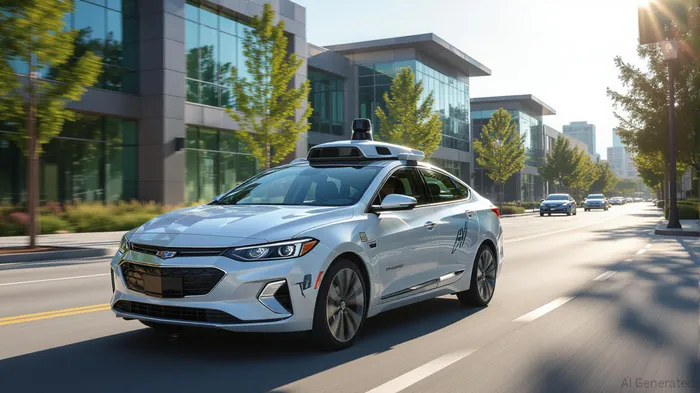
In 2025, General MotorsGM-- (GM) is making a bold move to reassert its position in the autonomous vehicle (AV) race, leveraging its recent divestiture of the Cruise robotaxi business to pivot toward personal AV development. This strategic shift, marked by the rehiring of former Cruise alumni and a partnership with NvidiaNVDA--, raises critical questions about the potential for a "second-chance tech renaissance" in legacy automotive firms. For investors, the stakes are high: GM's success could redefine the industry's trajectory, while failure might cement the dominance of agile newcomers like TeslaTSLA-- and Waymo.
The Strategic Pivot: From Robotaxis to Personal AVs
GM's decision to refocus on personal AVs—rather than commercial robotaxis—reflects a pragmatic recalibration. The Cruise division, once a $2 billion-a-year investment, faced insurmountable challenges: regulatory hurdles, public safety concerns (exemplified by a 2024 pedestrian injury incident), and the high costs of scaling a driverless fleet. By shuttering the robotaxi arm and redirecting resources, GMGM-- is now prioritizing Level 3 autonomy for consumer vehicles, a market segment with clearer near-term demand.
The rehiring of former Cruise engineers, led by Sterling Anderson (a Tesla Autopilot and Aurora veteran), underscores GM's commitment to leveraging its own technical talent. These engineers bring expertise in lidar integration, real-time data processing, and simulation modeling—skills critical for refining GM's Super Cruise system, which now covers 750,000 miles of North American roads. This move not only reactivates GM's innovation pipeline but also reduces reliance on external partnerships, a key advantage in a capital-intensive industry.
Technological Edge: Nvidia's Blackwell AI and Simulation-Driven Development
GM's partnership with Nvidia is a cornerstone of its strategy. The automaker is deploying Nvidia's Blackwell-powered AI platforms, capable of 1,000 trillion operations per second, to accelerate simulation-based development. By using Nvidia's Omniverse and CosmosATOM-- platforms, GM can test autonomous systems in virtual environments, drastically cutting the need for costly real-world trials. This approach aligns with industry trends: simulation-driven development is projected to reduce AV testing costs by up to 40% by 2030, according to McKinsey.
The financial implications are significant. GM's restructuring of Cruise has already yielded $1 billion in annual savings, which are being reinvested into high-impact projects. This capital efficiency is critical in an industry where AV development costs can exceed $10 billion per project. By pairing AI-driven simulation with strategic cost-cutting, GM is positioning itself to compete with startups like Aurora and Waymo, which rely on venture capital rather than legacy automaker balance sheets.
Competitive Landscape: Navigating Tesla's FSD Dominance and Waymo's Expansion
The AV market in 2025 is dominated by Tesla's Full Self-Driving (FSD) software, which has logged 500 million real-world miles and operates on 4 million vehicles. Tesla's data advantage—its FSD Beta adoption grew 400% in 2023—creates a formidable barrier to entry. However, GM's focus on Level 3 autonomy for personal vehicles offers a differentiator. Unlike Tesla's consumer-centric approach, GM is targeting a hybrid model: hands-free driving systems that still require a human in the vehicle, with a long-term goal of full autonomy. This phased strategy reduces regulatory risk while building consumer trust.
Waymo, another key player, is expanding its robotaxi fleet with Geely's ZeekrZK-- brand, but its focus on commercial services leaves a gap in the personal AV market. GM's pivot to consumer-oriented autonomy positions it to capture this niche, particularly as the U.S. Department of Transportation projects 70% of new vehicles to have Level 3+ autonomy by 2040.
Financial Viability and Investor Sentiment: A Calculated Bet
GM's financial restructuring has been pivotal. The $5 billion in 2024 special charges related to Cruise were offset by a projected $500 million cost reduction in 2025, signaling improved capital efficiency. CEO Mary Barra's emphasis on autonomy as a "key priority" during the Q2 2025 earnings call further underscores the company's commitment. However, investor sentiment toward legacy automakers remains cautious.
The broader market favors agile NEV startups, which have outperformed legacy automakers in stock performance. For example, Rivian's 2021 IPO raised $13.7 billion, while GM's EV and AV investments are still in the validation phase. Yet, GM's scale and brand strength offer unique advantages. Its Super Cruise system, now available on 20 models, provides a proven foundation for Level 3 autonomy. Additionally, the company's $10–11 billion 2025 capital expenditure plan—focused on battery manufacturing and EV infrastructure—demonstrates a balanced approach to innovation and profitability.
Risks and Opportunities: A Dual-Edged Sword
While GM's strategy is compelling, risks persist. Regulatory delays, particularly in the U.S., could slow deployment timelines. Competitors like Tesla and Waymo are also advancing rapidly: Tesla's FSD v12 update in 2025 introduced improved urban navigation, while Waymo's sixth-generation self-driving system is set to launch in 2026. Additionally, public skepticism about AV safety remains a hurdle, as evidenced by the 2024 pedestrian injury incident that led to Cruise's shutdown.
However, GM's reentry into AVs aligns with broader industry trends. The AV software market is projected to grow at a 36.2% CAGR through 2030, reaching $25 billion. By focusing on personal AVs—a segment with $1.2 trillion in potential market value by 2035—GM is targeting a high-growth area with immediate consumer demand.
Investment Implications: A Long-Term Play with Caution
For investors, GM's AV reentry represents a high-conviction, long-term opportunity. The company's strategic partnerships, cost discipline, and phased development approach mitigate some of the risks inherent in AV development. However, patience is required: GM's Super Cruise expansion and Level 3 autonomy goals are not expected to generate revenue until the late 2020s.
A key metric to monitor is GM's EBIT-adjusted performance, which is projected to reach $13.7–15.7 billion in 2025. If the company can maintain this trajectory while scaling its AV initiatives, it could close the valuation gap with Tesla and other NEV startups. Conversely, delays in regulatory approvals or technical setbacks could erode investor confidence.
Conclusion: A Renaissance Within Reach
GM's strategic reentry into AVs is a calculated bet on the future of mobility. By rehiring Cruise alumni, leveraging Nvidia's AI platforms, and pivoting to personal autonomy systems, the automaker is addressing both technological and financial challenges. While the road ahead is fraught with risks, the potential rewards are substantial. For investors willing to bet on a legacy automaker's ability to reinvent itself, GM's AV strategy offers a compelling case study in resilience and innovation.
In an industry where the only constant is change, GM's second-chance tech renaissance could redefine what it means to be a legacy automaker in the 21st century.
"""

Stay ahead of the market.
Get curated U.S. market news, insights and key dates delivered to your inbox.
AInvest
PRO
AInvest
PRO



Comments
No comments yet