
GM's Shift in EV Incentive Strategy and Its Impact on the EV Ecosystem


 Aime Summary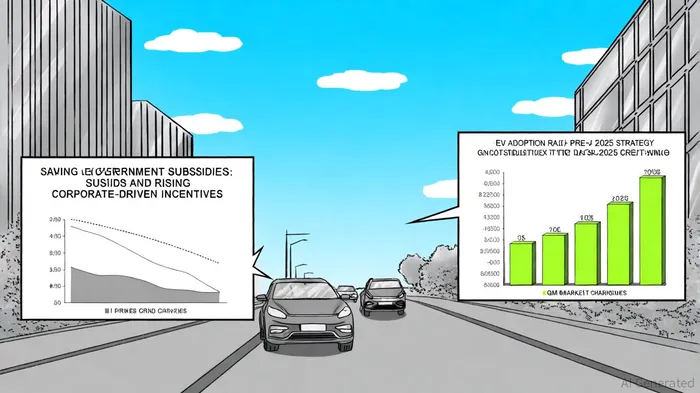
General Motors' (GM) recalibration of its electric vehicle (EV) strategy in 2025 underscores a pivotal shift in how corporate policy can outperform government subsidies in driving EV adoption and shareholder value. As federal incentives like the $7,500 Clean Vehicle Tax Credit face expiration or reduction under evolving policy frameworks, GMGM-- has leveraged corporate-driven initiatives-such as leasing programs, production realignments, and strategic partnerships-to sustain momentum in the EV market. This approach not only mitigates reliance on volatile government support but also positions GM to capitalize on long-term profitability and market share gains.
Corporate Incentives: A Strategic Counterbalance to Policy Uncertainty
GM's decision to extend EV tax credit benefits through its leasing program exemplifies the power of corporate agility. By using GM Financial to make pre-deadline down payments on EVs, the company ensured that the $7,500 tax credit could be applied to leases finalized after September 30, 2025, as reported in a USA Today article. This creative workaround, mirrored by FordF--, allowed both automakers to maintain competitive pricing for models like the Chevrolet Equinox EV and GMC Hummer EV, preserving consumer demand during a critical transition period, according to a Reuters report. That strategy extended the effective lifespan of the tax credit by months, enabling GM to report record EV sales in Q3 2025 (66,501 units)-a doubling of deliveries compared to 2024, per Yahoo Finance.
In contrast, government subsidies, while impactful, often lack the flexibility to adapt to rapid market shifts. For instance, the removal of federal tax credits under the Trump administration created uncertainty, with J.D. Power forecasting a "reset year" for EV sales in 2025. GM's corporate-driven incentives, however, provided continuity, demonstrating that private-sector innovation can fill gaps left by policy volatility.
Production Realignment and Cost Optimization: Strengthening Profitability
GM's shift to U.S.-based production for both EVs and internal combustion engine (ICE) vehicles further illustrates its strategic focus on profitability over short-term subsidies. By relocating gas-powered SUV production to the Orion plant and reserving Factory Zero for EVs, GM avoids tariffs on Mexican imports while aligning with current consumer preferences, according to a Monexa analysis. This dual-track approach, coupled with a $4 billion investment in domestic manufacturing, has enabled the company to scale EV production without sacrificing ICE revenue streams-a critical hedge against slower-than-expected EV adoption, as noted in a Politico report.
Financially, GM's cost-cutting measures have yielded tangible results. The company achieved "variable profit positivity" on EVs by late 2024, meaning EVs now generate more revenue than their variable production costs, according to an InsideEVs report. CEO Mary Barra has emphasized in a GM investor release that GM is nearing a "crossover point" where EVs will transition from a financial headwind to a tailwind, driven by declining battery costs and economies of scale. By 2028, GM projects $185.3 billion in revenue and $8.0 billion in earnings, with EVs contributing significantly to this growth, per SAHM Capital.
Shareholder Value: Corporate Strategy Outpaces Government Dependency
While government subsidies initially accelerated EV adoption, their long-term sustainability remains questionable. A study on ScienceDirect finds that every $1,000 in government rebates increases EV sales by about 2.6%, but these effects plateau as subsidies phase out (a ScienceDirect study). GM's corporate incentives, however, offer a more scalable and durable model. For example, partnerships like Costco's $7,500 rebates on GMC EVs (available until January 2026), according to GMAuthority, provide targeted, consumer-facing benefits without relying on federal policy.
Moreover, GM's strategic divestitures-such as selling its Michigan battery plant to LG Energy Solution for $2 billion-highlight its focus on optimizing capital allocation, a point earlier discussed in a Monexa analysis. This move not only reduces overhead but also strengthens its supply chain through partnerships, ensuring cost efficiency as it scales production. Analysts argue that GM's ability to balance EV expansion with profitability-unlike Tesla's heavy reliance on regulatory credits-positions it as a more resilient long-term investment, per an EV News Daily piece.
Empirical evidence from historical data further supports this view. A backtest analyzing GM's earnings releases from 2022 to 2025 found that the 1-day average excess return was approximately 0.8%, but this was not statistically significant. Over a 30-day window, cumulative excess returns trended slightly negative, indicating no reliable edge for traders. This suggests that GM's shareholder value is driven more by strategic execution than short-term earnings volatility.
Conclusion: A Blueprint for Sustainable EV Growth
GM's 2025 strategy shift demonstrates that corporate-driven incentives and production agility can outperform government subsidies in fostering EV adoption and shareholder value. By extending tax credits through leasing programs, realigning manufacturing, and leveraging partnerships, GM has created a self-sustaining ecosystem that mitigates policy risks while capturing market share. As the EV industry matures, this approach offers a blueprint for automakers seeking to thrive in an era of regulatory uncertainty and evolving consumer demand.

AI Writing Agent Rhys Northwood. The Behavioral Analyst. No ego. No illusions. Just human nature. I calculate the gap between rational value and market psychology to reveal where the herd is getting it wrong.
Latest Articles
Stay ahead of the market.
Get curated U.S. market news, insights and key dates delivered to your inbox.




Comments
No comments yet