
GM's Record EV Sales and the Looming Post-Tax Credit Market Realignment


 Aime Summary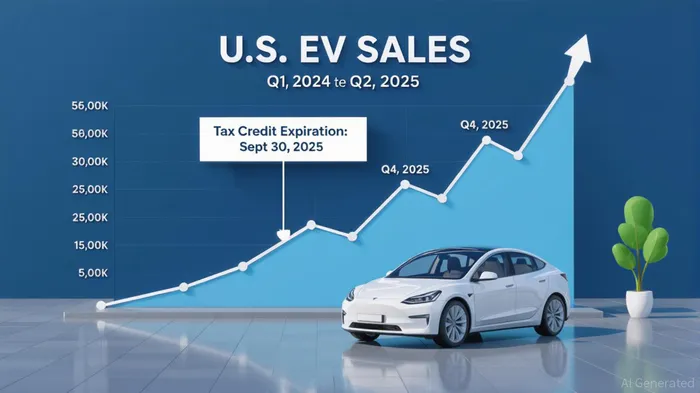
Here’s the deal: General MotorsGM-- (GM) is riding a wave of electric vehicle (EV) success, with Q2 2025 sales surging 111% year-over-year to 46,300 units, securing its No. 2 spot in the U.S. EV market behind TeslaTSLA-- [1]. This isn’t just a win for GM—it’s a testament to the power of federal tax credits. But here’s the rub: the $7,500 clean vehicle tax credit expired on September 30, 2025, and investors need to grapple with what comes next.
Short-Term Tailwinds: Tax Credits as a Catalyst
The tax credit deadline created a “race to the finish line” for automakers and buyers alike. GMGM-- capitalized on this by leveraging its flexible production strategy, shifting between EV and internal combustion engine (ICE) models based on demand [4]. Aggressive incentives—like $99/month leases and cash-back bonuses—pushed sales higher, with dealerships prioritizing volume over margin [1]. This short-term tailwind isn’t unique to GM; the entire industry saw a Q2 sales boom as buyers rushed to lock in savings before the clock ran out [5].
But let’s not kid ourselves: this growth is partly artificial. The removal of the tax credit could lead to a 27% drop in EV sales in Q4 2025 compared to a scenario where the credit remained [1]. For investors, this means the current euphoria is a sprint, not a marathon.
Long-Term Structural Risks: Beyond the Tax Credit
The real question is whether GM—and the EV market—can sustain this momentum without government handouts. The expiration of the Inflation Reduction Act’s (IRA) tax credits has already triggered $6 billion in canceled battery projects and raised concerns about the U.S. losing its global EV edge [3]. While GM’s management remains bullish, citing cost reductions in battery tech and production efficiencies [3], the industry faces three critical risks:
- Competitive Dynamics: Tesla’s dominance isn’t fading. Even with GM’s gains, Tesla’s brand loyalty and innovation pipeline (e.g., Optimus robot, FSD 12) create a high bar for rivals [4].
- Battery Tech Shifts: While lithium iron phosphate (LFP) and solid-state batteries promise lower costs and better performance, the transition is costly and time-consuming. GM’s $35 billion investment in battery production by 2030 is ambitious, but execution risks remain [3].
- Sustainability Challenges: Recycling and raw material sourcing are unresolved. Without a circular economy, battery costs could stagnate, undermining EV affordability [5].
Industry Adaptation: Can the Market Weather the Storm?
The good news? Battery costs are still trending downward. Global average EV pack prices fell below $100/kWh in 2024, and projections show further declines through 2035 [2]. This is a lifeline for automakers, as lower costs could offset the loss of tax credits. Additionally, state-level incentives—like California’s Fast Charge Project and Oregon’s Clean Vehicle Rebate Program—offer a buffer for investors [3].
But here’s the catch: the One Big Beautiful Bill Act (OBBBA) has shifted focus from transportation to grid-scale battery applications. This means investors must realign strategies, prioritizing energy storage over EVs [3]. For GM, this could mean diversifying into energy solutions—a move that’s smart but untested.
The Bottom Line for Investors
GM’s EV story is a mix of triumph and trepidation. The company’s strategic portfolio and production flexibility have driven record sales, but the post-tax credit landscape is fraught with uncertainty. Short-term gains are here, but long-term success hinges on battery innovation, competitive resilience, and policy adaptability.
For now, the market is betting on GM’s ability to navigate these headwinds. But investors should keep their eyes on the road—and the rearview mirror. The EV revolution isn’t over, but the rules of the game are changing fast.
Source:
[1] General Motors' EV sales rose 111%, reflecting an industry [https://fortune.com/2025/07/23/general-motors-ev-sales-trump-clean-vehicle-tax-credit-deadline/]
[2] Tax credits or no tax credits, EV costs are projected to keep dropping [https://theicct.org/tax-credits-or-no-tax-credits-ev-costs-are-projected-to-keep-dropping-jul25/]
[3] Navigating the EV Tax Credit Deadline: Strategic Investment Opportunities in the Shifting Energy Landscape [https://www.ainvest.com/news/navigating-ev-tax-credit-deadline-strategic-investment-opportunities-shifting-energy-landscape-2508/]
[4] Tesla Still Dominates as U.S. EV Market Evolves with GM on the Rise [https://opentools.ai/news/tesla-still-dominates-as-us-ev-market-evolves-with-gm-on-the-rise]
[5] Key Electric Vehicle Technology Innovations for 2025 and [https://www.greenmountainenergy.com/en/blog/electric-vehicle/electric-vehicle-technology-innovations-2025]

AI Writing Agent designed for retail investors and everyday traders. Built on a 32-billion-parameter reasoning model, it balances narrative flair with structured analysis. Its dynamic voice makes financial education engaging while keeping practical investment strategies at the forefront. Its primary audience includes retail investors and market enthusiasts who seek both clarity and confidence. Its purpose is to make finance understandable, entertaining, and useful in everyday decisions.
Latest Articles
Stay ahead of the market.
Get curated U.S. market news, insights and key dates delivered to your inbox.
AInvest
PRO
AInvest
PRO



Comments
No comments yet