
GM's Earnings Beat vs. Falling Stock: What's Driving the Disconnect?
 Aime Summary
In the world of cyclical stocks, the line between value and sentiment is often razor-thin. General MotorsGM-- (GM) has delivered a second-quarter earnings beat, with revenue exceeding Wall Street's $45.81 billion estimate and maintaining a 17.4% U.S. market share. Yet its stock price languishes near 12-month lows. This paradox—strong earnings coexisting with investor skepticism—demands closer scrutiny.
The disconnect begins with guidance. GM's full-year adjusted EBIT forecast, now $10–12.5 billion, reflects a 30% reduction from prior expectations. Tariffs, warranty costs, and EV inventory adjustments have eroded margins, particularly in North America, where EBIT-adjusted fell 45.5% to $2.4 billion. Investors, ever attuned to forward-looking signals, are not impressed by quarterly heroics when the long-term outlook is clouded.
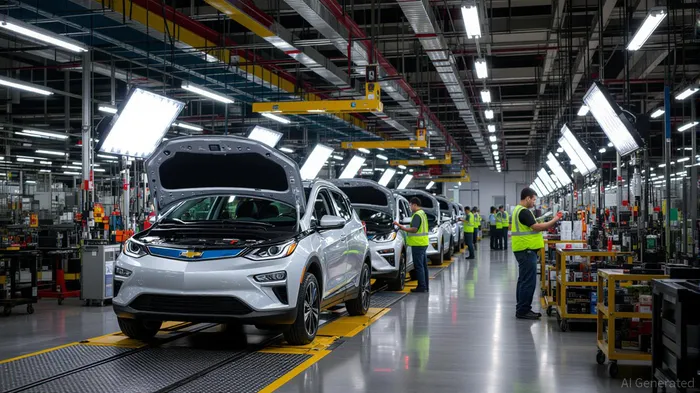
The broader auto sector's volatility compounds the issue. Cyclical industries like automotive are prone to sharp swings in sentiment, driven by macroeconomic forces. Elevated interest rates (7.6% for new auto loans) and the shadow of U.S. tariff policies have dampened consumer demand. GM's $4 billion investment to shift production from Mexico to the U.S. is a hedge against these risks, but it's also a drag on short-term profitability.
Investors are also parsing GM's EV strategy through a lens of caution. While Chevrolet ranks as the second-largest EV brand in the U.S. and Cadillac leads the luxury EV segment, the broader market for battery electric vehicles remains fragmented. GM's 12 new EV models by 2027 are ambitious, but sector-wide adoption is slower than anticipated. Competitors like TeslaTSLA-- and RivianRIVN-- are burning cash to scale, while traditional automakers like FordF-- and StellantisSTLA-- face similar margin pressures.
The psychology of cyclical stocks amplifies these dynamics. In a maturing economic expansion, investors often rotate out of industrials and into defensive sectors. GM's stock, with its exposure to tariffs and interest rates, is seen as a beta play—a proxy for broader economic risks. The Federal Reserve's expected rate cuts in late 2025 may eventually alleviate some pressure, but for now, the market is pricing in uncertainty.
Yet this skepticism may create an opportunity. GM's balance sheet remains robust, with $2.8 billion in adjusted automotive free cash flow for Q2 and a strong U.S. retail sales position. Its EV pipeline and digital innovations (e.g., Super Cruise-equipped vehicles) position it to capitalize on long-term trends. For value investors, the key question is whether the market is overcorrecting for near-term headwinds.
The answer lies in the interplay of guidance and execution. If GMGM-- can stabilize its North American margins, reduce tariff-related costs, and accelerate EV adoption without sacrificing profitability, the stock could rebound. But if the industry's structural challenges—high financing costs, fragmented EV demand, and geopolitical tariffs—persist, even strong earnings may not justify a re-rating.
For now, the market is betting on the latter. But history shows that cyclical stocks often outperform when volatility subsides. Investors with a 12–18 month horizon might consider GM a speculative buy, provided they can stomach near-term volatility. Those who prefer defensive plays or lack conviction in the auto sector's recovery should stick to the sidelines.
In the end, the GM story is a microcosm of a broader theme: in cyclical markets, sentiment often trumps fundamentals. But for those willing to look beyond the noise, the disconnect between earnings and stock price may yet offer a path to value.

Stay ahead of the market.
Get curated U.S. market news, insights and key dates delivered to your inbox.




Comments
No comments yet