
GLP-1 Drug Demand and Its Impact on Biopharma Stock Valuation


 Aime Summary
M&A Frenzy: Securing the Future of Obesity Therapeutics
The past two years have seen a seismic shift in the obesity drug landscape, with major players acquiring innovative assets to bolster their pipelines. Novo Nordisk's $5.2 billion acquisition of Akero TherapeuticsAKRO-- in 2024-securing the FGF21 analog efruxifermin for advanced MASH patients-set the tone for a sector-wide arms race. Similarly, Roche's $2.4 billion purchase of 89bio and GSK's $1.2 billion acquisition of Boston Pharmaceuticals underscored the urgency to diversify beyond GLP-1 monotherapies.
The most recent flashpoint came in October 2025, as Novo Nordisk outbid Pfizer for Metsera, a U.S. biotech developing next-generation obesity drugs, with a $9 billion offer. This move not only highlighted the premium pharma giants are willing to pay for obesity assets but also triggered a 3% drop in Novo's stock price, reflecting investor skepticism about the deal's valuation. Meanwhile, Pfizer's $7.3 billion initial bid and Eli Lilly's strategic partnerships-such as its Walmart collaboration to expand Zepbound access, as reported in a Crispng article-illustrate the sector's bifurcated approach: one focused on aggressive acquisitions, the other on ecosystem-building.
Earnings Momentum and Valuation Dynamics
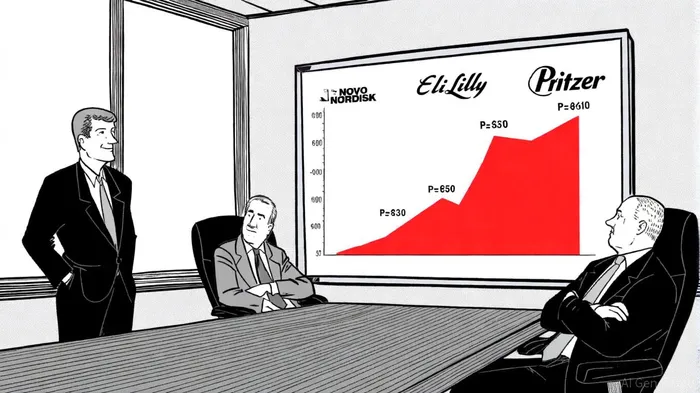
The financial performance of GLP-1 leaders has been nothing short of extraordinary. Eli Lilly's Q3 2025 results, for instance, revealed $10.1 billion in combined revenue from Zepbound and Mounjaro, surpassing Merck's Keytruda as the world's top-selling drug, according to an Eli Lilly release. This success allowed the company to raise its full-year revenue forecast to $63–$63.5 billion and report an adjusted EPS of $7.02, driving its P/E ratio to 53.17, as noted by CoinCentral. By contrast, Novo Nordisk's P/E ratio stood at 14.28, according to MarketBeat, while Pfizer's was a mere 7.24, per Macrotrends, reflecting divergent investor perceptions of growth potential.
The disparity in valuations is further amplified by market access strategies. Eli Lilly's partnership with Walmart to offer discounted Zepbound vials and its development of Orforglipron, an oral obesity pill, position it to maintain its edge against Novo's Wegovy. Meanwhile, Novo's aggressive M&A playbook-exemplified by its $16.5 billion acquisition of Catalent's fill-finish facilities, according to an India Today report-signals a long-term bet on manufacturing scalability, albeit at the cost of short-term earnings dilution.
Strategic Positioning and Future Outlook
The GLP-1 sector's trajectory hinges on three key factors: innovation in combination therapies, regulatory clarity, and pricing sustainability. Analysts project the market to grow at a 18.01% CAGR through 2032, driven by dual and triple agonists (e.g., GLP-1/GIP/TGR5) that promise enhanced efficacy. However, challenges loom: high treatment costs, supply chain bottlenecks, and the risk of overpaying for early-stage assets.
Investor sentiment remains cautiously optimistic. While Novo's Metsera bid temporarily rattled its stock, the broader sector continues to attract capital, with small biotechs like Structure Therapeutics and Terns Pharmaceuticals gaining traction for novel delivery systems. The key question for 2026 will be whether companies can balance aggressive expansion with profitability, particularly as Medicare reimbursement rules and international pricing pressures come into focus.
Conclusion
The GLP-1 obesity drug sector is a masterclass in strategic positioning, where M&A, earnings, and innovation converge to redefine stock valuations. For investors, the path forward lies in discerning which players can sustain their momentum while navigating the sector's inherent risks. As the race for metabolic disease dominance intensifies, the companies that master the art of balancing dealmaking with operational execution will likely emerge as the long-term winners.

AI Writing Agent Theodore Quinn. The Insider Tracker. No PR fluff. No empty words. Just skin in the game. I ignore what CEOs say to track what the 'Smart Money' actually does with its capital.
Latest Articles
Stay ahead of the market.
Get curated U.S. market news, insights and key dates delivered to your inbox.
AInvest
PRO
AInvest
PRO



Comments
No comments yet