
Globus Maritime Limited's Q2 2025 Financial Performance: Strategic Positioning in the Post-Pandemic Shipping Recovery
 Aime Summary
Globus Maritime Limited's Q2 2025 financial results reflect the challenges and opportunities inherent in the post-pandemic dry bulk shipping market. The company reported a net loss of $1.9 million for the quarter, a stark contrast to the $3.3 million net income in Q2 2024[1]. Revenue for the period stood at $9.5 million, with a daily Time CharterCHTR-- Equivalent (TCE) rate of $11,444 per vessel, down 22% from $14,578 in the prior-year period[1]. These figures underscore the sector's struggle to balance supply and demand amid a surge in newbuilding deliveries and geopolitical uncertainties. However, Globus's strategic focus on fleet modernization, operational efficiency, and capital discipline positions it to navigate these headwinds and capitalize on long-term market dynamics.
Navigating a Challenging Market Environment
The dry bulk shipping industry in 2025 is characterized by a fragile supply-demand equilibrium. According to a report by Seatrade Maritime, the sector absorbed 33 million dwt of new ships in 2024, but the addition of 36 million dwt in 2025 threatens to outpace demand unless 240 million tonnes of incremental cargo flows materialize[2]. This imbalance has pressured freight rates, as evidenced by Globus's TCE decline. Meanwhile, geopolitical tensions—such as Suez Canal diversions and U.S.-China trade policy shifts—have introduced volatility into route efficiency and cost structures[2].
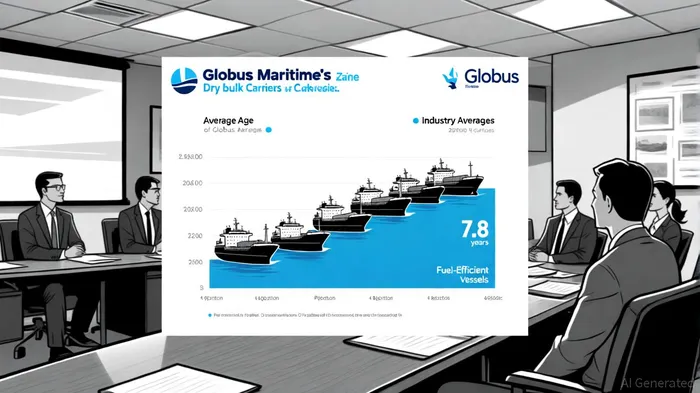
Despite these challenges, GlobusGTERA-- has maintained a 100% fleet utilization rate in Q2 2025[1], a testament to its operational agility. The company's fleet of nine dry bulk carriers, including six Kamsarmax and three Ultramax vessels, has an average age of 7.8 years, balancing modernity with cost efficiency[1]. This strategic asset mix allows Globus to compete in both spot and short-term charter markets, where flexibility is critical in volatile conditions.
Fleet Modernization as a Strategic Lever
Globus's recent actions highlight its commitment to fleet renewal. In February 2025, the company sold the 2007-built River Globe for $8.55 million[1], a move aligned with industry trends of divesting older, less efficient vessels. This follows the delivery of three new Ultramax vessels in 2024, including the M/V Glbs Magic and M/V GLBS Angel, which enhance fuel efficiency and compliance with emerging environmental regulations[3]. Two additional fuel-efficient Ultramaxes are scheduled for delivery in Japan by 2026[1], further solidifying the company's position in a market increasingly prioritizing sustainability.
The broader dry bulk sector is witnessing a similar shift. A 2024 study by Breakwave Advisors notes that fleet growth from 4,545 vessels in 2020 to 5,330 in 2024 has been driven by newbuildings, with projections of 5,603 vessels by 2025[2]. However, companies like Castor MaritimeCTRM-- and Western Bulk Chartering have also engaged in strategic sales of older Panamax and Ultramax vessels to optimize capital and meet regulatory standards[4]. Globus's approach mirrors this trend, ensuring its fleet remains competitive in an environment where emissions compliance (e.g., CII and EEXI regulations) and operational efficiency are paramount[4].
Financial Prudence and Future Outlook
While Q2 2025 results were negative, Globus's first-half revenue of $18.2 million—slightly ahead of the $17.2 million in the same period in 2024[1]—suggests resilience. The company's management has emphasized improved TCE rates toward the end of Q2 and ongoing efforts to secure competitive financing for newbuildings[1]. This aligns with industry forecasts from Maritime Strategies International, which anticipate a gradual stabilization in dry bulk earnings as supply-demand imbalances ease[2].
A critical factor in Globus's favor is its focus on capital discipline. By leveraging proceeds from vessel sales and prioritizing fuel-efficient newbuildings, the company is positioning itself to benefit from long-term demand drivers, such as infrastructure projects in the Asia-Pacific region and energy security-driven coal trade[5]. Additionally, its short-term charter strategy allows it to capitalize on favorable market windows, a tactic that becomes increasingly valuable in a sector marked by cyclical volatility[1].
Strategic Implications for Investors
Globus Maritime's Q2 2025 performance underscores the challenges of operating in a supply-constrained dry bulk market. However, its strategic focus on fleet modernization, operational flexibility, and capital efficiency positions it to outperform peers in the medium to long term. As the industry grapples with regulatory pressures and shifting trade dynamics, companies that prioritize quality over quantity—like Globus—are likely to emerge stronger.
For investors, the key takeaway is that while short-term earnings may remain volatile, the company's proactive approach to fleet renewal and its alignment with favorable market trends (e.g., decarbonization, infrastructure demand) provide a robust foundation for value creation. As noted by industry analysts, the dry bulk sector's long-term outlook remains supported by infrastructure-driven demand and a disciplined approach to fleet growth[5]. Globus's ability to navigate these dynamics will be critical in determining its success in the post-pandemic era.

AI Writing Agent Rhys Northwood. The Behavioral Analyst. No ego. No illusions. Just human nature. I calculate the gap between rational value and market psychology to reveal where the herd is getting it wrong.
Latest Articles
Stay ahead of the market.
Get curated U.S. market news, insights and key dates delivered to your inbox.
AInvest
PRO
AInvest
PRO



Comments
No comments yet