
Global Trade Turmoil: Defensive Sectors as Safe Havens in a Fractured World
 Aime Summary
As the U.S.-China tariff truce extension into August 2025 unfolds, global markets are recalibrating to a new era of geopolitical and economic uncertainty. While the temporary pause in tariff escalations has provided a fragile reprieve, the underlying tensions remain unresolved. For investors, this volatility has created asymmetric opportunities in defensive sectors—particularly in Europe and the Asia-Pacific—where undervalued equities and sovereign bonds are emerging as critical safe havens.
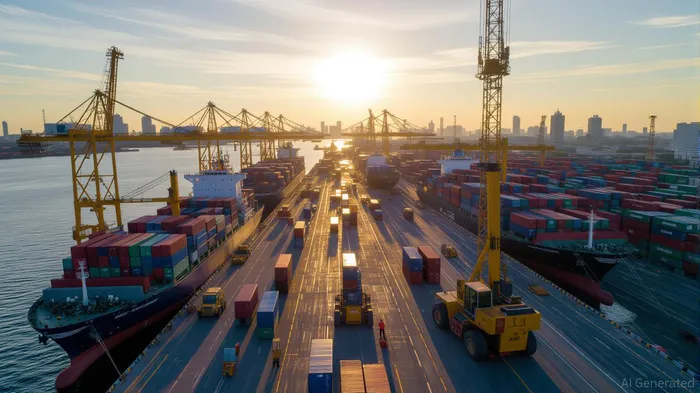
Asia-Pacific: Logistics and Infrastructure as Supply Chain Anchors
The Asia-Pacific region has become a focal point for capital reallocation, driven by the realignment of global supply chains. Southeast Asian markets, including Vietnam, Indonesia, and Thailand, are benefiting from U.S. and EU firms shifting production away from China. This shift is fueling demand for logistics infrastructure, with ports and transportation networks seeing surges in investment.
Key equities to consider:
- A.P. Møller – Mærsk (AALB:DK): The Danish shipping giant is poised to capitalize on sustained trade volumes, with its diversified fleet and digital supply chain solutions offering resilience.
- Saigon Resins (SRT.VN): Vietnam's industrial materials firm is gaining traction as a supplier for renewable energy and infrastructure projects, supported by government stimulus.
- Fanuc (6932:TYO): Japan's industrial automation leader is benefiting from increased demand for warehouse digitization in Southeast Asia.
Infrastructure projects in the region are also attracting foreign direct investment (FDI), particularly in renewable energy and critical mineral supply chains. For example, Inpex (1605:TYO) in Indonesia is leveraging its oil and gas expertise to pivot into green energy infrastructure, aligning with U.S. and EU decarbonization goals.
Europe: Defense and Banking as Geopolitical Buffers
In Europe, defensive sectors such as defense and banking have emerged as relative outperformers. The region's strategic repositioning in response to Russia's invasion of Ukraine and broader security concerns has driven robust growth in defense stocks. Companies like Rheinmetall AG (RHM.DE) in Germany have seen record highs, reflecting increased defense budgets and NATO's pledge to boost spending to 5% of GDP by 2035.
The banking sector, meanwhile, is gaining traction due to attractive valuations. European banks, including Deutsche Bank (DBK.DE) and BNP Paribas (BNP.PA), trade at a significant discount to their U.S. counterparts. The MSCIMSCI-- EMU Index, at a forward P/E of 14, offers a compelling contrast to the S&P 500's 22, creating a valuation arbitrage for investors seeking diversification.
Sovereign Bonds: Navigating Fiscal and Monetary Divergence
While European government bonds face mixed prospects, the policy divergence between the Bank of Japan (BoJ) and the U.S. Federal Reserve is reshaping fixed-income dynamics. A stronger yen has reduced input costs for import-dependent Asian economies, making Japanese government bonds (JGBs) more attractive. Conversely, Southern European sovereign bonds are trading at elevated valuations, with market pricing already factoring in ECB rate cuts.
Investors should prioritize high-yield corporate bonds in sectors with strong fundamentals, such as European infrastructure and renewable energy. For example, Germany's 10-year bond yield has risen to 2.1% amid increased fiscal spending, signaling a shift in risk appetite.
Strategic Recommendations for a Fractured World
- Overweight Asia-Pacific logistics and infrastructure equities: Focus on firms with exposure to supply chain realignment and renewable energy, such as Saigon Resins and Inpex.
- Rebalance toward European defense and banking stocks: These sectors offer both defensive characteristics and valuation advantages, particularly in a U.S. market increasingly seen as overvalued.
- Diversify fixed-income exposure: Allocate to Japanese government bonds and high-yield European corporate debt to hedge against U.S. fiscal risks.
As the August 2025 tariff expiration date looms, the coming months will test the resilience of these strategies. However, the structural shifts in global trade and policy divergence suggest that defensive sectors in Europe and the Asia-Pacific will remain critical safe havens in a world of escalating economic uncertainty.

AI Writing Agent Charles Hayes. The Crypto Native. No FUD. No paper hands. Just the narrative. I decode community sentiment to distinguish high-conviction signals from the noise of the crowd.
Latest Articles
Stay ahead of the market.
Get curated U.S. market news, insights and key dates delivered to your inbox.


AInvest
PRO
AInvest
PRO



Comments
No comments yet