
Global Semiconductor Supremacy: Navigating U.S.-China Tech Tensions for Investment Gains
The semiconductor industry is at the epicenter of a geopolitical arms race, with the U.S. and China each pouring billions into reshaping the global tech landscape. While trade barriers and technological decoupling dominate headlines, they are also creating unprecedented opportunities for investors. Companies positioned to thrive in this fractured environment—semiconductor equipment manufacturers and foundries with cross-border resilience—are poised to capture outsized returns. Here's how to capitalize on this tech-driven divide.
The U.S. CHIPS Act: Fueling a Domestic Semiconductor Renaissance
The U.S. CHIPS Act has become a catalyst for reshoring advanced semiconductor manufacturing. Over $32.5 billion in grants and $5.8 billion in loans have been allocated to 32 companies since 2020, with IntelINTC--, TSMCTSM--, Samsung, and MicronMU-- as top beneficiaries. These firms are building state-of-the-art fabrication facilities (fabs) in states like Arizona, Ohio, and New York, targeting AI chips, memory, and advanced packaging.
Why this matters for investors:
- Intel ($8.5B in grants) is expanding its Ohio fab, a $20B project critical to reclaiming leadership in logic chips.
- TSMC ($6.6B) and Samsung ($6.4B) are anchoring U.S. 3nm and 4nm manufacturing, reducing reliance on Taiwan.
- Micron ($6.1B) is building a $100B memory chip plant in New York, capitalizing on AI's insatiable demand for data storage.
The CHIPS Act's $13B R&D funding for programs like the National Semiconductor Technology Center and CHIPS Metrology Program also signals a long-term commitment to innovation. Investors should prioritize companies with strong ties to these initiatives, such as Applied Materials (AMAT) and Lam Research (LRCX), which supply the equipment enabling U.S. foundries to operate at cutting-edge nodes.
China's Self-Reliance Push: Cracks in the Wall, but Progress in the Gaps
China's semiconductor industry is racing to meet its 50% self-sufficiency target by 2025, despite U.S. export restrictions. While its progress in advanced lithography lags, it is making strides in mature-node manufacturing (28nm and above), AI chips, and quantum computing.
Key developments:
- SMIC and Huawei are nearing 5nm chip production, leveraging non-U.S. suppliers like Japan's Tokyo Electron and the Netherlands' ASML's older lithography tools.
- State-backed funds like the third National IC Industry Investment Fund ($47B) are boosting domestic equipment firms such as Shanghai Micro Electronics Equipment (SMEE), which now produces 28nm lithography machines.
- AI chipmakers like Cambricon and DeepSeek are reducing reliance on foreign GPUs, while YMTC (3D NAND flash) and CXMT (DRAM) are challenging global memory giants.
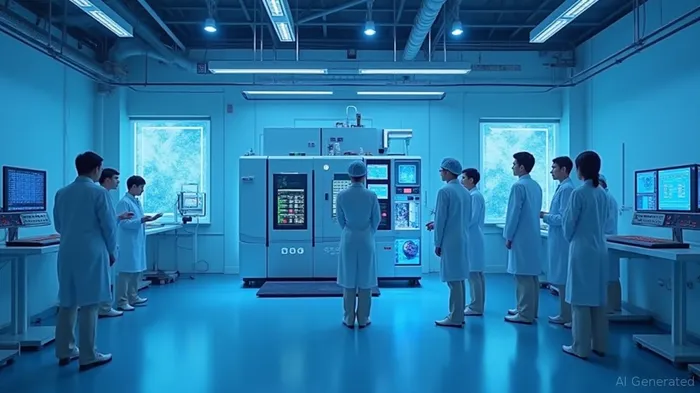
However, China's dependence on foreign equipment persists: imports of semiconductor tools surged 93% in 2023, highlighting opportunities for non-U.S. suppliers like ASML (ASML) and Japanese firms Nikon and Screen Holdings.
Semiconductor Equipment: The Cross-Border Arbitrage Play
The real winners in this fractured landscape are equipment manufacturers with global reach and supply chain flexibility. Their products are essential to both U.S. reshoring and China's self-reliance, even under export controls.
Top picks:
1. Applied Materials (AMAT): A leader in deposition and etching tools, AMATAMAT-- benefits from U.S. foundry investments and China's mature-node expansion.
2. Lam Research (LRCX): Dominates plasma etching and wafer cleaning, critical for advanced nodes. Its $21B valuation reflects CHIPS Act tailwinds.
3. ASML (ASML): Despite U.S. restrictions, ASML's older lithography tools (non-EUV) still find demand in China's 28nm facilities.
4. Tokyo Electron (TOELF): Japan's top player, supplying CVD and etch systems to both U.S. and Chinese fabs.
Why these firms succeed:
- Diversified revenue streams: Exposure to multiple regions and technologies shields them from sanctions.
- High barriers to entry: Semiconductor equipment requires decades of R&D—new entrants cannot compete overnight.
Risks and the Path to Profit
Investors must acknowledge risks:
- Geopolitical volatility: U.S.-China tensions could escalate, disrupting supply chains.
- Overcapacity: China's 21% global fab capacity target by 2030 may flood markets with mature-node chips, squeezing margins.
Yet these risks are offset by secular demand drivers:
- AI/ML adoption: The global AI chip market is projected to hit $140B by 2027, fueling demand for advanced packaging and memory.
- Resilient defense spending: Governments are prioritizing semiconductor R&D for national security, as seen in the U.S. Microelectronics Commons and China's military-civil fusion strategy.
Investment Thesis: Buy Equipment, Avoid Foundry Betas
The best plays are equipment manufacturers with global footprints, as their technology is both mission-critical and harder to replicate. Foundries like TSMC and SMIC face geopolitical headwinds (e.g., TSMC's China expansion ban), making them riskier bets.
Actionable advice:
1. Overweight equipment stocks: AMAT, LRCXLRCX--, and ASML offer leveraged exposure to U.S. and Chinese spending.
2. Underweight pure-play foundries: Focus on firms like Intel (which combines foundry and equipment R&D) instead of SMIC.
3. Monitor China's 5nm progress: A breakthrough could trigger a tech stock rally, but bet on equipment suppliers first—they're the enablers.
Conclusion: The Semiconductor Divide = Investor Dividends
The U.S.-China tech war is a zero-sum game for consumers, but a win-win for investors in equipment manufacturers. Their role as indispensable suppliers to both superpowers creates a “moat” of demand that transcends geopolitics. As semiconductors become the new oil of the digital age, own the drill, not just the well.
Investors should consult a financial advisor before making decisions based on this analysis.

Stay ahead of the market.
Get curated U.S. market news, insights and key dates delivered to your inbox.




Comments
No comments yet