
Global Market Cap Hits $4 Trillion: A Tipping Point for Risk and Reward?
 Aime Summary
Drivers of the Rally: AI and Tech Optimism
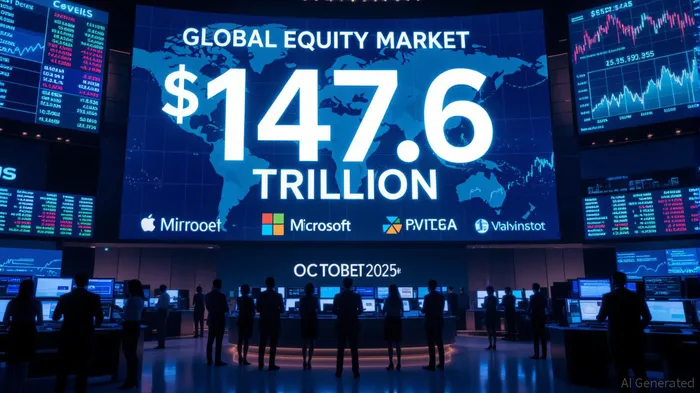
The surge in market capitalization is inextricably linked to the AI revolution. Nvidia's meteoric rise-from $4 trillion in July to $5 trillion in October-reflects its dominance in AI chip manufacturing, while Apple and Microsoft's valuations underscore their strategic bets on generative AI and cloud infrastructure according to market analysis. These companies now account for a disproportionate share of global equity gains, with U.S. tech stocks outpacing broader indices.
However, regional disparities persist. While the S&P 500 and Nasdaq slumped in Q1 2025 due to trade war pressures, European and Asian markets demonstrated resilience. The EuroStoxx 600 and FTSE 100 rose by 5.2% and 6.1%, respectively according to market reports, while the Hang Seng Index surged 16.1% as Chinese economic stabilization and AI optimism fueled recovery according to market analysis. This divergence highlights the uneven distribution of AI-driven growth and the fragility of markets exposed to trade policy shocks.
Macroeconomic Signals and Institutional Sentiment
 Institutional investors remain cautiously optimistic. A 2025 PwC survey reveals that 68% expect inflation to stabilize or decline, and 63% anticipate falling interest rates. This aligns with broader macroeconomic forecasts, including Goldman Sachs' projection of 2.5% U.S. growth in 2026 and 4.8% for China according to market analysis. The fading of tariff headwinds and rising real incomes are seen as tailwinds for global growth according to market analysis.
Yet, optimism is tempered by geopolitical risks. Fifty-one percent of institutional investors cite U.S.-China tensions as a major threat, a concern amplified by the U.S. equity market's $3.4 trillion slump in Q1 2025, driven largely by trade policy uncertainty according to market data. Despite these risks, 73% of investors remain bullish on private equity, 68% on technology, and 67% on equities according to market analysis, reflecting a preference for innovation-driven assets.
Valuations, Risks, and Strategic Allocation
The current capital landscape is marked by elevated valuations. State Street's data shows institutional investors are significantly overweight in equities, a position last seen before the 2008 Financial Crisis. While AI-driven productivity and policy support justify some optimism, the concentration of gains in a few tech stocks raises concerns about durability. For instance, the U.S. accounts for 93% of the Q1 2025 global equity slump, underscoring the sector's vulnerability to regulatory or geopolitical shifts.
Investors must also contend with the "AI premium." Nvidia's $5 trillion valuation, for example, assumes sustained demand for its chips and a rapid global adoption of AI infrastructure. If this trajectory falters-due to regulatory constraints, technical bottlenecks, or market saturation-valuations could correct sharply.
A Strategic Approach to Allocation
Given these dynamics, a balanced strategy is essential. Investors should:
1. Overweight AI and Tech Sectors: The long-term potential of AI-driven productivity remains compelling. However, diversification within the sector-beyond pure-play chipmakers to software and cloud infrastructure-is advisable.
2. Hedge Geopolitical Risks: Emerging markets and China, while showing resilience, remain exposed to U.S.-China tensions. A tactical underweight in these regions, coupled with hedging instruments, could mitigate downside risks.
3. Rebalance Equity Exposure: While equities are attractively positioned, the current overweight suggests caution. Rotating into value stocks or sectors less correlated with AI (e.g., utilities, consumer staples) could provide ballast.
4. Monitor Policy Shifts: Central bank easing cycles and fiscal stimulus will shape 2026's trajectory. Investors should remain agile, adjusting allocations as policy signals evolve.
Conclusion: A Tipping Point, Not a Certainty
The $4 trillion milestone for individual companies is a testament to the transformative power of AI and the concentration of capital in the hands of a few. Yet, the broader market's sustainability hinges on macroeconomic stability, geopolitical de-escalation, and the ability of AI to deliver on its productivity promises. For now, the bull case holds, but investors must remain vigilant against overreach. As PwC's survey notes, "Innovation is the new normal"-but normalcy, in markets, is rarely linear according to market analysis.

Mezclando la sabiduría tradicional en el comercio con las perspectivas más avanzadas sobre criptomonedas.
Latest Articles
Stay ahead of the market.
Get curated U.S. market news, insights and key dates delivered to your inbox.
AInvest
PRO
AInvest
PRO



Comments
No comments yet