
Global Market Cap Drops Below $4T as Bitcoin and Ethereum Prices Fall
 Aime Summary
The global crypto market cap has fallen to $2.35 trillion, driven by regulatory uncertainty and profit-taking. EthereumETH-- remains the backbone of decentralized finance and stablecoin industries, with over 50% of stablecoins issued on its network. Institutional adoption of cryptocurrencies is growing, with major banks like Fidelity and Goldman SachsGS-- incorporating crypto into their offerings.
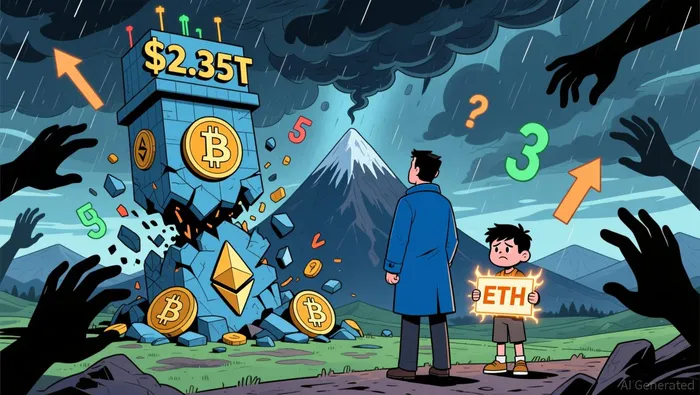
The global crypto market has faced a decline in value, with the market cap dropping to $2.35 trillion as BitcoinBTC-- and Ethereum prices fell. This selloff has been attributed to regulatory uncertainty and a broader profit-taking sentiment among investors. Bitcoin has fallen below $69,200, triggering a broader selloff in altcoins.
Ethereum's role in decentralized finance, stablecoin, and tokenization has remained central despite a recent 40% price decline over the last three months. The U.S. government has passed stablecoin legislation, legitimizing tokenized versions of traditional currencies and paving the way for existing financial institutions to explore stablecoins and blockchain solutions. Citigroup analysts predict the stablecoin market could reach between $1.9 trillion and $4 trillion by 2030, with over 50% of stablecoins currently issued on Ethereum.
Bitcoin's long-term potential remains strong, with Eric Trump expressing confidence in its ability to reach $1 million in the future. Over the past decade, Bitcoin has outperformed other asset classes with an average annual return of 70%. While Bitcoin has dropped significantly from its peak of $126,198 to around $70,000, Trump highlighted its volatility as part of its appeal and vitality. Major financial institutions are increasingly adopting crypto, with allocations climbing from 0% to 5-6% in some cases.
What Drives Ethereum's Future Growth Potential?
Ethereum's growth is closely tied to the tokenization of assets and the expansion of decentralized finance. Tokenization of assets like Treasuries and equities, as explored by Nasdaq and the New York Stock Exchange, could further boost Ethereum's utility and value. Additionally, the U.S. government's passage of stablecoin legislation has legitimizing tokenized versions of traditional currencies.
While new entrants may develop private blockchains, Ethereum's dominance in the current landscape positions it well for potential growth. The integration of tokenized assets and the expansion of blockchain solutions are expected to drive Ethereum's transaction volume and increase its price historically.
What Are the Key Risk Factors in the Current Market?
The crypto market faces several key risk factors that contribute to the current downturn. These include weaker investor confidence, liquidations, a stronger U.S. dollar, and geopolitical tensions. The situation highlights macroeconomic and geopolitical risks as critical factors influencing crypto price movements.
ETF outflows have also contributed to the selloff, with Bitcoin ETFs losing $7.9 billion and EtherETH-- ETFs losing $3.2 billion since October. Delays in the CLARITY Act and increased stablecoin adoption indicate ongoing market uncertainty. Institutional outflows and reduced leverage have exacerbated the selloff, with Bitcoin's ability to hold above $68,670 seen as key to market stability.
How Do Recent Regulatory Developments Impact the Market?
Regulatory clarity and the passage of the CLARITY Act could provide a catalyst for market recovery. The U.S. government's passage of stablecoin legislation has already paved the way for existing financial institutions to explore stablecoins and blockchain solutions.
Dubai's structured approach to digital assets is enhancing investor confidence and credibility. Some tokens, such as LEO, have defied the trend, indicating potential for longer bear phases. Institutional adoption remains a key factor for capturing large-scale liquidity on the XRPXRP-- Ledger.
Robinhood's confirmation that RippleRLUSD-- tokenized $1.8 billion in real-world assets on the XRP Ledger has boosted XRP's 9% weekly gain. The XRP Ledger now hosts $1.8 billion in tokenized real-world assets, excluding stablecoins. Robinhood's infrastructure build-out, including its public testnet for RobinhoodHOOD-- Chain, could eventually drive significant on-chain volume by moving its user base into tokenized asset markets.
The market remains in a state of uncertainty, with regulatory clarity and institutional adoption seen as key drivers for future growth. The broader market is watching for any signs of stabilization and potential recovery as the CLARITY Act progresses and more institutions enter the crypto space.

Blending traditional trading wisdom with cutting-edge cryptocurrency insights.
Latest Articles
Stay ahead of the market.
Get curated U.S. market news, insights and key dates delivered to your inbox.


AInvest
PRO
AInvest
PRO



Comments
No comments yet