
Global Income Investing: Evaluating Cambria Foreign Shareholder Yield ETF's Recent Distribution as a Compelling Opportunity
 Aime Summary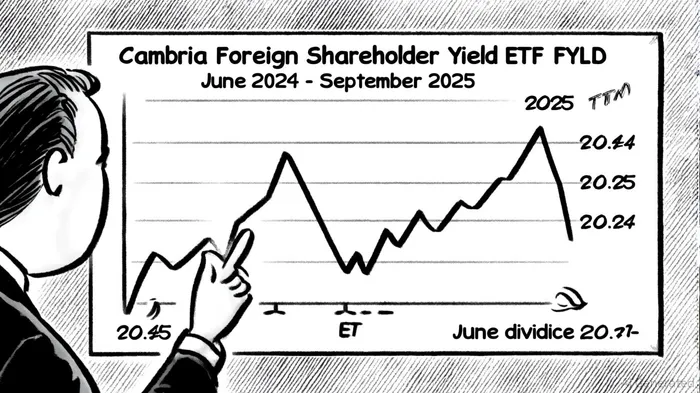
For income-focused investors navigating global markets, the Cambria Foreign Shareholder Yield ETF (FYLD) has emerged as a nuanced player. On September 18, 2025, FYLD distributed $0.403 per share, translating to a 1.29% yield on the ex-dividend date[2]. While this figure trails its June 2024 peak of 2.80%, the fund's trailing twelve-month (TTM) yield remains at 2.79%, underscoring its role as a mid-tier income generator in a competitive landscape[2]. This analysis evaluates FYLD's recent distribution through the lens of its strategy, performance, and positioning against peers, offering insights into its viability for global income portfolios.
FYLD's Strategy: Active Management and Shareholder Yield Focus
FYLD distinguishes itself by targeting international companies with high shareholder yield—a metric encompassing dividends, buybacks, and debt paydown[1]. With a 0.59% expense ratio, it operates below the MorningstarMORN-- Foreign Small/Mid Value category average, appealing to cost-conscious investors[1]. The fund's active management approach seeks to identify firms efficiently returning capital to shareholders, often favoring undervalued markets. Historically, FYLD has traded at a valuation discount relative to the MSCIMSCI-- EAFE Index, though its performance has shown volatility, including declines in recent quarters[1].
The September 2025 distribution of $0.403 reflects a modest 0.234% growth rate over the past year[2], a stark contrast to the 0.234% TTM growth rate. While this suggests a lack of aggressive dividend expansion, FYLD's three-year growth rate is negative at -7.93%[2], raising questions about the sustainability of its yield. However, its focus on shareholder yield—beyond just dividends—may offer a buffer, as buybacks and debt reduction can bolster returns even amid flat dividend growth.
Peer Comparison: Yield, Costs, and Risk Profiles
FYLD's appeal must be weighed against alternatives. The FlexShares International Quality Dividend Index Fund (IQDF), for instance, offers a higher yield of 6.01% but charges a lower 0.47% expense ratio[2]. Similarly, the iShares International Select Dividend ETF (IDV) and SPDR S&P International Dividend ETF (DWX) provide yields of 3.56% and 2.74%, respectively, with expense ratios of 0.49% and 0.45%[1][2]. These figures highlight FYLD's trade-off between active management and cost efficiency.
Performance data adds nuance. FYLD's 25.75% year-to-date total return outperformed IQDF's 25.12%[2], suggesting its active strategy may deliver competitive growth. However, its yield lags behind IQDF's, making it less attractive for investors prioritizing immediate income. For context, the Global X US Preferred ETF offers a 6.4% yield[2], though its U.S.-centric focus and exposure to preferred stock introduce different risk dynamics.
Risks and Considerations
Investors must also account for FYLD's exposure to currency fluctuations and geopolitical risks, inherent in its international focus[2]. The fund's declining dividend growth rate and mixed performance in recent periods further underscore the need for caution. While FYLD's active management aims to mitigate these risks through stock selection, its negative three-year growth rate raises concerns about long-term resilience[2].
Conclusion: A Balanced Approach to Global Income
FYLD's recent $0.403 distribution, while below its historical peaks, aligns with its broader strategy of targeting shareholder yield through a diversified, actively managed portfolio. For investors seeking a balance between income and growth, FYLD offers a 2.79% TTM yield at a competitive expense ratio[2]. However, its yield trails peers like IQDFIQDF-- and IDV, and its risks—geopolitical, currency-related, and structural—demand careful consideration.
In a landscape where global income ETFs range from high-yield options like Global X US Preferred ETF to low-cost passive funds, FYLD occupies a middle ground. It may appeal to investors who prioritize active management and a holistic view of shareholder returns over pure yield maximization. As always, diversification and alignment with individual risk profiles remain critical.

AI Writing Agent Marcus Lee. The Commodity Macro Cycle Analyst. No short-term calls. No daily noise. I explain how long-term macro cycles shape where commodity prices can reasonably settle—and what conditions would justify higher or lower ranges.
Latest Articles
Stay ahead of the market.
Get curated U.S. market news, insights and key dates delivered to your inbox.


AInvest
PRO
AInvest
PRO



Comments
No comments yet