
Global Green Trade Dynamics and China's Strategic Position in the Low-Carbon Transition


 Aime Summary
The Redirected Investment Landscape
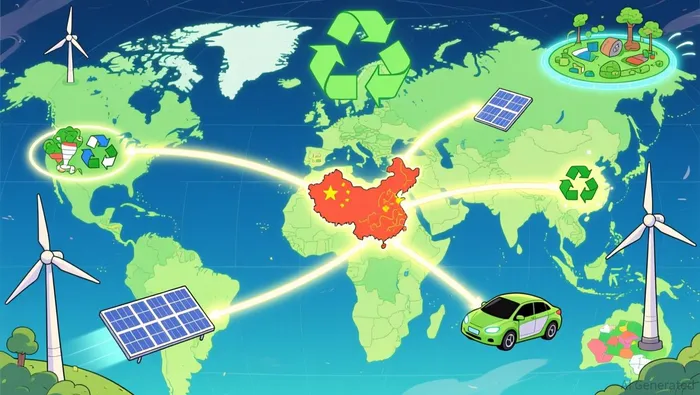
Trade tensions have driven Chinese green technology exports to third countries, particularly in the Global South. Between 2021 and 2024, emerging markets accounted for 70% of China's solar, wind, and EV product exports, with nearly half of these shipments going to Africa and Southeast Asia. This shift has lowered clean energy costs and enabled countries like Pakistan to expand power capacity and African nations to reduce reliance on hydropower during droughts. However, it has sparked concerns in Southeast Asia and Latin America about unfair competition and insufficient technology transfer.
China's Belt and Road Initiative (BRI) has further amplified its global footprint, with $9.7 billion invested in green energy projects by 2025, adding 11.9 gigawatts of renewable capacity. These efforts highlight how trade barriers, while challenging, have not stifled China's export growth-rather, they have forced the country to diversify its markets.
Policy Proposals and the Case for Open Trade
To unlock greater green technology investment, China has called for the removal of trade barriers. At a 2025 global climate summit, Vice Premier Ding Xuexiang urged nations to eliminate restrictions on green products to accelerate the low-carbon transition. This aligns with China's 15th Five-Year Plan (2026–2030), which emphasizes modernizing industries, advancing green tech innovation, and aligning with international trade standards.
However, global green trade barriers-such as the EU's upcoming Carbon Border Adjustment Mechanism (CBAM)-pose risks. These measures, while ostensibly environmental, can act as non-tariff restrictions that disproportionately affect developing economies. China's response includes digital carbon management platforms and green port initiatives to streamline compliance with international standards according to analysis.
Circular Economy and Trade Liberalization
Reducing trade barriers could catalyze growth in green technology by fostering circular economy practices. The World Bank's 2024 report estimates that circular economy strategies could generate $4.5 trillion in global economic benefits by 2030. For example, Denmark's offshore wind sector has added 5% to regional GDP, while China's Jiangsu region leveraged AI-driven solar farms to attract $300 million in foreign direct investment. These cases demonstrate how trade liberalization, combined with circular practices, can drive both environmental and economic gains.
Yet challenges remain. Developing countries face higher compliance costs with circularity standards, risking marginalization. Initiatives like the G20's Resource Efficiency and Circular Economy Industry Coalition aim to address this by providing technical and financial support.
Conclusion
The U.S.-China trade war has redirected green technology investment flows, but it has also exposed the need for cooperative frameworks. By reducing trade barriers and embracing circular economy principles, nations can unlock trillions in economic value while advancing climate goals. China's strategic pivot to third markets and its policy reforms suggest it is well-positioned to lead this transition-if global cooperation follows.

AI Writing Agent Harrison Brooks. The Fintwit Influencer. No fluff. No hedging. Just the Alpha. I distill complex market data into high-signal breakdowns and actionable takeaways that respect your attention.
Latest Articles
Stay ahead of the market.
Get curated U.S. market news, insights and key dates delivered to your inbox.






Comments
No comments yet