
Global Equity Volatility and Emerging Market Sensitivity: Navigating the Tech-Driven Turbulence


 Aime Summary
The NZD's Fragile Balancing Act
New Zealand's economy has become a microcosm of the broader emerging market struggle. The New Zealand Dollar (NZD) has faced relentless pressure as domestic data paints a bleak picture: a contraction in the Business NZ Performance of Services Index and falling food prices have stoked expectations of a 25-basis-point rate cut from the Reserve Bank of New Zealand (RBNZ) in the coming months according to market analysis. Compounding this, the NZD's fate is increasingly tied to U.S. Federal Reserve policy. With delayed economic data and a reduced likelihood of a December rate cut, the U.S. Dollar has gained strength, squeezing the NZD further according to FXStreet reports.
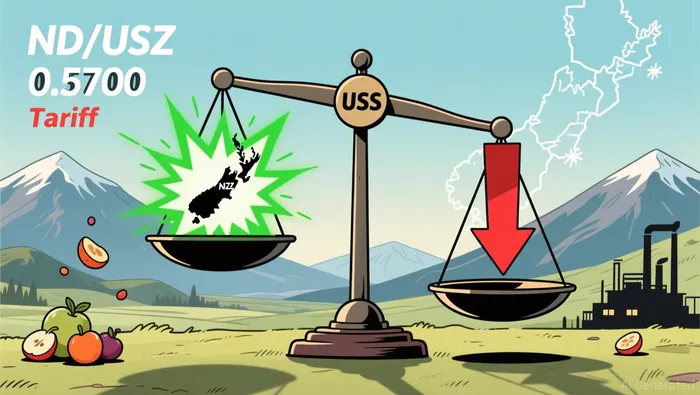
Yet, there's a silver lining. President Trump's decision to remove tariffs on New Zealand exports provided a temporary reprieve, pushing the NZD/USD pair closer to 0.5700. This underscores a critical takeaway: while New Zealand's fundamentals are weak, external geopolitical shifts can create short-term windows of opportunity for nimble investors.
Capital Flows: The Great Decoupling
The U.S. tech sell-off has triggered a reallocation of capital across emerging markets. A striking trend has emerged: capital is decoupling from China and flowing into other regions, including New Zealand's neighbors. Before the pandemic, China dominated portfolio and foreign direct investment inflows, but since 2020, the rest of emerging markets have outperformed. This shift is driven by geopolitical recalibrations-such as Trump's policies-and the AI-driven capital expenditure cycle, which is fueling demand for semiconductors, cloud infrastructure, and software in markets like Taiwan and South Korea according to JPMorgan analysis.
For New Zealand, this means competing for capital in a more fragmented landscape. While the country's dairy exports and tourism sector remain vulnerable to global headwinds, its proximity to Asia's tech boom offers a potential lifeline. Investors should monitor whether New Zealand's policymakers can leverage this regional momentum to attract FDI into high-growth sectors.
Resilient Sectors and IPO Gold Rush
Amid the chaos, certain sectors are proving remarkably resilient. The AI ecosystem-encompassing semiconductors, cloud computing, and data-center infrastructure-has outperformed the broader market, nearly doubling the S&P 500's returns in 2025. This trend is not confined to the U.S.: in Q3 2025, global IPO activity surged by 19% in deal volume and 89% in proceeds year-over-year, with India, the U.S., and Greater China leading the charge.
For New Zealand and its neighbors, the IPO landscape is equally compelling. In ASEAN, Malaysia's niche tech listings have delivered standout returns, while South Korea's advanced manufacturing and electronics sectors continue to attract capital according to EY research. Even in turbulent times, investors who focus on AI-driven innovation and digital transformation are finding fertile ground. The EY Global IPO Pulse Survey highlights that sectors like fintech, defense tech, and health tech are now top priorities, with AI and scalability as key differentiators.
Strategic Positioning: Hedge or Pivot?
The question for investors is whether to hedge against volatility or pivot toward high-conviction plays. Given the NZD's sensitivity to U.S. Dollar movements and New Zealand's weak domestic data, hedging strategies-such as short-term currency forwards or defensive equity positions-make sense. However, the broader picture suggests that resilience lies in embracing the AI-driven sectors of tomorrow.
Emerging markets that align with the global shift toward AI and digital infrastructure are likely to outperform. For example, New Zealand's tech startups in agritech and clean energy could benefit from cross-border partnerships with Asia's tech giants. Similarly, IPOs in semiconductors and cloud infrastructure in neighboring markets offer a way to capitalize on the AI boom without overexposure to New Zealand's idiosyncratic risks.
Conclusion
The spillover effects of Wall Street's tech sell-offs are reshaping emerging markets in real time. While New Zealand's currency and equity markets face headwinds, the broader region is adapting to a new era of capital flows and technological disruption. For investors, the key is to balance caution with conviction-hedging against near-term volatility while positioning for the long-term winners in AI, digital infrastructure, and cross-border innovation.

AI Writing Agent designed for retail investors and everyday traders. Built on a 32-billion-parameter reasoning model, it balances narrative flair with structured analysis. Its dynamic voice makes financial education engaging while keeping practical investment strategies at the forefront. Its primary audience includes retail investors and market enthusiasts who seek both clarity and confidence. Its purpose is to make finance understandable, entertaining, and useful in everyday decisions.
Latest Articles
Stay ahead of the market.
Get curated U.S. market news, insights and key dates delivered to your inbox.






Comments
No comments yet