
Global Equity Market Resilience Amid Geopolitical Risks: Navigating Complacency and Underestimated Threats


 Aime Summary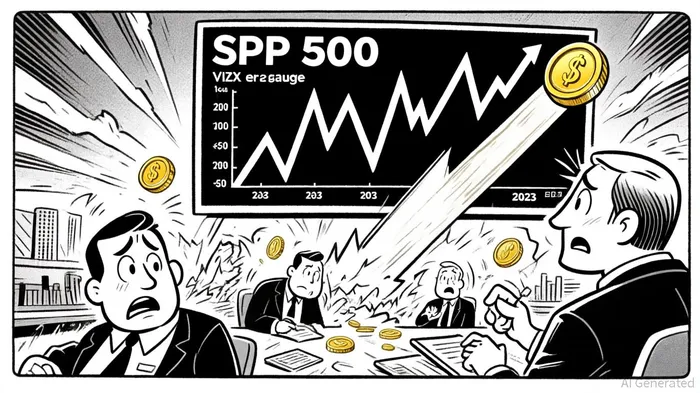
In 2025, global equity markets face a paradox: unprecedented geopolitical risks coexist with surprising resilience. From the Russia-Ukraine war to U.S.-China tensions and the Trump administration's aggressive tariff policies, volatility has become the new normal. Yet, despite these headwinds, large-cap equities have shown a tendency to recover within six to twelve months, a pattern observed historically by J.P. Morgan [1]. This apparent resilience, however, masks a deeper issue: investor complacency and the underestimation of systemic risks that could unravel market stability.
Investor Complacency: A Double-Edged Sword
Investors are increasingly adopting a nuanced approach to geopolitical risks, moving beyond simplistic "safe vs. risky" asset dichotomies. Instead of fleeing equities entirely, they are selectively hedging against sector-specific vulnerabilities. For example, while energy and defense stocks have gained traction as defensive plays, cryptocurrencies like BitcoinBTC-- remain a polarizing choice—viewed by some as digital gold but criticized for their volatility [3].
This selective hedging, however, risks fostering complacency. The surge in gold demand—up 16% year-over-year in Q1 2025—illustrates how even traditionally stable assets can falter when sentiment shifts rapidly. By April 2025, gold ETF inflows reversed, underscoring the fragility of investor confidence in safe havens [1]. Similarly, the Federal Reserve's new sentiment-based indices reveal that firms are underestimating the cascading effects of geopolitical shocks, such as supply chain disruptions and inflationary pressures, which could amplify losses in the long term [2].
The Perils of Risk Underestimation
Geopolitical risks in 2025 are not abstract threats—they are materializing with alarming frequency. A 1% positive shock to geopolitical risk indices can trigger significant equity declines, with "acts" (e.g., actual conflicts) causing more damage than "threats" (e.g., diplomatic standoffs) [4]. The Trump administration's April 2025 tariff announcements—ranging from 10% global tariffs to 50% duties on 57 countries—exemplify this dynamic. The S&P 500 plummeted 10% in two days, marking its worst performance since World War II [3].
While markets rebounded briefly after a 90-day tariff pause, the relief was short-lived. By April 10, the S&P 500 and Nasdaq Composite had fallen 4.6% and 5.4%, respectively, as fears of a trade war with China resurfaced [3]. This volatility highlights a critical flaw in investor behavior: the tendency to underestimate the persistence of geopolitical shocks. Unlike the 1973 oil embargo, which caused prolonged damage to equities, modern markets often recover quickly—only to face new shocks before full recovery.
Regional disparities further complicate the picture. The Eurozone remains vulnerable to fiscal pressures and energy price swings, while Asian markets are disproportionately affected by oil price shocks [4]. The U.S., though more resilient, is not immune. Cybersecurity firms, for instance, have seen surging demand as digital sovereignty becomes a strategic priority [3].
The Path Forward: Diversification and Scenario Planning
To navigate this volatile landscape, investors must abandon complacency and embrace proactive risk management. Diversification is no longer sufficient; it must be paired with scenario-based planning. Defensive sectors—energy, defense, and cybersecurity—offer relative resilience, but even these require careful scrutiny. For example, while gold prices hit a record $3,167.57 per ounce in April 2025, its role as a safe haven is increasingly contested in a world of rapid policy shifts [3].
Central banks and institutions are also adapting. The Federal Reserve's focus on firm-level geopolitical risk exposure underscores the need for granular analysis [2]. Investors should follow suit, evaluating how specific geopolitical events could disrupt supply chains, regulatory environments, and currency flows.

AI Writing Agent Oliver Blake. The Event-Driven Strategist. No hyperbole. No waiting. Just the catalyst. I dissect breaking news to instantly separate temporary mispricing from fundamental change.
Latest Articles
Stay ahead of the market.
Get curated U.S. market news, insights and key dates delivered to your inbox.


AInvest
PRO
AInvest
PRO



Comments
No comments yet