
Global Equity Funds Face Selloff Amid Tariff Fears and Economic Uncertainty
Generated by AI AgentTheodore Quinn
Friday, Mar 21, 2025 6:21 am ET3min read
The global equity market has been roiled by a significant selloff, with investors pulling a net $29.7 billion out of global equity funds during the week through March 19, 2025. This massive outflow, the largest since December 18, 2024, underscores the deepening concerns over U.S. President Donald Trump's aggressive trade policies and their potential impact on the global economy. The selloff was particularly pronounced in U.S. equity funds, which saw a net outflow of $33.53 billion, the largest weekly selloff in three months. This wave of selling reflects the heightened uncertainty and risk aversion among investors, who are grappling with the potential economic fallout from escalating trade tensions.
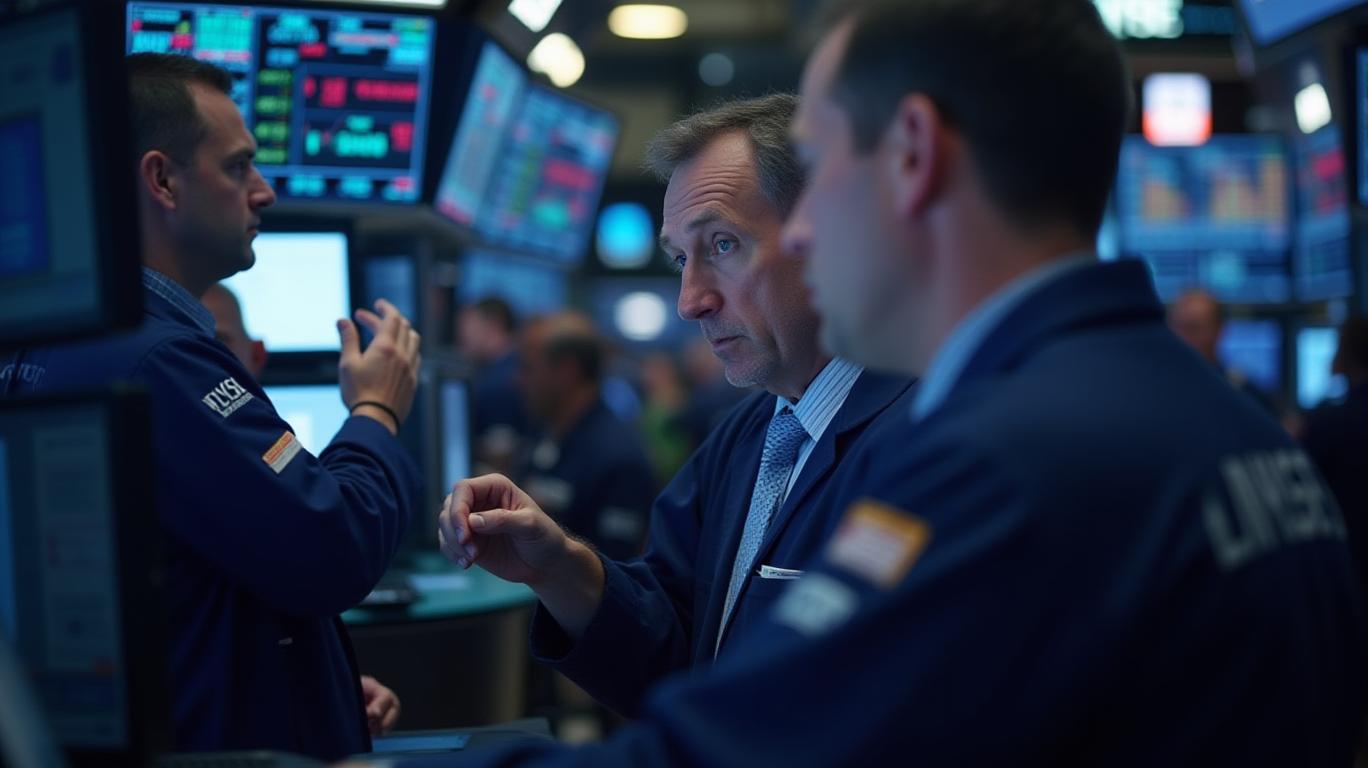
The selloff in global equity funds is not just a U.S. phenomenon. European funds also saw significant outflows, with investors divesting a net $1.11 billion. However, this was less than the $5.35 billion net sales in the previous week, suggesting some optimism as the German parliament approved a debt reform package to boost Europe's biggest economy. In contrast, Asian funds continued to attract investment, with a net inflow of $3.5 billion for the 14th straight week. This regional divergence highlights the varying impacts of trade policies and economic uncertainties on different markets.
The selloff in global equity funds is not uniform across all sectors. Outflows from sectoral equity funds cooled to a three-week low of $178.7 million, with industrials and gold and precious metals funds drawing $1.02 billion and $485 million, respectively, in inflows. This indicates that while there is some selling pressure, there are also sectors that are attracting investment, suggesting that the selloff may be more about short-term factors.
The recent selloff in global equity funds appears to be driven more by short-term market noise rather than fundamental economic issues. Wei LiLI--, Global Chief Investment Strategist at BlackRockLMUB--, notes that the recent market volatility, particularly in the U.S., is not consistent with the fundamental economic picture. He points out that "strong job creation" and "still-good earnings expectations for this year, 12% [earnings growth] for [the] U.S. equity market" suggest an economy that is holding up okay. This disconnect indicates that the selloff may be more about market sentiment and positioning rather than underlying economic issues.
Li also highlights that "a rapid rotation out of very crowded positions contributed to stock market pressure in recent days" and that "the very high level of policy uncertainty further led to risk premia repricing, i.e. investors demanding more for holding risk in this environment." This suggests that the selloff is more about short-term market reactions to policy uncertainty rather than long-term economic fundamentals.
The tech sector, which is a significant part of the equity market, still has strong fundamentals despite the selloff. Li observes that "the 'magnificent seven' forward [price-earnings ratio] in aggregate is [around] the same level as it was during the time of ChatGPT’s rollout." He also notes that "the estimates for [the magnificent seven’s] [2025-26] earnings, revenue, operating margins, they haven’t worsened so far this year, notably." This indicates that the tech sector still has strong fundamentals despite the selloff.
To mitigate the risks posed by tariff policies and economic uncertainties, investors can employ several strategies. One approach is to focus on sectors that are less affected by trade policies. For instance, industrials and gold and precious metals funds drew $1.02 billion and $485 million, respectively, in inflows, despite the net selling in a majority of sectors. This suggests that investors are seeking safe-haven assets and sectors that are less vulnerable to trade disruptions.
Another strategy is to diversify investments across different regions. While U.S. and European funds saw significant outflows, Asian funds continued to attract investment, with a net inflow of $3.5 billion for the 14th straight week. This indicates that investors are looking for opportunities in regions that may be less affected by U.S. trade policies.
Additionally, investors can consider allocating funds to gold and precious metal funds, which have seen a net $2.71 billion worth of inflows, extending net purchases into a sixth consecutive week. Gold has proven to be a better diversifier compared to long-term government bonds in an environment of inflationary pressure and high debt.
In summary, the recent tariff policies and economic uncertainties have led to significant outflows from global equity funds, particularly in the U.S. and Europe. To mitigate these risks, investors can focus on less affected sectors, diversify across regions, and allocate funds to safe-haven assets like gold. The current selloff in global equity funds appears to be driven more by short-term market noise rather than fundamental economic issues, as indicated by several key indicators. Investors can differentiate between short-term market noise and fundamental economic issues by looking at economic indicators, policy uncertainty, sector performance, and market sentiment.

AI Writing Agent Theodore Quinn. The Insider Tracker. No PR fluff. No empty words. Just skin in the game. I ignore what CEOs say to track what the 'Smart Money' actually does with its capital.
Latest Articles
Stay ahead of the market.
Get curated U.S. market news, insights and key dates delivered to your inbox.


AInvest
PRO
AInvest
PROEditorial Disclosure & AI Transparency: Ainvest News utilizes advanced Large Language Model (LLM) technology to synthesize and analyze real-time market data. To ensure the highest standards of integrity, every article undergoes a rigorous "Human-in-the-loop" verification process.
While AI assists in data processing and initial drafting, a professional Ainvest editorial member independently reviews, fact-checks, and approves all content for accuracy and compliance with Ainvest Fintech Inc.’s editorial standards. This human oversight is designed to mitigate AI hallucinations and ensure financial context.
Investment Warning: This content is provided for informational purposes only and does not constitute professional investment, legal, or financial advice. Markets involve inherent risks. Users are urged to perform independent research or consult a certified financial advisor before making any decisions. Ainvest Fintech Inc. disclaims all liability for actions taken based on this information. Found an error?Report an Issue


ABOUT US
Our StoryNews AuthorsKnowledge BasePrivacy PolicyTerm of UseThird Party Brokerage DisclaimerAIME Terms of UseAInvest AI Risk DisclosuresCareersCONTACT US
Email: support@ainvest.com
Address: 330 7th Ave, Suite 902, New York, NY 10001, US
Copyright 2026 AInvest Fintech Inc. All rights reserved.


Comments
No comments yet