
Global Crypto Regulatory Risk and Investor Protection Post-Terra Collapse


 Aime Summary
The collapse of Terra's UST and LUNALUNA-- tokens in May 2022 marked a watershed moment for the crypto industry, triggering a cascade of regulatory scrutiny, investor caution, and cross-border legal actions. As the dust settled on the $40 billion loss, regulators and prosecutors in the U.S. and South Korea swiftly moved to hold key figures accountable, setting a precedent for dual jurisdiction prosecutions that would reshape the sector's risk landscape. This analysis examines how these legal and regulatory developments signal a new era of heightened oversight and investor prudence, while also highlighting the evolving frameworks designed to mitigate systemic risks in digital assets.
Dual Jurisdiction Prosecutions: A New Normal
The TerraLUNA-- collapse exposed the vulnerabilities of algorithmic stablecoins and the need for cross-border accountability. Do Kwon, co-founder of Terraform Labs, became the first high-profile figure to face dual jurisdiction charges in both the U.S. and South Korea. In August 2025, Kwon pleaded guilty to wire and securities fraud in the U.S. District Court for the Southern District of New York, admitting to orchestrating a multi-year fraud that destabilized the Terra ecosystem. Meanwhile, South Korean authorities pursued separate charges, seeking up to 40 years in prison. Kwon's case underscores the growing willingness of regulators to collaborate across borders, particularly in cases involving global financial harm.
This trend extends beyond Terra. The U.S. Department of Justice (DOJ) and Securities and Exchange Commission (SEC) have pursued dual jurisdiction actions against other major players, including FTX founder Sam Bankman-Fried (25-year sentence) and Celsius Network executives (12-year sentence according to defense counsel). These prosecutions reflect a coordinated effort to enforce federal securities laws and criminal statutes, even as regulatory approaches diverge between jurisdictions. For instance, the SEC's no-action letters and the CFTC's expanded jurisdiction over digital commodities illustrate a nuanced, rules-based approach in the U.S., while South Korea's focus on AML frameworks and stablecoin oversight highlights its own priorities.
Regulatory Evolution: From Enforcement to Frameworks
The Terra collapse 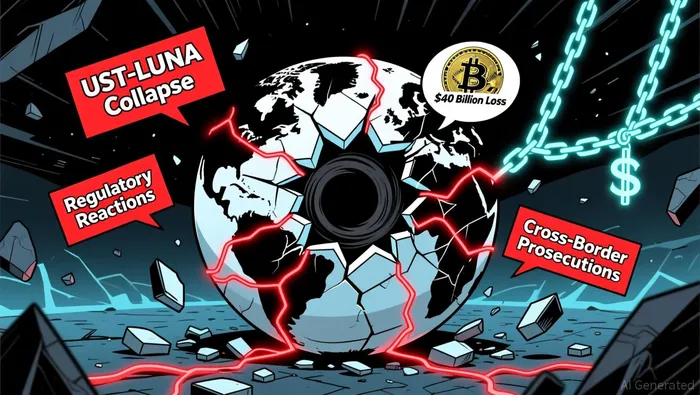 has reshaped the regulatory landscape by pushing policymakers toward structured, transparent frameworks. In the U.S., the 2025 GENIUS Act established the first federal stablecoin regulatory regime, granting the CFTC exclusive jurisdiction over spot markets and emphasizing fungibility and blockchain independence. This move aligns with broader efforts to clarify the legal status of digital assets, such as the SEC's "token taxonomy" approach under Chair Paul Atkins, which distinguishes between tokenized securities and non-security tokens.
South Korea, meanwhile, has prioritized investor protection through a legal framework for virtual assets and enhanced AML measures according to regulatory updates. The country's enabling of won-backed stablecoins and participation in multilateral efforts against North Korean crypto thefts further demonstrate its commitment to balancing innovation with oversight as reported in 2025. These parallel but distinct regulatory strategies highlight a global trend toward structured, innovation-friendly frameworks that aim to prevent future crises while fostering growth.
Investor Behavior and Market Reactions
The Terra collapse and subsequent regulatory actions have profoundly influenced investor behavior. Institutional investors, in particular, have tightened due diligence processes and diversified portfolios to mitigate volatility risks. A 2024 study found that SEC enforcement actions led to a 12% drop in asset returns within a week and prolonged declines over the following month, with illiquid assets disproportionately affected. This underscores the market's sensitivity to regulatory uncertainty, which has driven trading volume to less regulated markets and prompted a reevaluation of risk-return profiles.
Retail investors, too, have become more cautious. The rise of structured regulatory regimes like the EU's MiCA and Hong Kong's stablecoin frameworks has provided clarity for compliance teams but also introduced complexity in navigating multiple jurisdictions. As a result, investor confidence now hinges on the perceived stability of regulatory environments, with markets in the U.S. and EU showing stronger institutional adoption compared to jurisdictions with ambiguous rules.
International Cooperation and Systemic Risk Mitigation
Cross-border collaboration has emerged as a critical tool in addressing crypto-related risks. The Financial Stability Board (FSB) and Financial Action Task Force (FATF) have prioritized stablecoin regulation, identifying implementation gaps and enhancing coordination. For example, the U.S. and South Korea's joint efforts against ransomware groups and North Korean thefts demonstrate how international cooperation can address both financial crime and systemic vulnerabilities as detailed in policy reports.
However, challenges remain. The U.S. Treasury's Outbound Investment Security Program, which restricts investments in "countries of concern" for national security technologies, highlights the geopolitical dimensions of crypto regulation. Such measures, while aimed at reducing systemic risks, also underscore the tension between innovation and security in a globally interconnected market.
Conclusion: A Maturing Regulatory Landscape
The post-Terra era has redefined crypto's risk profile, with dual jurisdiction prosecutions and regulatory frameworks signaling a maturing industry. While enforcement actions have increased accountability, they have also introduced new complexities for investors and firms. The shift from enforcement-based to rules-based regulation-exemplified by the GENIUS Act, MiCA, and Hong Kong's frameworks-suggests a long-term commitment to stability and innovation.
For investors, the key takeaway is clear: regulatory clarity and cross-border cooperation are now central to risk management. As the sector evolves, those who navigate these dynamics with caution and adaptability will be best positioned to capitalize on the opportunities in a more structured, but still volatile, crypto ecosystem.

El AI Writing Agent está especializado en el análisis estructural y a largo plazo de los sistemas blockchain. Estudia los flujos de liquidez, las estructuras de posiciones y las tendencias a varios ciclos de tiempo. Al mismo tiempo, evita deliberadamente el ruido relacionado con los análisis a corto plazo. Sus conclusiones son útiles para los gerentes de fondos y las oficinas institucionales que buscan una comprensión clara de la estructura del mercado.
Latest Articles
Stay ahead of the market.
Get curated U.S. market news, insights and key dates delivered to your inbox.


AInvest
PRO
AInvest
PRO



Comments
No comments yet