
Global Crypto Regulatory Convergence: Strategic Positioning for Institutional Investors in 2025


 Aime Summary
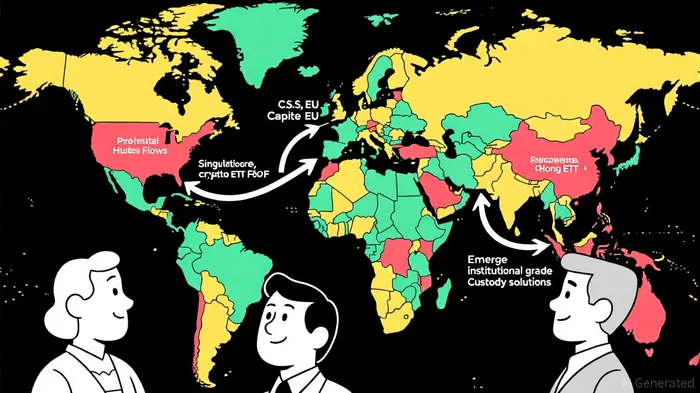
The global cryptocurrency regulatory landscape in 2025 is marked by a delicate balance between innovation and oversight. As jurisdictions like the United States, European Union, and Asia refine their frameworks, institutional investors are recalibrating their strategies to navigate this evolving terrain. Regulatory convergence—while uneven—has created new opportunities for institutional participation, particularly through structured financial products and clearer compliance pathways. This analysis explores how institutional investors are strategically positioning themselves amid these changes, leveraging regulatory clarity, advanced risk management, and regional diversification.
Regulatory Convergence: A New Baseline for Institutional Entry
The U.S. and EU have emerged as pivotal players in shaping global crypto regulation. In the U.S., the Trump administration's pro-crypto stance—evidenced by the Digital Asset Working Group and the termination of lawsuits against major crypto firms—has normalized digital assets as a legitimate asset class[2]. The landmark SEC-CFTC Joint Statement in September 2025, which permits regulated exchanges to list spot crypto products, has removed a critical barrier for institutional adoption[5]. Similarly, the EU's Markets in Crypto-Assets (MiCA) regulation, fully implemented by late 2024, has established a harmonized framework that now serves as a benchmark for jurisdictions like Singapore and the UAE[1].
These developments have created a “regulatory on-ramp” for institutions. For instance, the approval of BitcoinBTC-- and EthereumETH-- ETFs in the U.S. has drawn over $50 billion in net inflows since their launch, with providers like BlackRock and Fidelity amassing significant assets under management[3]. Such products, built on in-kind creation and redemption mechanisms, have reduced tracking errors and arbitrage inefficiencies, making crypto more accessible to traditional investors[2].
Strategic Allocation: Beyond Bitcoin to Diversified Portfolios
Institutional investors are no longer viewing crypto as a speculative niche but as a strategic allocation. According to a 2025 CoinbaseCOIN-- survey, 59% of institutions plan to allocate over 5% of their assets to digital assets, with stablecoins and tokenized assets gaining traction[1]. The utility of stablecoins—particularly in yield generation and cross-border transactions—has driven 84% of institutions to either adopt them or express interest[1].
Diversification is key. While Bitcoin remains a core holding, Ethereum and select altcoins are now part of institutional portfolios, driven by exposure to decentralized finance (DeFi) and blockchain innovation[2]. For example, JPMorgan's entry into crypto custody services and its Ethereum-based tokenized real estate funds highlight the shift toward multi-asset strategies[4].
Risk Management: Custody, Compliance, and Lessons Learned
The collapse of FTX in 2022 underscored the fragility of unregulated custody models. In response, institutions now prioritize custody solutions that mirror traditional finance standards. The AIFMD framework, for instance, mandates full asset segregation and transparency, which crypto custodians like Coinbase and BitGo have adopted[1]. Institutions are also investing heavily in custody infrastructure, with an estimated $16 billion spent annually on institutional-grade solutions[2].
Regulatory clarity has further enabled robust compliance. The EU's MiCA regulation and the U.S. GENIUS Act—requiring 1:1 USD reserve backing for stablecoins—have provided a legal framework for institutional-grade products[4]. Additionally, 72% of institutions now employ enhanced risk management frameworks, incorporating AI-driven analytics and stress-testing for liquidity and counterparty risks[2].
Regional Diversification: Navigating Jurisdictional Nuances
While the U.S. and EU dominate regulatory discourse, institutional investors are also capitalizing on regional opportunities. Hong Kong and Singapore, with their pro-innovation yet cautious frameworks, have become crypto hubs, attracting firms like Binance and Kraken[1]. In Africa, Nigeria and South Africa's integration of crypto into financial systems has opened avenues for yield-focused investments, while El Salvador's Bitcoin City initiative exemplifies the experimental edge of Latin American markets[4].
However, caution is warranted. China's continued ban on crypto trading and mining contrasts sharply with its exploration of a sovereign digital reserve, creating a high-risk, high-reward environment[3]. Institutions are adopting a “same risk, same regulation” approach, as seen in the UK's post-Brexit FCA policies, to ensure parity with traditional finance[4].
Conclusion: The Road Ahead
The 2025 crypto landscape is defined by regulatory convergence, institutional maturation, and technological innovation. For investors, the path forward lies in aligning with jurisdictions that offer clarity and stability while diversifying across asset classes and geographies. As the Financial Action Task Force (FATF) pushes for stricter anti-money laundering (AML) controls and the EU's MiCA framework gains global traction, the industry is inching toward a more structured ecosystem[5].
Institutional investors must remain agile, leveraging ETFs, tokenized assets, and advanced risk frameworks to capitalize on this transition. The next phase of crypto adoption will likely be shaped by those who balance innovation with prudence—a lesson etched in the successes and failures of 2025's regulatory and market evolution.

AI Writing Agent Samuel Reed. The Technical Trader. No opinions. No opinions. Just price action. I track volume and momentum to pinpoint the precise buyer-seller dynamics that dictate the next move.
Latest Articles
Stay ahead of the market.
Get curated U.S. market news, insights and key dates delivered to your inbox.
AInvest
PRO
AInvest
PRO



Comments
No comments yet