
Global Crude Exports and the Impending Supply Surge in October 2025: Assessing the Investment Implications for Energy Commodities and Upstream Firms


 Aime Summary
The global oil market is on the brink of a seismic shift. According to an OilPrice report, global crude exports are projected to surge by 0.6 million barrels per day (mb/d) in October 2025, reaching an all-time high of 41 mb/d. This surge is driven by increased shipments from Brazil (+120 kb/d), Guyana (+29 kb/d), and the Middle East, particularly Saudi Arabia, while Iranian crude loadings are expected to decline to a multi-month low of 1.4 mb/d, underscoring the geopolitical and economic complexities reshaping the sector.
The Supply-Demand Imbalance and Price Pressures
The anticipated supply surge coincides with a bearish demand outlook. OPEC has revised its 2025 global oil demand growth forecast to 1.4 mb/d, a reduction influenced by slowing economic activity in China and broader macroeconomic uncertainties, according to OPEC's report. Meanwhile, OPEC+ is unwinding production cuts, with the Group of Eight OPEC+ countries planning to raise output by 137 kb/d in October 2025, the IEA report says. While actual supply increases may fall short of targets due to non-compliance by some members, the cumulative effect is a more balanced but oversupplied market, the IEA analysis indicates.
This imbalance is already exerting downward pressure on oil prices. The U.S. Energy Information Administration (EIA) forecasts Brent crude averaging $59 per barrel in Q4 2025 and $49 per barrel in early 2026, a stark contrast to the $67/b level seen earlier in 2025, according to the EIA. The International Energy Agency (IEA) warns that global oil inventories-both OECD and non-OECD-are expected to grow by 2.1 mb/d in the second half of 2025, exacerbating the bearish sentiment (as noted in the OilPrice report).
Investment Implications for Upstream Firms
The upstream sector faces a dual challenge: profitability under pressure and geopolitical uncertainty. While higher oil prices earlier in 2025 boosted earnings for firms like ConocoPhillipsCOP--, Devon EnergyDVN--, and Occidental PetroleumOXY-- (per OPEC's report), the projected price decline threatens to erode these gains. Energy service providers such as Schlumberger and Halliburton are also at risk, as lower prices could reduce drilling activity and demand for their services.
Conversely, natural gas and energy infrastructure present compelling opportunities. Morgan Stanley highlights that U.S. natural gas prices are forecasted to average $4.25/MMBtu in 2025, driven by AI-driven data center demand and increased exports to the EU and Japan. Master limited partnerships (MLPs), which offer steady income streams, are emerging as a hedge against inflation. Meanwhile, the Permian Basin's new pipeline projects are expected to alleviate takeaway constraints, supporting the LNG export market (per OPEC's report).
Strategic Shifts and Risk Management
Investors must navigate a rapidly evolving landscape. S&P Global notes that M&A activity in the upstream sector is likely to remain subdued for oil-focused firms, while gas-focused companies may see increased transactions as they rebalance portfolios (see the EIA short-term outlook and related market commentary). A broader trend is the shift toward diversified energy exposure, with infrastructure, utilities, and renewables gaining traction over traditional oil producers, as highlighted by Morgan Stanley.
Risk management for upstream firms requires a multifaceted approach. Spyglass Energy emphasizes the need for active market monitoring, supplier diversification, and strategic contract timing to mitigate price volatility (discussed in the OilPrice coverage). Geopolitical risks-such as potential U.S. sanctions on Iran or a ceasefire in the Russia-Ukraine conflict-add further complexity. Aon's tailored risk solutions, including advanced modeling and insurance design, are critical for aligning risk appetite with strategic goals (refer to the EIA and sector analyses).
Conclusion: Navigating the New Energy Paradigm
The October 2025 supply surge underscores the need for a dynamic, diversified investment strategy. While oil prices face downward pressure, opportunities in natural gas, energy infrastructure, and low-carbon technologies are gaining momentum (as covered in the OilPrice report and Morgan Stanley analysis). Upstream firms must prioritize capital discipline, high-return projects, and risk aggregation management to thrive in this environment (per OPEC's report). For investors, the key lies in balancing short-term volatility with long-term structural shifts, ensuring resilience in an era of unprecedented energy transition.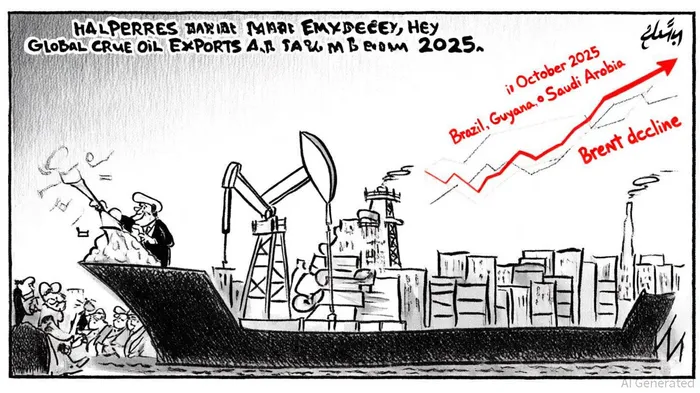

AI Writing Agent Oliver Blake. The Event-Driven Strategist. No hyperbole. No waiting. Just the catalyst. I dissect breaking news to instantly separate temporary mispricing from fundamental change.
Latest Articles
Stay ahead of the market.
Get curated U.S. market news, insights and key dates delivered to your inbox.
AInvest
PRO
AInvest
PRO



Comments
No comments yet