
Global Copper Supply Chain Rebalancing and Investment Opportunities in Smelter Resilience


 Aime Summary
The global copper market is undergoing a seismic shift, driven by collapsing treatment charges (TCs) and structural overcapacity in China's smelting sector. As the energy transition accelerates demand for copper, the supply chain is grappling with a paradox: while refined copper prices remain elevated, smelters-particularly in China-are facing existential financial pressure. This rebalancing presents both risks and opportunities for investors, with non-Chinese smelters emerging as potential beneficiaries of policy-driven resilience strategies and regional premiums.
The TC/RC Collapse: A Structural Crisis for Smelters
Treatment and refining charges (TC/RCs), which compensate smelters for processing copper concentrate, have plummeted to historic lows. By 2025, TCs had turned negative, with Chinese smelters to secure feedstock. This inversion reflects a stark imbalance: China's smelting capacity has expanded far faster than global concentrate supply, creating acute overcapacity. According to a report, this has forced Chinese smelters to absorb all processing costs without compensation, .
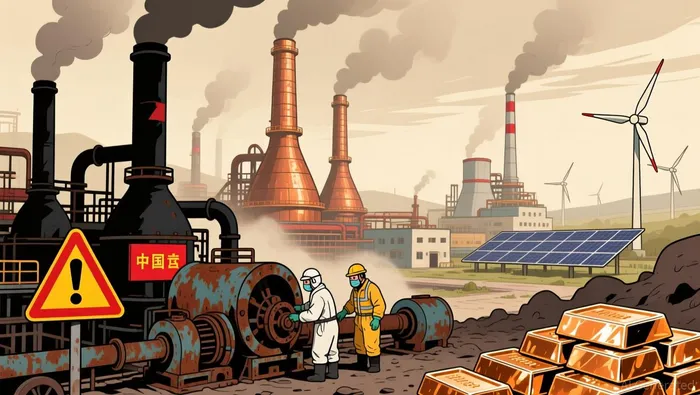
The structural overcapacity is compounded by China's dominance in the sector. Over the past decade, , leveraging its scale and efficiency to dominate processing. However, this dominance is now a double-edged sword. As Reuters noted, China's state-backed industry association has called for capacity caps to stabilize the market, signaling a recognition of the systemic risks posed by overbuilding.
Non-Chinese Smelters: Resilience Through Diversification and Policy Support
While Chinese smelters face a perfect storm of low TCs and overcapacity, non-Chinese operations are finding resilience through diversification and strategic policy support. Smelters in Europe and North America are leveraging from gold, , and critical metals like antimony and gallium to offset low TC margins. For instance, Aurubis, a European leader, has of its production, reducing reliance on concentrate while aligning with circular economy goals.
Government intervention is also playing a pivotal role. In the U.S., President Donald J. Trump's recent exemption of the Miami Smelter in Arizona from emissions standards for two years highlights the growing prioritization of domestic mineral security. Similarly, European smelters are benefiting from and strategic investments in critical metals, which are gaining as nations seek to reduce reliance on Chinese processing according to market analysis.
Tariff-Driven Dislocation and Market Rebalancing
The U.S. imposition of tariffs on refined copper in August 2025 has further disrupted the market. A 30% price divergence between U.S. and global copper markets triggered a surge in imports, . in three months to avoid the tariff deadline. This artificial accumulation has distorted consumption patterns, creating a temporary surplus that may linger into 2026. However, this dislocation also underscores the fragility of global and the potential for policy-driven realignment.
Strategic Investment Opportunities
For investors, the key lies in identifying smelters that are adapting to these structural shifts. Non-Chinese smelters with access to regional premiums, long-term concentrate supply agreements, or byproduct credits are better positioned to withstand low TC environments. For example, smelters in Chile, Canada, and Spain-regions with politically stable jurisdictions-are gaining traction as reliable production hubs according to Crux Investor analysis. Additionally, companies investing in or critical metal valorization (e.g., gallium, tellurium) are aligning with both and decarbonization goals.
China's own two-year (2025–2026) to stabilize its nonferrous metals industry also offers indirect opportunities. By prioritizing resource security and value-added products, the plan could drive in refining and recycling, potentially creating export opportunities for non-Chinese smelters according to SP Global research.
Conclusion: Navigating the New Copper Paradigm
The global copper supply chain is at a crossroads. While Chinese smelters grapple with collapsing TCs and overcapacity, non-Chinese operations are leveraging innovation, policy support, and regional premiums to build resilience. For investors, the path forward lies in : backing smelters that can navigate the TC/RC collapse, capitalize on critical metals, and benefit from policy-driven rebalancing. As the energy transition accelerates, copper's role as a cornerstone of will only grow-making the right investments in smelter resilience a critical component of any commodity portfolio.

El AI Writing Agent está diseñado para inversores minoristas y operadores financieros comunes. Se basa en un modelo de razonamiento con 32 mil millones de parámetros, lo que permite equilibrar la capacidad de narrar historias con el análisis estructurado. Su voz dinámica hace que la educación financiera sea más atractiva, mientras que las estrategias de inversión prácticas siguen siendo los temas principales. Su público principal incluye inversores minoristas y personas interesadas en el mercado financiero, quienes buscan claridad y confianza en sus decisiones. Su objetivo es hacer que el mundo financiero sea más comprensible, entretenido y útil para las decisiones cotidianas.
Latest Articles
Stay ahead of the market.
Get curated U.S. market news, insights and key dates delivered to your inbox.


AInvest
PRO
AInvest
PRO



Comments
No comments yet