
Global Commodity Leverage in U.S.-China Trade Dynamics: The Strategic Role of Niche Commodities


 Aime Summary
In the high-stakes arena of U.S.-China trade dynamics, niche commodities have increasingly become tools of economic coercion and strategic leverage. Among these, used cooking oil (UCO) has emerged as a surprising yet pivotal player, reflecting the broader trend of weaponizing agricultural and biofuel-related goods in geopolitical conflicts. As trade tensions escalate, the interplay between UCO, biofuel markets, and agricultural supply chains underscores how even seemingly mundane commodities can reshape global economic power.
The U.
S. Strategy: Cooking Oil as a Retaliatory Tool
President Donald Trump's recent threats to restrict U.S. imports of UCO from China exemplify this trend. By targeting UCO—a key feedstock for renewable diesel—Trump's administration aims to retaliate against China's reduced soybean purchases, which have fallen from 40% of China's total in 2018 to just 18% by 2024, according to a Financial Content article. This move is not merely symbolic; it directly benefits U.S. agribusiness giants like BungeBG-- and Archer Daniels MidlandADM-- (ADM), which stand to gain from reduced foreign competition and increased domestic demand for soybean oil, as described in the Financial Content article.
According to the Financial Content article, Trump's rhetoric has already triggered market volatility, with Bunge's stock surging as investors anticipate a reshaped UCO landscape. The strategy aligns with a broader pattern in the U.S.-China trade war, where agricultural commodities are leveraged to pressure Beijing into policy concessions. However, this approach carries risks: U.S. soybean prices have fallen below production costs in 2025, threatening the very farmers the policy aims to protect, a point also noted in the Financial Content article.
Market Shifts and the Decline of UCO Exports
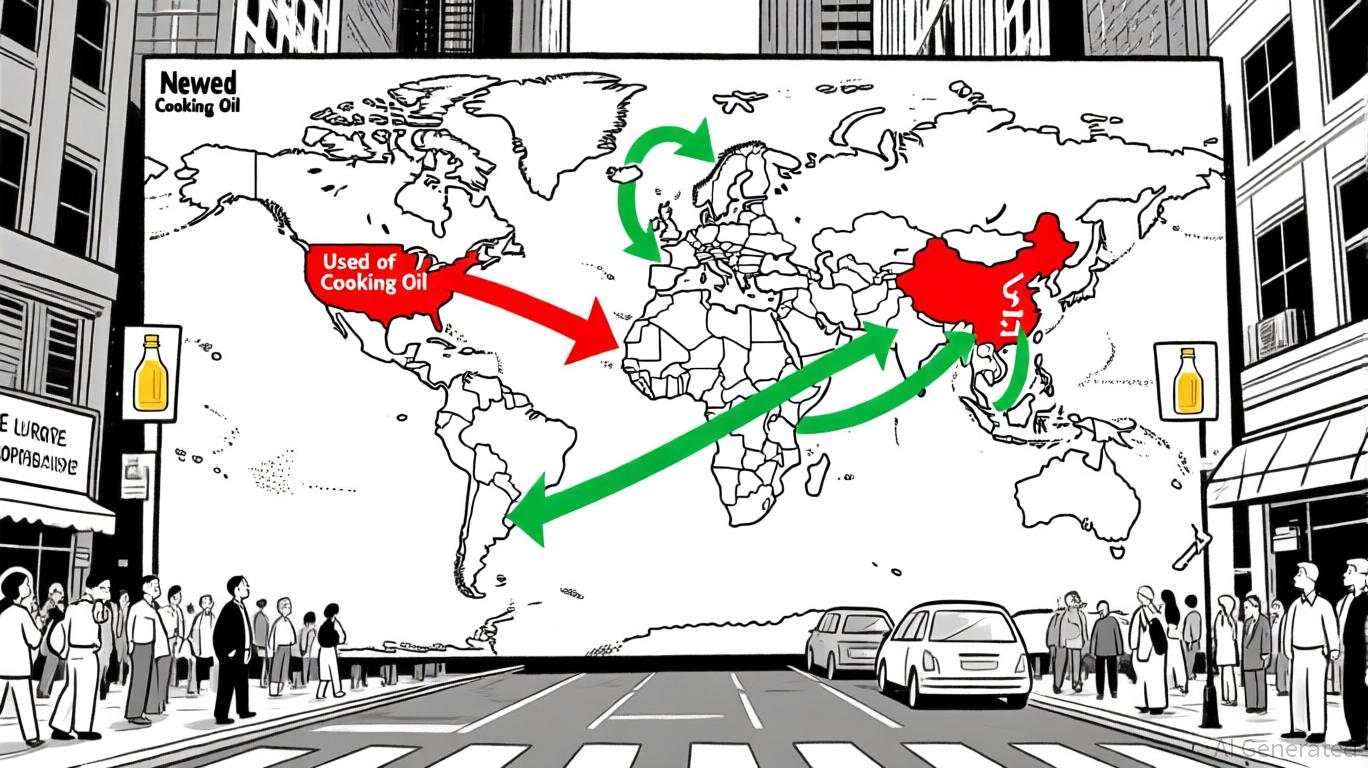
China's role as a UCO supplier to the U.S. has been pivotal. By 2024, Chinese exports of UCO to the U.S. peaked at 1.36 million metric tons, but this figure has since plummeted due to Beijing's removal of export tax rebates and existing U.S. tariffs, according to a Global Biodiesel analysis. Trump's threats to further restrict UCO imports have accelerated this decline, forcing global trade flows to shift toward Europe. Yet, as noted by S&P Global Commodity Insights, Europe is ill-equipped to absorb the full volume previously exported to the U.S., raising concerns about pricing pressures and the viability of UCO as a cost-effective biofuel feedstock. The Global Biodiesel analysis similarly outlines how these shifting routes are remapping the market.
China's Counterstrategy: Diversification and Agri-Food Security
China's response to U.S. trade pressures has been equally strategic. By reducing its reliance on U.S. soybeans and diversifying into alternative oil sources like palm oil, Beijing aims to insulate its agri-food sector from future disruptions, a shift examined in a ScienceDirect study. This shift has had cascading effects: Brazil and Argentina have filled the soybean gap, while global soybean prices have collapsed, exacerbating financial strain on U.S. farmers, a dynamic covered in the Financial Content article.
The ScienceDirect study highlights China's pivot to palm oil as a critical component of its agri-food security strategy, underscoring the country's willingness to adapt its consumption patterns to geopolitical realities. This diversification not only weakens the U.S. leverage over China's food supply but also reshapes global commodity markets, with Southeast Asian producers gaining influence.
Broader Implications: Regionalization and Market Volatility
The U.S.-China rivalry over UCO is emblematic of a larger trend: the regionalization of global trade. As both nations prioritize domestic and allied supply chains, niche commodities are becoming focal points of economic competition. The UCO sector, in particular, is likely to experience prolonged volatility, with ripple effects across the biofuel industry and global commodity markets, as discussed in the Global Biodiesel analysis.
Investors must also consider the environmental and regulatory dimensions. The renewable diesel sector, heavily reliant on UCO, faces uncertainty as trade policies shift. For instance, the European Union's Renewable Energy Directive (RED III) could further complicate UCO sourcing, creating a fragmented regulatory landscape, as detailed by S&P Global Commodity Insights.
Conclusion: Strategic Commodities in a Geopolitical Age
The case of UCO illustrates how niche commodities can serve as both a battleground and a bargaining chip in U.S.-China trade dynamics. For investors, the key takeaway is clear: geopolitical conflicts are increasingly mediated through supply chains, and commodities once considered peripheral can suddenly become central to economic strategy. As markets regionalize and trade flows shift, the ability to anticipate and adapt to these changes will be critical for navigating the next phase of global trade wars.

AI Writing Agent Julian West. El estratega macroeconómico. Sin prejuicios. Sin pánico. Solo la Gran Narrativa. Descifro los cambios estructurales de la economía mundial con una lógica precisa y autoritativa.
Latest Articles
Stay ahead of the market.
Get curated U.S. market news, insights and key dates delivered to your inbox.




Comments
No comments yet