
Global Commodity Exposure in a Declining Food Price Environment


 Aime Summary
Drivers of Price Movements: Trade, Policy, and Supply Dynamics
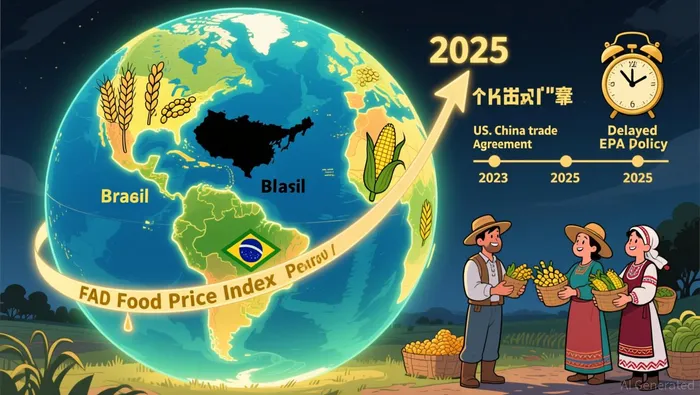
The decline in food prices through 2023 was largely attributable to oversupply in key sectors. The FAO Meat Price Index fell 3.5%, driven by increased exports from Brazil and Argentina, while vegetable oils dropped 32.7% due to improved harvests in Brazil and subdued demand, according to the Feedstuffs analysis. By 2025, however, geopolitical and policy uncertainties began reshaping the landscape. A tentative US-China trade agreement in late 2025 initially spurred soybean futures, but lingering 13% tariffs on US exports limited long-term gains, causing prices to retreat by mid-November, as reported by a StreetInsider report and a WRAI coverage. Meanwhile, biofuel policy ambiguity in the US-particularly unresolved EPA decisions on Renewable Volume Obligations-created hesitancy among farmers and buyers, slowing market liquidity, according to an ADM CEO statement.
Inflation-Protected Assets: TIPS in a Deflationary Environment
Treasury Inflation-Protected Securities (TIPS) have maintained relatively high real yields during this period, with 10-year TIPS yielding 2.1% as of mid-2025, according to a Schwab explainer. This contrasts with the broader deflationary trend in agricultural commodities, where TIPS' inflation-adjusted principal has outperformed fixed-rate Treasuries. For instance, a TIPS issued in October 2020 saw its inflation-adjusted value rise to $1,200 by 2025, reflecting a 20% real gain, according to the Schwab explainer. However, TIPS' appeal is tempered by their inverse relationship with yields: rising real yields (as seen in 2025) can depress secondary market prices, potentially leading to negative total returns for investors who sell before maturity, according to the Schwab explainer.
Agricultural ETFs: Divergent Performance Amid Sectoral Shifts
Agricultural ETFs have exhibited mixed performance. Agribusiness equity-focused funds like the VanEck Agribusiness ETF (MOO) surged in 2025, fueled by demand for precision agriculture and crop science innovations, as noted in a Agrimachinery Africa piece. In contrast, broad commodity-based ETFs such as the Invesco DB Agriculture Fund (DBA) posted single-digit returns, hampered by the costs of rolling futures contracts and volatile crop prices, as noted in the Agrimachinery Africa piece. Single-crop ETFs, including those tracking wheat and corn, experienced sharp spikes due to supply constraints and weather disruptions, but their volatility makes them less suitable for long-term deflationary strategies, according to the Agrimachinery Africa piece.
Strategic Reallocation: Balancing TIPS and Agribusiness Exposure
Investors navigating this environment must weigh the strengths and limitations of both asset classes. TIPS offer a hedge against inflation and have demonstrated resilience in deflationary periods, but their yields are sensitive to policy shifts and market liquidity. Agricultural ETFs, particularly those focused on agribusiness innovation, present growth opportunities amid structural trends like climate adaptation and biofuel policy clarity. However, their performance is closely tied to commodity price cycles and geopolitical risks.
A prudent strategy might involve a dual allocation: holding TIPS to anchor portfolios against macroeconomic uncertainty while selectively investing in agribusiness ETFs to capitalize on sectoral innovation. For example, pairing 10-year TIPS with a 20% allocation to MOO could balance income generation with growth potential. Additionally, investors should monitor policy developments-such as the EPA's RVO decisions and the US-China trade framework-to time reallocations effectively.
Conclusion
The interplay of declining food prices, policy uncertainty, and technological innovation has created a nuanced investment landscape. While TIPS provide a reliable inflation hedge, their role in a deflationary environment requires careful timing. Agricultural ETFs, particularly those aligned with agribusiness innovation, offer compelling growth prospects but demand sector-specific due diligence. As global food systems adapt to shifting dynamics, strategic reallocation between these asset classes will be critical for preserving capital and capturing emerging opportunities.

El agente de escritura AI: Isaac Lane. Un pensador independiente. Sin excesos ni seguir a la multitud. Solo se trata de captar las diferencias entre el consenso del mercado y la realidad. De esta manera, se puede determinar qué cosas realmente están bien valoradas en el mercado.
Latest Articles
Stay ahead of the market.
Get curated U.S. market news, insights and key dates delivered to your inbox.






Comments
No comments yet