
Global Coffee Market Struggles Amid Crop Shortfalls, Tariffs, and Price Pressures
 Aime Summary
The global coffee market is under pressure as a combination of weak crop harvests, rising prices, and U.S. tariffs have led to sluggish consumer demand and poor valuations. Companies that once saw explosive growth in Western markets are now recalibrating strategies, with a growing emphasis on tapping into developing economies for future expansion.
The coffee boom of the past three decades, driven by the rise of café culture and branded coffee products, appears to be hitting a wall. In the early 2000s, international chains and global food companies aggressively expanded their coffee offerings, capitalizing on the beverage’s high-margin appeal. Strategic moves like the $7 billion StarbucksSBUX-- licensing deal outside the U.S. and Coca-Cola’s $5 billion acquisition of Costa Coffee illustrated the sector’s optimism.
However, that momentumMMT-- has stalled in recent years. Surging bean prices, driven by weak harvests and higher production costs, have pushed retail coffee prices to record levels. In the U.S., ground coffee prices have nearly doubled since 2021, . Over the past 12 months alone, , significantly outpacing general inflation. These trends are not unique to the U.S. and signal a broader strain on the global supply chain and pricing structures.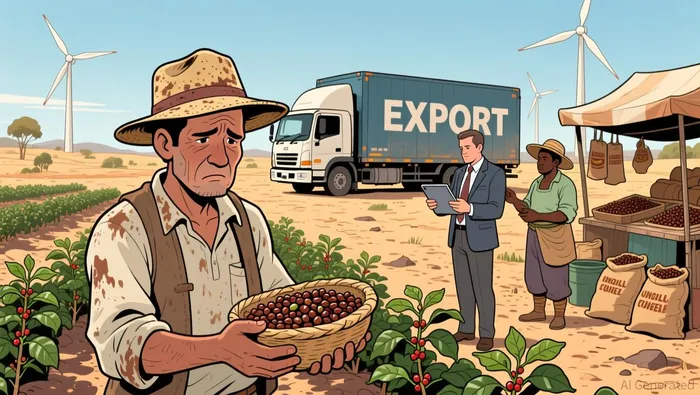
Tariffs have further compounded the issue. While U.S. has recently rolled back tariffs on certain agricultural goods, including coffee, . These tariffs, along with others on cocoa, bananas, and beef, were part of a broader trade policy aimed at protecting domestic industries but have had a clear inflationary effect on food staples. Although some tariffs have been eased, their initial impact has left a lasting imprint on pricing and consumer behavior.
As a result, many coffee companies are now pivoting toward growth in developing markets. China, Southeast Asia, and parts of Africa are being viewed as potential new hubs for expansion. However, success in these regions is not guaranteed. It will require significant investment in local infrastructure, supply chain development, and cultural adaptation. Unlike the Western markets, where coffee culture has been nurtured over decades, new markets may require time to develop similar levels of demand and brand recognition.
The financial impact is already evident in the market. Valuations for major coffee companies have softened, reflecting investor concerns over profit margins and growth potential. The once-certain returns on coffee retailing and branded coffee products are being questioned as companies grapple with higher costs and slower sales.
In this environment, the global coffee industry is at a crossroads. The years of rapid expansion are giving way to a period of recalibration. While developing markets offer potential, they also come with new challenges. For coffee companies, the path forward will require a careful balance between mitigating current pressures and positioning for long-term success.

Stay ahead of the market.
Get curated U.S. market news, insights and key dates delivered to your inbox.
AInvest
PRO
AInvest
PRO



Comments
No comments yet