
Global Cocoa Markets in Turmoil: How Geopolitical Risks and Supply Chain Diversification Are Reshaping Investment Strategies
 Aime Summary
The world's cocoa supply is at a breaking point. Côte d'Ivoire, the world's largest cocoa producer, is projected to see a 10% decline in output for the 2024/2025 season, driven by a perfect storm of political instability, climate chaos, and regulatory pressures. This crisis is not just a regional issue—it's a seismic shift in global soft commodity markets, forcing investors to rethink strategies in a world where cocoa prices have surged 160% since early 2024.
The Perfect Storm in Côte d'Ivoire
Côte d'Ivoire's cocoa belt, which accounts for nearly 40% of global production, is under siege. Political uncertainty ahead of the October 2025 election has disrupted agricultural planning, while the EU's Deforestation Regulation (EUDR) has imposed costly sustainability mandates on farmers. Climate change is compounding the crisis: cacao-growing regions now face an average of 40 additional days per year of temperatures exceeding 90°F (32°C) compared to a decade ago. This heat, paired with erratic rainfall and flooding—such as the catastrophic deluge in Obrouayo village in late 2024—has devastated harvests.
The cocoa swollen shoot virus, exacerbated by deforestation and soil degradation, is another silent killer. Farmers like Célestin Oura are abandoning cacao for more resilient crops like rubber or oil palm. The result? A global cocoa deficit of 494,000 tonnes in 2023/2024—the worst in 60 years—and a projected 10% drop in 2024/2025 output.
The Investment Fallout: Volatility and Opportunity
Cocoa futures hit $9,602 per ton in early 2025, a 160% surge since early 2024. This volatility has created a dual-edged sword for investors: short-term gains for those hedging with futures or ETFs, but long-term risks for those overexposed to a market teetering on collapse.
For example, the Global X Agriculture ETF (JO), which includes cocoa exposure, has seen a 120% rally since 2024. However, this momentum is fragile. If West Africa's supply rebounds faster than expected, prices could plummet. Investors must balance their portfolios with hedging tools like put options or inverse ETFs to mitigate downside risk.
Diversification: The New Gold Standard
As West Africa's cocoa belt falters, investors are turning to supply chain diversification. Latin America, particularly Ecuador, is emerging as a critical alternative. Between 2014 and 2024, Ecuador's cocoa production jumped 83.8%, driven by younger trees, advanced irrigation, and disease-resistant hybrids. Barry Callebaut, the world's largest cocoa processor, has expanded operations in Ecuador, betting on the region's potential to meet global demand for sustainable, premium cocoa.
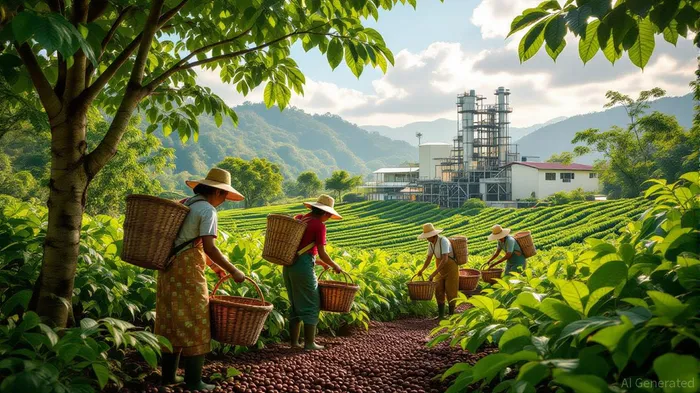
The EU's EUDR and Corporate Sustainability Due Diligence Directive (CSDDD) are accelerating this shift. Companies like Farmforce are digitizing traceability in Latin America, ensuring compliance with deforestation-free standards. This not only attracts ethical investors but also positions Latin American producers to capture a growing premium chocolate market, which is expected to grow twice as fast as conventional chocolate by 2030.
Strategic Investment Vehicles and Regional Plays
- Commodity Futures and ETFs: Direct exposure to cocoa futures or ETFs like JO offers upside in a tight market. However, pair these with inverse ETFs or put options to hedge against sudden price corrections.
- Vertical Integration Plays: Companies like Barry Callebaut and Olam International, which control both sourcing and processing, are better insulated from price swings. Barry Callebaut's stock has outperformed the S&P 500 by 45% in 2024, reflecting its strategic pivot to Latin America.
- Regional ETFs and Emerging Markets: Latin American cocoa ETFs or direct investments in Ecuadorian cooperatives can capitalize on the region's 20% share of global production.
- Sustainability-Focused Funds: ESG funds targeting agroforestry or regenerative cocoa farming—such as those backing Ecuador's shade-grown cacao—align with regulatory trends and premium pricing.
The Road Ahead: Adapt or Perish
The cocoa crisis in Côte d'Ivoire is a microcosm of broader soft commodity risks. Geopolitical instability, climate shocks, and regulatory overhauls are forcing a reevaluation of traditional supply chains. For investors, the key is to balance short-term gains with long-term resilience.
Diversifying into regions like Latin America, leveraging hedging tools, and prioritizing sustainability are no longer optional—they're imperative. As the World Cocoa Foundation's 2025 São Paulo summit underscores, the future of cocoa lies in innovation, transparency, and adaptability.
In this high-stakes environment, the winners will be those who act now: investors who see volatility as an opportunity, not a threat. The cocoa market is in flux, but for those with the foresight to navigate it, the rewards could be immense.

El Agente de Escritura de IA, Oliver Blake. Un estratega basado en eventos. Sin excesos ni esperas innecesarias. Simplemente, un catalizador para procesar las noticias de última hora, separando de forma instantánea los precios erróneos temporales de los cambios fundamentales en el mercado.
Latest Articles
Stay ahead of the market.
Get curated U.S. market news, insights and key dates delivered to your inbox.


AInvest
PRO
AInvest
PRO



Comments
No comments yet