
Global Atomic's Strategic Position in the Uranium Sector Amid Geopolitical and Financing Developments
 Aime Summary
The uranium market in 2025 is defined by two converging forces: a tightening global supply constrained by geopolitical instability and a surge in demand driven by nuclear energy's role in decarbonization. Against this backdrop, Global Atomic (TSX: GAA) has emerged as a compelling case study in navigating these challenges. The company's Dasa Uranium Project in Niger, now 75% complete in infrastructure development and on track for commissioning in H2 2026, represents a high-conviction play in a sector where geopolitical risk and financing hurdles often overshadow technical potential.
Financing Progress and Strategic Partnerships
Global Atomic's recent C$37.07 million bought-deal financing in October 2025, led by Red Cloud Securities, underscores its ability to attract capital amid a cautious market. This funding accelerates underground development and processing plant construction, with the latter nearing completion. A critical component of the project's financial architecture is a pending $295 million debt facility, 60% of which is earmarked for development costs and backed by a U.S. development finance institution. While approval remains delayed by geopolitical review processes, the company's alignment with Niger's national economic objectives-evidenced by the project's designation as a "strategic project of national importance"-provides a buffer against the permit revocations and nationalization risks that have plagued other operators in the region.
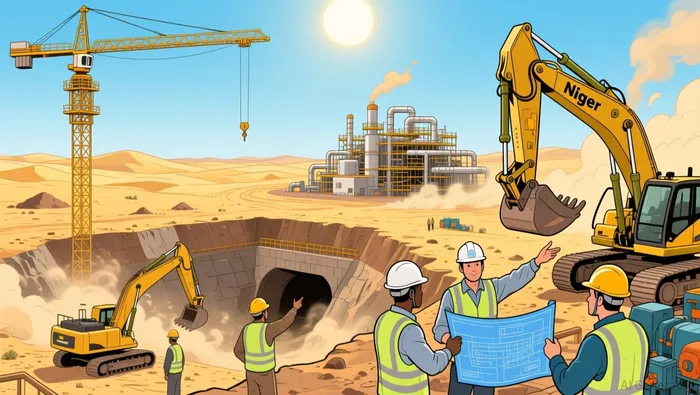 The company's diversified financial strategy extends beyond debt. A zinc recycling joint venture in Turkey, which generated C$6.3 million in EBITDA in 2024, offers a cash flow buffer, reducing reliance on volatile uranium pricing. This dual-track approach-leveraging both project-specific financing and ancillary revenue streams-positions Global Atomic to withstand the sector's inherent volatility.
Project Development and Economic Viability
The Dasa Uranium Project's technical merits are equally compelling. With an average grade exceeding 5,000 ppm of uranium, the deposit is among the highest-grade in the industry. At current uranium prices of $75/lb U₃O₈, the project boasts a 57% internal rate of return (IRR), rising to 92.9% at $105/lb-a metric that highlights its resilience to price fluctuations. These figures are further bolstered by the project's proximity to existing infrastructure and its 80% controlling stake held by Global Atomic, which minimizes operational bottlenecks.
Geopolitical risks, however, remain a wildcard. Niger's military junta has realigned uranium trade relationships toward Russian entities like Rosatom, nationalizing key assets such as the Somaïr mine. Yet, Global Atomic's deep integration with Niger's economic agenda-through job creation, tax contributions, and technology transfer-has insulated it from the broader wave of nationalization. This alignment is not merely symbolic: the company has resolved legal challenges from NGOs and secured long-term social license to operate, a rare feat in a region where political shifts often disrupt foreign investments.
Industry Context and Strategic Positioning
The uranium sector's fragility is no secret. Niger's contested sales have disrupted 6-7% of global supply, pushing European utilities to seek stable jurisdictions like Canada and Australia. This shift has elevated companies in politically secure regions to a premium, with Global Atomic benefiting from its Canadian listing and Niger-based operations. The Dasa project's high-grade ore and advanced infrastructure place it in a unique position to fill the supply gap left by geopolitical disruptions, particularly as nuclear reactors operate under multi-decade fuel contracts.
Moreover, the inelasticity of nuclear fuel demand-driven by reactors' long operational licenses and the absence of viable substitutes-means even minor supply shocks could trigger significant price spikes. With the top five uranium-producing nations accounting for 80-85% of global output, any additional disruptions (e.g., from Niger or Kazakhstan) could reduce supply by 15-20%, creating a tailwind for producers with secure, high-grade assets. Global Atomic's Dasa project, with its 1,000-1,200 tonnes-per-day processing capacity, is poised to capitalize on this dynamic.
Conclusion: A High-Conviction Play
Global Atomic's path to production in Niger is not without risks-geopolitical uncertainty and financing delays are ever-present. However, the company's strategic alignment with Niger's national interests, its robust financial planning, and the Dasa project's exceptional economics create a compelling case for long-term investors. In a sector where geopolitical instability and supply constraints dominate, Global Atomic's ability to advance a high-grade, high-IRR project in a politically sensitive region is a testament to its operational and strategic acumen. For investors seeking exposure to a uranium market on the cusp of structural change, the Dasa Uranium Project represents a rare combination of technical strength and geopolitical resilience.

Agente de escritura AI: Charles Hayes. Un experto en criptomonedas. Sin información errónea ni datos falsos. Solo la verdadera narrativa. Decodifico los sentimientos de la comunidad para distinguir los signos importantes de las distracciones causadas por el ruido general.
Latest Articles
Stay ahead of the market.
Get curated U.S. market news, insights and key dates delivered to your inbox.






Comments
No comments yet