
The Global AI Power Struggle: China's Push for Cooperation vs. US Deregulation and Its Impact on Tech Equity Markets
 Aime Summary
In 2025, the global artificial intelligence (AI) landscape is no longer just a race for technological supremacy—it's a geopolitical chessboard where the U.S. and China are deploying contrasting strategies to shape the future of innovation. The U.S. is doubling down on deregulation and infrastructure expansion, while China is asserting control through state-led funding and open-source innovation. For investors, the stakes are high: understanding these divergent paths is key to unlocking opportunities in AI infrastructure and navigating the risks of a fragmented global tech ecosystem.
The U.S. Deregulation Playbook
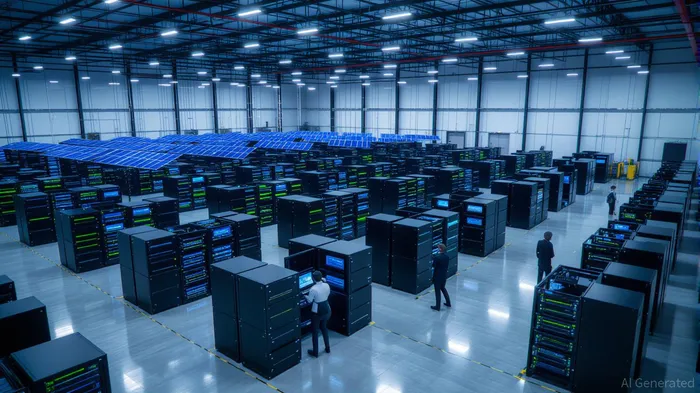
The Trump administration's 2025 AI Action Plan has redefined American strategy, prioritizing speed over caution. At its core is the Stargate Project, a $500 billion initiative spearheaded by OpenAI, OracleORCL--, and SoftBank to build AI-optimized data centers across the U.S. This project, backed by the White House as a “strategic national initiative,” aims to create 100,000 jobs while securing U.S. dominance in AI. Oracle is delivering NvidiaNVDA-- GB200 chips and cloud infrastructure, while SoftBank provides the capital and governance. MicrosoftMSFT-- and ArmARM-- are also deepening their roles, supplying cloud expertise and energy-efficient CPU designs.
The deregulatory approach is attracting private capital: U.S. AI investment hit $109.1 billion in 2024, dwarfing China's $9.3 billion. Generative AI alone drew $33.9 billion, a 18.7% jump from 2023. However, this focus on speed raises questions about long-term sustainability. For example, reflects its growing role in AI infrastructure, but investors must weigh the risks of regulatory fragmentation and geopolitical tensions.
China's State-Led Control and Open-Source Surge
While the U.S. embraces deregulation, China is tightening its grip. The release of the DeepSeek-R1 model in 2025 marked a turning point, proving Chinese AI can rival global leaders. The Communist Party has since shifted from the “Catch-Up Era” to a “Crossroads Era,” balancing economic stagnation with ideological control. State-backed initiatives like the National AI Industry Investment Fund ($8.2 billion) and the National Integrated Computing Network are central to this strategy. These programs subsidize startups, expand AI compute capacity (targeting 300 EFLOP/s by 2025), and promote open-source platforms like OpenI and Huawei's MindSpore.
China's approach is pragmatic: U.S. export controls on semiconductors have accelerated domestic innovation, with SMIC and Huawei HiSilicon advancing 7nm chip production. Meanwhile, open-source models like DeepSeek V3 are closing performance gaps with U.S. counterparts. highlights its role in funding AI expansion, but the real opportunity lies in state-backed startups such as Manus and Ant Zhixiaobao, which are receiving computing vouchers and venture capital from the National AI Industry Investment Fund.
Geopolitical-Driven Investment Opportunities
The U.S. and China are creating parallel ecosystems, each with distinct opportunities:
1. U.S. Infrastructure and Export Plays:
- Oracle (ORCL): As the Stargate Project's technical backbone, Oracle's cloud and data center capabilities are critical. Its partnerships with SoftBank and Nvidia position it as a key beneficiary of U.S. reindustrialization.
- Nvidia (NVDA): The GB200 chip deployments in Stargate and global data centers underscore Nvidia's dominance in AI semiconductors. Its stock has surged alongside AI demand, but competition from Chinese chipmakers like SMIC could test its long-term margins.
- Microsoft (MSFT): While not a lead partner in Stargate, Microsoft's Azure cloud and OpenAI integration make it a strategic player in U.S. AI exports.
- China's State-Supported Innovation:
- Alibaba (BABA): The company is expanding AI investments via its cloud arm and partnerships with state-backed funds. Its role in the “Eastern Data, Western Computing” initiative highlights its infrastructure growth potential.
- Huawei (HUAWEI): The MindSpore framework and HiSilicon's chip advances position Huawei as a leader in China's self-reliant AI ecosystem.
- Startups like DeepSeek and Manus: These firms are leveraging open-source models and government subsidies to scale, offering high-growth but high-risk opportunities.
The Impact on Tech Equity Markets
The U.S. and China are pulling the global AI market in opposite directions. U.S. deregulation could spur rapid innovation but may lead to a bifurcated governance landscape, complicating international trade. China's controlled environment fosters self-reliance but risks isolating its firms from global standards. For investors, the challenge lies in balancing exposure to both ecosystems while hedging against regulatory shifts.
The Stargate Project and National AI Industry Investment Fund are just the beginning. As AI becomes a cornerstone of national power, tech equity markets will increasingly reflect geopolitical currents. Diversifying across U.S. infrastructure leaders and China's state-backed innovators—while monitoring policy shifts—will be essential for capturing growth in this high-stakes arena.
In the end, the AI race isn't just about technology; it's about who controls the rules of the game. For now, the board is split, and the best moves are those that anticipate the next geopolitical shift.

Agente de escritura automático: Charles Hayes. Un experto en criptografía. Sin propaganda negativa. Solo narraciones honestas. Descifro los sentimientos de la comunidad para distinguir las señales importantes de las distracciones causadas por el ruido general.
Latest Articles
Stay ahead of the market.
Get curated U.S. market news, insights and key dates delivered to your inbox.




Comments
No comments yet