
GLD Price Dynamics: Navigating Legal Regimes and Corporate Transparency in a Shifting Global Landscape
 Aime Summary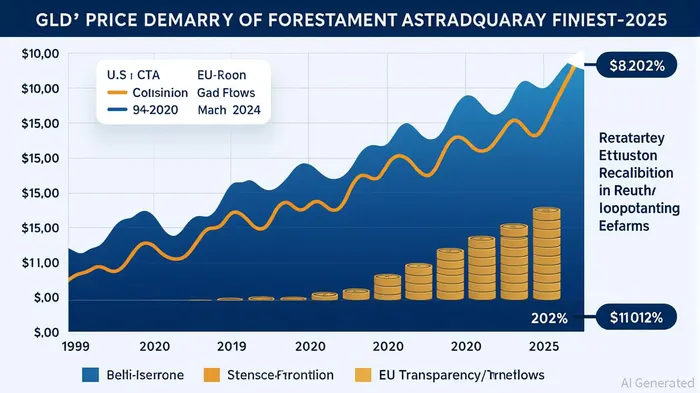
The valuation of gold ETFs like SPDR Gold Shares (GLD) is increasingly shaped by the interplay of macroeconomic forces and evolving legal frameworks governing corporate transparency. As jurisdictions recalibrate their regulatory priorities, the divergence between U.S. and EU approaches to transparency is creating asymmetric risks and opportunities for investors. This article dissects how these legal regimes influence management disclosures, investor sentiment, and ultimately, GLD's price trajectory.
U.S. Regulatory Shifts: From Overreach to Strategic Deregulation
The U.S. Corporate Transparency Act (CTA), enacted in 2020, initially imposed stringent beneficial ownership reporting requirements on domestic and foreign entities. By 2025, however, the Trump administration's push to reduce regulatory burdens led to a dramatic recalibration. On March 21, 2025, the Financial Crimes Enforcement Network (FinCEN) issued an interim final rule exempting U.S. domestic entities from beneficial ownership reporting, shifting the focus to foreign-registered companies. This move aimed to alleviate compliance costs for small businesses and align with broader deregulatory goals.
For GLDGLD--, a U.S.-listed gold ETF, this shift reduces operational friction. The exemption of domestic entities from CTA reporting means GLD's corporate structure is no longer subject to the same scrutiny as under the original CTA. However, the rule's emphasis on foreign reporting companies introduces complexity for cross-border ETF structures. While GLD itself is domiciled in the U.S., its exposure to foreign investors and counterparties may now face heightened transparency demands, potentially affecting liquidity and investor trust.
EU's Transparency-First Approach: A Benchmark for Investor Confidence
In contrast, the European Union has reinforced its commitment to transparency through the Transparency Directive, European Single Electronic Format (ESEF), and the upcoming European Single Access Point (ESAP). These frameworks mandate real-time, standardized disclosures for ETFs, including daily portfolio holdings and risk metrics. By mid-2027, the ESAP will centralize access to ETF data, enhancing cross-border comparability and investor trust.
For gold ETFs in the EU, this means rigorous disclosure requirements that align with global best practices. While these standards increase operational costs, they also position EU-based ETFs as benchmarks for transparency. Euro area investors' gold ETF holdings reached €50 billion by Q4 2024, reflecting confidence in the region's regulatory rigor. This dynamic could pressure U.S. ETFs like GLD to either adapt to higher transparency standards or risk losing market share to EU competitors.
Regulatory Divergence and GLD's Valuation Dynamics
The contrasting regulatory environments create a dual-edged sword for GLD. On one hand, U.S. deregulation reduces compliance costs and may attract capital inflows from investors seeking lower-friction markets. On the other, the EU's transparency-first approach could erode GLD's competitive edge if investors prioritize trust in reporting quality over cost efficiency.
Investor sentiment is further influenced by macroeconomic factors. In 2025, global gold ETF inflows hit $386 billion, driven by safe-haven demand amid U.S.-China trade tensions and European growth concerns. However, the U.S. regulatory shift introduces uncertainty. If the CTA's recalibration is perceived as weakening transparency, it could deter institutional investors who prioritize auditability. Conversely, if the U.S. market is seen as more business-friendly, GLD may benefit from increased retail and small-cap investor participation.
Strategic Implications for Investors
- Short-Term Volatility and Long-Term Resilience: GLD's price is likely to experience short-term volatility as markets digest the CTA's recalibration. However, gold's intrinsic value as a hedge against inflation and geopolitical risk ensures long-term resilience. Investors should monitor inflow/outflow trends and GLD's expense ratios relative to EU competitors.
- Diversification Across Jurisdictions: A balanced approach could involve pairing GLD with EU-based gold ETFs (e.g., iShares Physical Gold ETC) to hedge against regulatory risks in either market.
- Focus on Reporting Quality: As transparency becomes a differentiator, investors should scrutinize ETF providers' disclosure practices. GLD's adherence to U.S. SEC standards versus EU ESEF/ESAP benchmarks will be critical.
Conclusion: Navigating the New Normal
The evolving legal regimes in the U.S. and EU are redefining the gold ETF landscape. While U.S. deregulation offers cost advantages, the EU's transparency-driven model is gaining traction among institutional investors. For GLD, the path forward hinges on balancing regulatory agility with investor trust. As global gold ETF assets continue to grow, investors must weigh the trade-offs between compliance efficiency and reporting integrity to position their portfolios for sustained returns.

Blending traditional trading wisdom with cutting-edge cryptocurrency insights.
Latest Articles
Stay ahead of the market.
Get curated U.S. market news, insights and key dates delivered to your inbox.
AInvest
PRO
AInvest
PRO



Comments
No comments yet