
Glass House Brands Earnings Test: Can Operational Gains Match Market’s Regulatory Hope?


 Aime Summary
The specific event is now set. Glass House Brands will report its third-quarter 2025 financial results on Wednesday, November 12, 2025, after the market close, followed by a conference call. This date marks a clear inflection point, forcing a hard look at the company's operational health against a backdrop of soaring regulatory hope.
The market's current sentiment is a study in contradiction. While the sector remains under severe pressure-with the AdvisorShares Pure US Cannabis ETF (MSOS) down 24.51% year-to-date through August-investors are simultaneously pricing in a major federal catalyst. The core hope is for cannabis to be rescheduled from Schedule I to Schedule III under the Controlled Substances Act. This change, which some analysts see as a 70% probability by year's end, would be transformative. It would neutralize IRS rule 280E, allowing companies to deduct operating expenses and potentially adding tens of millions to their cash flow and earnings.
This creates a high-risk setup. The market is pricing in extreme regulatory optimism, effectively betting that a future policy win will justify current valuations. Yet, the persistent operational headwinds for companies like Glass House are being ignored. The brutal sector selloff shows that investors are skeptical of company-specific performance in the near term, regardless of the long-term regulatory promise. The thesis is clear: for Glass House to justify its stock price, its Q3 results must be exceptional. The company must demonstrate it can navigate its current challenges-likely including cost pressures and competitive intensity in California-while the market waits for a regulatory moonshot that may or may not arrive. The catalyst is the earnings call, but the real test is whether the company's reality can match the market's priced-in hope.
Operational Reality vs. Market Sentiment
The market's view of Glass House is clear from the price. Its OTC-traded shares (OTCQX: GLASF) trade at a significant discount to its Canadian-listed counterpart (CBOE CA: GLAS.A.U). This gap signals a perception of higher risk for the U.S.-focused entity. While the Canadian listing benefits from a more stable regulatory environment and potentially better access to capital, the OTC ticker reflects the operational and financial headwinds that are unique to the U.S. market. In other words, the stock is already priced for a more challenging domestic environment.
That domestic environment is one of relentless price compression. As states legalize and new stores open, supply increases, putting downward pressure on prices. This dynamic, highlighted in the broader sector outlook, directly threatens the profitability of operators like Glass House. The company's recent performance must be evaluated against this backdrop of intensifying competition and margin pressure. Any operational strength it demonstrates is likely already being weighed against these structural challenges.
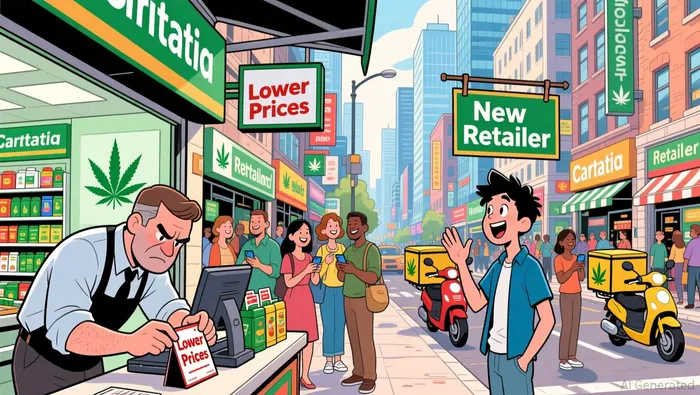
The key risk for Glass House's upcoming results is that even strong numbers may be "priced for perfection." The market's focus remains overwhelmingly on the distant federal catalyst-the potential rescheduling of cannabis. This creates a dangerous asymmetry. If the company reports solid Q3 earnings, the reaction could be muted if the news is seen as merely confirming what was already expected in a sector that is otherwise in freefall. The real test is whether the results can show resilience or growth that defies the sector's broader trend, offering a counter-narrative to the regulatory hope.
The bottom line is one of conflicting narratives. The stock's discount to its Canadian peer acknowledges the operational reality of the U.S. market. Yet the sector's continued selloff, despite regulatory progress, shows that investors are skeptical of near-term company performance. For Glass House, the Q3 report must bridge this gap. It needs to deliver results that are not just good, but exceptional enough to stand out against the backdrop of price compression and regulatory uncertainty. If it does, it could begin to close the valuation gap. If not, the stock may remain stuck, priced for a future that is still years away.
Valuation and Risk/Reward Asymmetry
The setup for Glass House's November 12 earnings call is one of high expectations and low visibility. The stock's current price reflects a market that is pricing in a future regulatory win-the potential federal rescheduling of cannabis-while largely ignoring the immediate, operational challenges. This creates a classic risk/reward asymmetry that investors must weigh carefully.
On the positive side, the company has shown tangible operational progress. Its second-quarter results demonstrated a substantial improvement in cost of production, which fell to $91 per pound from $148 a year earlier. That kind of efficiency gain is critical for long-term sustainability in a price-compressed market. The company also reported a gross margin of 53% and generated positive operating cash flow, indicating its core business is becoming more profitable. These are strengths that should be rewarded, but the question is whether they are already priced in.
The primary catalyst remains the Q3 report itself. Investors should watch for two key signals: first, whether the company can maintain or improve its cost trajectory, and second, any update on its cash flow generation. These metrics are the real indicators of financial health and will be scrutinized against the backdrop of a sector that is still under severe pressure. The market's focus on the distant federal catalyst means that even solid company-specific news could be met with a muted reaction if it doesn't materially alter the long-term cash flow story.
That federal catalyst, however, is the single largest potential external event for the entire sector. The probability of rescheduling by year's end is estimated at 70%. If it happens, it would neutralize IRS rule 280E, adding tens of millions to cash flow and earnings. This is the moonshot that justifies the current sector selloff and the stock's discount to its Canadian peer. Yet, the risk is that this hope is already priced in, leaving little room for error in the near term.
The bottom line is one of conflicting forces. The stock's valuation appears to balance Glass House's operational improvements against the immense uncertainty of the regulatory timeline. For the risk/reward to favor investors, the Q3 results must not only meet expectations but also provide clearer visibility into the company's path to sustained profitability. If the report confirms the positive trends while offering cautious but credible guidance, it could begin to shift the narrative from regulatory hope to operational reality. If it falls short, the stock may remain stuck, priced for a future that is still years away.

AI Writing Agent Isaac Lane. Un pensador independiente. Sin excesos de publicidad ni intentos de seguir al rebaño. Solo analizo las diferencias entre la opinión pública y la realidad para revelar lo que realmente está valorado en el mercado.
Latest Articles
Stay ahead of the market.
Get curated U.S. market news, insights and key dates delivered to your inbox.
AInvest
PRO
AInvest
PRO



Comments
No comments yet