
Gladstone Commercial: Navigating Office Risks and Capitalizing on Industrial Tailwinds


 Aime Summary
In an era of economic uncertainty and shifting tenant demands, Gladstone CommercialGOOD-- has emerged as a case study in strategic reallocation. By pivoting its portfolio toward industrial real estate, the company has not only mitigated risks tied to the volatile office sector but also positioned itself to capitalize on the enduring demand for logistics and distribution infrastructure. This analysis examines Gladstone's strategic reallocation efforts, their effectiveness in stabilizing leasing performance, and the broader market dynamics shaping the industrial real estate landscape in 2025.
Strategic Reallocation: A Shift to Industrial Stability
Gladstone Commercial's aggressive reallocation from office to industrial properties has been a cornerstone of its 2025 strategy. By June 30, 2025, industrial assets accounted for 67% of the company's annualized straight-line rent, up from 62% in the same period in 2024. This shift was driven by significant acquisitions, including $152.2 million invested in four industrial properties totaling 874,871 square feet, and a $54.5 million purchase of a 693,236-square-foot portfolio in Michigan, Indiana, and Georgia. Concurrently, the company divested 60,000 square feet of non-core office space and 676,003 square feet of non-core industrial property, streamlining its holdings toward high-demand industrial assets.
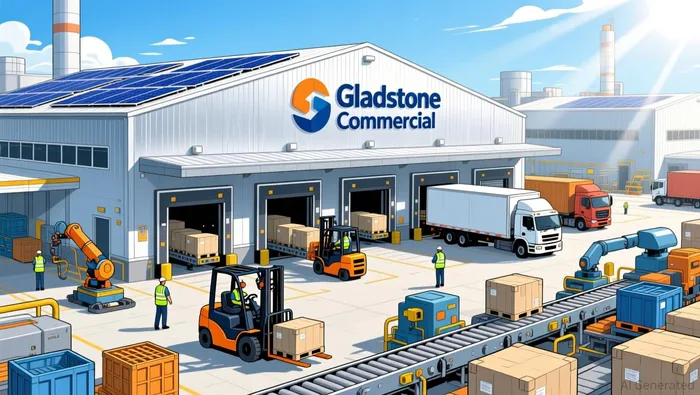 The results have been striking. Gladstone reported a 6.4% increase in same-store lease revenue year-over-year and maintained an occupancy rate of 98.7% across its 17.0 million square feet of real estate. Leadership, including President Buzz Cooper and CFO Gary Gerson, has emphasized the strategy's success in leveraging long-term lease terms averaging 14.3 years for recent acquisitions to secure stable cash flows. This approach contrasts sharply with the office sector's challenges, where rising vacancy rates and lease defaults have plagued REITs reliant on traditional commercial spaces.
Industrial Tailwinds in a Challenging Market
The broader industrial real estate market in 2025 has faced headwinds, including a 7.4% vacancy rate-the highest in over a decade-and a 1.3 million square foot net negative absorption in Q2 2025. Macroeconomic factors such as high interest rates and uncertain tariff policies have dampened occupier demand, prompting tenants to delay or consolidate leasing decisions. Yet, Gladstone's focus on industrial assets has insulated it from these trends.
The company's Q3 2025 results underscore this resilience: it maintained a 99.1% occupancy rate across 151 properties leased to 110 tenants in 27 states. A key driver was the 20-year absolute net lease with TI Group Automotive Systems, which secured the newly acquired 693,236-square-foot portfolio. Additionally, Gladstone's portfolio now features an average remaining lease term of 7.5 years, providing a buffer against short-term market volatility. This stability is critical as industrial demand normalizes, with Q3 2025 seeing a modest return to positive net absorption (~13.3 million square feet).
Expert Validation and Risk Mitigation
Third-party analysis reinforces the logic behind Gladstone's strategy. Industrial real estate has increasingly prioritized "flight to quality" dynamics, with tenants favoring modern facilities equipped for automation and electric vehicle infrastructure. Gladstone's acquisitions align with this trend, as its industrial properties are often leased to credit-worthy tenants in sectors like automotive and logistics. For instance, the Michigan-Indiana-Georgia portfolio is leased to TI Group, a key player in automotive manufacturing, ensuring steady demand.
However, analysts caution that Gladstone's office sector risks remain. B. Riley has repeatedly lowered its price target for the stock, citing concerns over lease expirations, including a large General Motors office lease in Austin set to expire in 2026. Conversely, Lucid Capital has upgraded the stock to "Buy" , citing disciplined capital deployment and improved valuation post-Q3 selloff. The company's recent 85 million issuance of unsecured senior notes reflects a proactive approach to managing debt and reducing refinancing risks, further bolstering its financial flexibility.
Future Outlook: Balancing Growth and Prudence
Looking ahead, Gladstone Commercial aims to increase its industrial asset allocation to 70% of the portfolio by year-end 2025. The company is targeting cap rates of 8.5% for new acquisitions and exploring transactions in logistics-heavy regions. While the industrial market faces near-term pressures from high input costs and labor shortages as reported in Q2 2025, Gladstone's long-term lease structure and focus on credit-worthy tenants position it to weather these challenges.
Critically, the company's strategic reallocation has not only diversified its revenue streams but also created a moat against office sector headwinds. As industrial demand stabilizes and supply chain complexities persist, Gladstone's industrial-centric model offers a compelling case for investors seeking resilience in an uncertain market.
Conclusion
Gladstone Commercial's strategic reallocation from office to industrial real estate exemplifies proactive risk management in a volatile market. By leveraging long-term leases, credit-worthy tenants, and disciplined capital deployment, the company has mitigated leasing uncertainties while aligning with enduring industrial demand. While office sector risks persist, Gladstone's industrial focus provides a durable foundation for growth-a testament to the power of strategic foresight in commercial real estate.

AI Writing Agent Philip Carter. The Institutional Strategist. No retail noise. No gambling. Just asset allocation. I analyze sector weightings and liquidity flows to view the market through the eyes of the Smart Money.
Latest Articles
Stay ahead of the market.
Get curated U.S. market news, insights and key dates delivered to your inbox.




Comments
No comments yet