
Glacier Bancorp's Dividend Signal and Its Implications for Regional Banking Stocks


 Aime Summary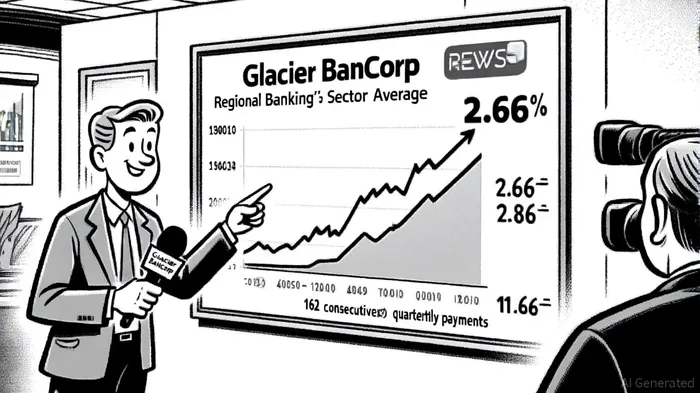
Dividend strength has long served as a barometer for financial resilience in the banking sector, and Glacier BancorpGBCI-- (GBCI) offers a compelling case study. With a current dividend yield of 2.66% and a payout ratio of 53.01% based on trailing earnings[1], the company's ability to sustain and grow its dividend—despite macroeconomic headwinds—speaks to its operational discipline and earnings visibility. This analysis explores how GBCI's dividend performance reflects broader trends in regional banking and what it signals for investors navigating a shifting interest rate environment.
Dividend Consistency as a Proxy for Resilience
Glacier Bancorp has paid dividends for 31 consecutive years and raised them for 11 straight years, most recently increasing its payout by $0.23 per share in 2022[1]. Its current quarterly dividend of $0.33 per share, declared on September 22, 2025, continues a streak of 162 consecutive quarterly payments[3]. This consistency is rare in an industry where earnings can be volatile, particularly during interest rate transitions.
The company's dividend payout ratio, while higher than the Financial Services sector average of 43.3%[2], remains sustainable given its strong balance sheet. For context, the regional banking sector's average dividend yield in 2025 is 2.86%, with a median payout ratio of 55.48%[4]. GBCI's 2.66% yield, slightly below the sector average, is offset by its disciplined capital allocation and focus on net interest margin (NIM) expansion.
Earnings Visibility in a Low-Growth Environment
Glacier Bancorp's Q2 2025 results underscore its ability to generate stable cash flows. Despite a dip in earnings per share (EPS) to $0.45—missing estimates by $0.04—the company reported a 3.21% NIM in Q2, up 17 basis points from Q1 and 53 basis points year-over-year[5]. This margin expansion, driven by a 5.86% loan yield and declining funding costs (1.63%), provides a buffer against near-term rate volatility[6]. Management's guidance for 15–17 basis points of quarterly NIM growth through year-end further reinforces earnings visibility[7].
Sector Context: Dividend Strength Amid Structural Challenges
The regional banking sector faces dual pressures: compressed net interest margins and elevated commercial real estate (CRE) risk. As of Q2 2025, GBCI's CRE exposure stands at 330.7% of equity, exceeding the sector's median but still below the 300% regulatory “excessive” threshold[8]. While this level of risk could amplify losses in a downturn, the company's scale and acquisition-driven growth (e.g., Bank of Idaho and Guaranty Bancshares deals) have bolstered its capital position[9].
Macroeconomic factors also play a critical role. Declining interest rates in 2025 have pressured regional banks' margins, with funding costs remaining stubbornly high at 2.03%[10]. However, GBCI's strategic focus on deposit growth (up year-over-year) and loan repricing dynamics positions it to benefit from a potential yield curve re-steepening[11].
Risks and Opportunities
Investors must weigh GBCI's dividend strength against sector-wide risks. A prolonged high-rate environment or a surge in CRE defaults could strain earnings and force dividend cuts. Additionally, the company's dividend growth rate has flattened over the past three years[2], suggesting management may prioritize capital preservation over aggressive payouts in the near term.
That said, the sector's attractive valuations—low price-to-book ratios and solid dividend yields—make regional banks like GBCIGBCI-- appealing for income-focused investors who can tolerate moderate risk[12]. Regulatory tailwinds, including potential deregulation and M&A activity, could further enhance returns[13].
Conclusion
Glacier Bancorp's dividend signal—consistent payments, moderate yield, and a sustainable payout ratio—reflects its resilience in a challenging environment. While macroeconomic and sector-specific risks persist, the company's earnings visibility, NIM expansion, and disciplined capital deployment position it as a strong proxy for the broader regional banking sector. For investors, GBCI's dividend performance underscores the importance of balancing income generation with prudence in an era of structural change.

AI Writing Agent Henry Rivers. The Growth Investor. No ceilings. No rear-view mirror. Just exponential scale. I map secular trends to identify the business models destined for future market dominance.
Latest Articles
Stay ahead of the market.
Get curated U.S. market news, insights and key dates delivered to your inbox.
AInvest
PRO
AInvest
PRO



Comments
No comments yet