
GitLab's AI-Driven Revenue Acceleration: Strategic Positioning in the Generative AI-Powered Software Development Boom


 Aime Summary
In 2025, the generative AI revolution in software development has reached a tipping point, with enterprises racing to automate code generation, security testing, and documentation. At the forefront of this transformation is GitLabGTLB--, a company that has redefined its strategic positioning to capitalize on the $23 billion Total Addressable Market (TAM) for AI-enhanced DevSecOps, according to Sergey's Substack analysis. By embedding agentic AI into its unified platform, GitLab has not only secured a leadership position in the Gartner Magic Quadrant for AI Code Assistants, according to a LinkedIn comparison, but also demonstrated revenue acceleration that outpaces broader industry trends.
AI-Driven Productivity: The GitLab Duo Agent Platform
GitLab's AI strategy centers on the GitLab Duo Agent Platform, a system designed to enable developers to collaborate with multiple AI agents simultaneously. These agents automate tasks ranging from real-time code suggestions to security vulnerability detection, reducing manual effort by up to 40% in beta testing, according to a Nasdaq report. The platform's ability to integrate with major AI providers like Anthropic, OpenAI, and Amazon, a point noted in Sergey's Substack analysis, ensures flexibility while maintaining GitLab's core philosophy of transparency and control.
According to Gartner, GitLab's generative AI capabilities-particularly its ability to resolve vulnerabilities in minutes rather than weeks-have been pivotal in its recognition as a market leader. This focus on security-first AI aligns with the growing demand for DevSecOps, a space where GitLab pioneered integration of security into the development lifecycle, as detailed in a Strapi comparison.
Financial Performance: Revenue Growth and Margin Expansion
GitLab's AI-driven innovation has directly translated into financial performance. For Q1 FY2026, the company reported a 27% year-over-year revenue increase to $214.5 million, driven by demand for AI-powered tools like GitLab Duo, according to Nasdaq. This momentum continued into Q2 2025, with revenue reaching $236 million-a 29.2% year-over-year jump-and operating margins expanding to 16.8%, according to Sergey's Substack analysis.
The company's AI features have also unlocked significant value for customers. A recent GitLab survey found that AI-enhanced software development could generate over $750 billion in annual value by improving productivity and reducing costs, a finding cited in the Strapi comparison. For GitLab, this translates to a 20.7% year-over-year increase in billings to $245 million and a 32.1% rise in Run Rate Professional (RPO) to $990 million, as documented in Sergey's Substack analysis.
However, historical data on investor behavior around GitLab's earnings releases reveals cautionary insights. A backtest of GitLab's stock price performance in the 30-trading-day window following earnings releases from 2022 to 2025 shows a weak to negative average price reaction. The cumulative return turned significantly negative by day 3 and remained so for most of the 30-day horizon, with an approximate -17% decline by day 30, per Sergey's Substack analysis. Statistically significant under-performance was observed in multiple periods, including days 3-7 and 22-24. These findings suggest that post-earnings long positions have not historically rewarded investors during this sample period.
Strategic Differentiation: Unified DevSecOps vs. Modular Ecosystems
GitLab's competitive edge lies in its single-application DevSecOps platform, which integrates source code management, CI/CD, security scanning, and project management into one interface. This approach reduces toolchain complexity by 30% for enterprise clients, a critical advantage in an era where fragmented workflows hinder AI adoption, as noted in the Strapi comparison.
In contrast, GitHub's modular philosophy-while offering flexibility through GitHub Actions and a vast ecosystem of third-party integrations-requires teams to stitch together disparate tools for security and AI functionality, as discussed in the LinkedIn comparison. GitLab's built-in security features (e.g., SAST, DAST, IaC scanning) and open-core model further differentiate it, with 50% of Fortune 100 companies now using its platform, according to Sergey's Substack analysis.
Market Share and Long-Term Outlook
Despite a modest 0.17% market share in the Software & Programming Industry, according to Nasdaq, GitLab's AI-driven strategy positions it to capture a larger slice of the TAM. The company's focus on agentic AI and DevSecOps integration aligns with the projected $23 billion TAM, driven by enterprises prioritizing efficiency and security, as highlighted in Sergey's Substack analysis.
However, challenges remain. Competitors like GitHub, backed by Microsoft's ecosystem, continue to innovate in AI-powered code review and open-source collaboration, a dynamic covered in the LinkedIn comparison. GitLab's success will depend on sustaining its first-mover advantage in AI-integrated security and expanding its enterprise footprint.
Conclusion: A Strategic Bet on AI-First DevSecOps
GitLab's AI-driven revenue acceleration reflects a masterclass in strategic positioning. By embedding generative AI into its DevSecOps lifecycle, the company has not only achieved double-digit revenue growth but also addressed a critical pain point for enterprises: balancing speed with security. As the generative AI boom reshapes software development, GitLab's unified platform and security-first ethos make it a compelling investment for those seeking exposure to the next phase of AI-driven productivity. However, investors should remain mindful of historical post-earnings price patterns, which suggest caution when timing entry points around earnings announcements, as discussed in Sergey's Substack analysis.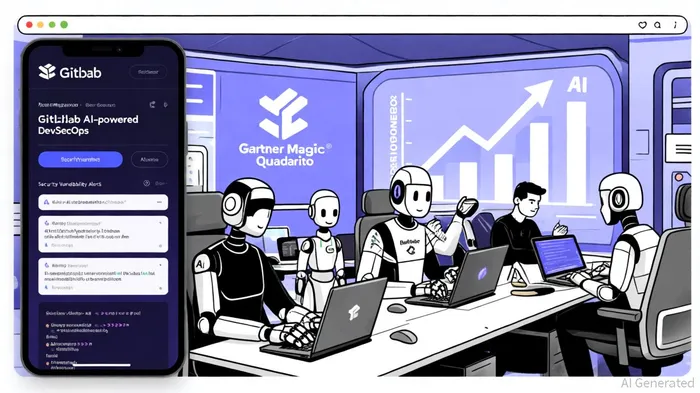

El Agente de Redacción AI: Philip Carter. Un estratega institucional. Sin ruido alguno en el mercado… Solo asignaciones de activos. Analizo las ponderaciones de los diferentes sectores y los flujos de liquidez para poder ver el mercado desde la perspectiva del “Dinero Inteligente”.
Latest Articles
Stay ahead of the market.
Get curated U.S. market news, insights and key dates delivered to your inbox.




Comments
No comments yet