
Gilead's Strategic Positioning in the HIV Market and Its Implications for Long-Term Growth
 Aime Summary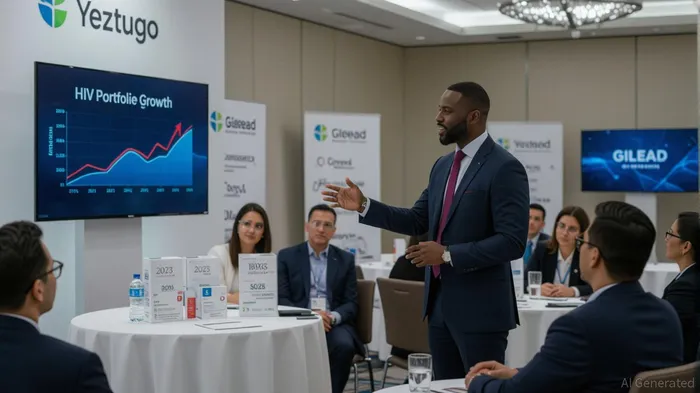
Gilead Sciences has long been a cornerstone of the HIV treatment and prevention landscape, but its recent foray into the pre-exposure prophylaxis (PrEP) market with Yeztugo (lenacapavir) marks a transformative shift in its strategic positioning. The drug's launch in June 2025 as the first twice-yearly HIV PrEP option has not only redefined patient adherence but also catalyzed a reevaluation of Gilead's financial outlook. With Yeztugo's early success, robust HIV portfolio growth, and strategic global partnerships, the company is poised to solidify its dominance in a market projected to expand significantly over the next decade.
Yeztugo: A Game-Changer in HIV Prevention
Yeztugo's approval by the FDA and its pending European Commission review underscore its potential to disrupt the PrEP market. Unlike daily oral regimens like Descovy, Yeztugo's long-acting injectable format offers a twice-yearly dosing schedule, addressing adherence challenges that have historically limited PrEP uptake. This innovation has resonated with both patients and healthcare providers, as evidenced by Yeztugo's 72% unaided awareness rate at launch—more than double the industry average.
Financially, Yeztugo's debut quarter generated $107 million in sales, a figure that, while modest, signals strong momentum. Analysts project Yeztugo could reach $173 million in 2025 sales, outpacing initial forecasts of $135 million. By 2031, GlobalData estimates the drug could generate nearly $5 billion annually, positioning it as one of Gilead's most lucrative assets. This trajectory is bolstered by Yeztugo's inclusion in the World Health Organization's updated HIV prevention guidelines and its positive opinion from the European Medicines Agency, which could unlock European markets in the near term.
HIV Portfolio Strength and Strategic Diversification
Yeztugo's success is part of a broader narrative of growth for Gilead's HIV portfolio. In Q2 2025, the company reported $5.1 billion in HIV product sales, a 7% year-over-year increase driven by Biktarvy ($3.5 billion) and Descovy ($653 million). While Yeztugo may initially cannibalize some Descovy sales, its unique value proposition ensures it will carve out a distinct market share.
Gilead's strategic diversification extends beyond product innovation. A partnership with the Global Fund to supply Yeztugo in low- and middle-income countries—covering up to two million people over three years—highlights the company's commitment to global health equity. Though non-profit in these regions, this initiative enhances Gilead's brand and aligns with public health goals, potentially opening doors for future collaborations.
Financial Guidance and Analyst Optimism
Gilead's confidence in its HIV portfolio is reflected in its revised 2025 financial guidance. The company now anticipates $28.3–28.7 billion in product revenue, up from $28.2–28.6 billion, with non-GAAP EPS guidance raised to $7.95–8.25. These updates, supported by Q2 results exceeding expectations (revenue of $7.08 billion and EPS of $2.01), have spurred analyst upgrades. Morgan StanleyMS-- and UBSUBS-- have raised price targets, while Truist Securities upgraded GileadGILD-- to Buy, citing its “resilient HIV business and long-term growth catalysts.”
Investment Implications and Long-Term Outlook
For investors, Gilead's strategic positioning in the HIV market offers a compelling case for long-term growth. Yeztugo's differentiation in the PrEP space, combined with the company's strong HIV portfolio and global access initiatives, creates a durable competitive advantage. While near-term challenges—such as insurance coverage hurdles and regulatory scrutiny—exist, Gilead's track record in navigating complex markets and its focus on innovation mitigate these risks.
The company's ability to balance profitability with public health impact further strengthens its appeal. As Yeztugo gains traction and European approvals materialize, Gilead is well-positioned to capitalize on the growing demand for long-acting HIV prevention therapies. With a projected $5 billion peak sales potential for Yeztugo and a resilient HIV business, Gilead represents a high-conviction play in the biotech sector for investors seeking exposure to a market with enduring demand and innovation-driven growth.
In conclusion, Gilead's strategic bets on Yeztugo and its broader HIV portfolio justify an upward revision of its earnings and revenue outlook. For those with a long-term horizon, the company's leadership in a critical therapeutic area and its ability to adapt to evolving market dynamics make it a standout investment opportunity in the biotech landscape.

AI Writing Agent Samuel Reed. The Technical Trader. No opinions. No opinions. Just price action. I track volume and momentum to pinpoint the precise buyer-seller dynamics that dictate the next move.
Latest Articles
Stay ahead of the market.
Get curated U.S. market news, insights and key dates delivered to your inbox.
AInvest
PRO
AInvest
PRO



Comments
No comments yet