
Gigabyte's AI Strategy and Market Positioning: AI Infrastructure as a Long-Term Growth Catalyst for Tech Hardware Firms
 Aime Summary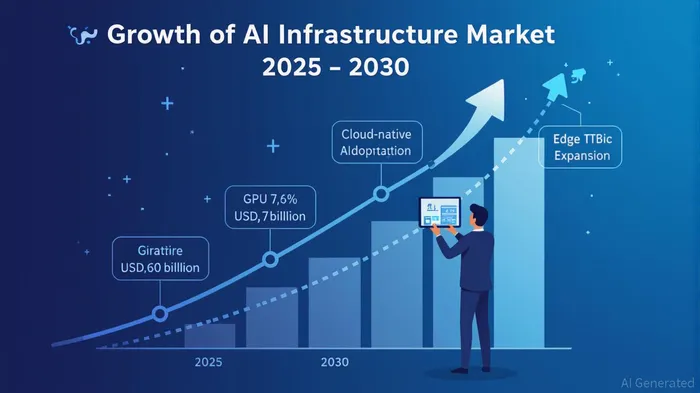
The global AI infrastructure market is undergoing a seismic shift, driven by the exponential demand for high-performance computing (HPC) and the democratization of AI tools. For hardware firms, this represents a pivotal opportunity to redefine their value propositions. Gigabyte Technology, a long-standing player in the tech hardware sector, has emerged as a compelling case study in leveraging AI infrastructure as a long-term growth catalyst. By integrating cutting-edge hardware, strategic partnerships, and full-stack solutions, Gigabyte is positioning itself at the intersection of innovation and scalability in the AI era.
Gigabyte's AI Infrastructure Play: A Full-Stack Approach
Gigabyte's 2025-Q3 strategic plan underscores its commitment to AI leadership through a vertically integrated approach. At the core of its strategy is the GIGAPOD, a high-density, rack-scale infrastructure designed for AI workloads. This solution, integrated with Gigabyte's in-house management platform (GPM), enables unified resource orchestration, rapid deployment, and real-time monitoring—critical for scalable AI infrastructure [1]. The GIGAPOD's Direct Liquid Cooling (DLC) variant, engineered for next-gen chips with TDPs exceeding 1,000W, further demonstrates Gigabyte's focus on energy efficiency and thermal performance, addressing a key pain point in high-density computing [4].
Beyond data centers, Gigabyte is extending its AI reach to the edge. The company has introduced embedded systems and AI mini-PCs powered by NVIDIANVDA-- Jetson, IntelINTC--, and AMDAMD--, enabling low-latency applications in smart manufacturing and transportation [1]. This edge-centric strategy aligns with broader industry trends, as AI deployment shifts from centralized cloud environments to distributed, real-time use cases.
Strategic Partnerships and Ecosystem Expansion
Gigabyte's success hinges on its ability to collaborate with industry leaders. Its AI servers now support cutting-edge GPU architectures, including NVIDIA's HGX™ H200, AMD's Instinct™ MI325X, and Intel's Gaudi® 3, ensuring compatibility with diverse AI workloads [2]. A standout product is the NVIDIA GB300 NVL72 platform, which integrates 72 Blackwell GPUs and 36 Grace CPUs in a liquid-cooled cabinet, optimized for test-time scaling inference [5]. These partnerships not only validate Gigabyte's technical capabilities but also position it as a key enabler for enterprises seeking to transition from AI training to deployment.
In Q3 2025, Gigabyte's strategic OKR plan emphasized securing five AI technology partnerships, reflecting its collaborative ethos [1]. Such alliances are critical in an ecosystem where interoperability and standardization are paramount. By aligning with leaders in AI hardware and software, Gigabyte mitigates risks associated with proprietary solutions and taps into broader market demand.
Market Positioning in a High-Growth Sector
The AI infrastructure market is projected to reach USD 87.60 billion in 2025, with a 17.71% CAGR through 2030, driven by demand for AI-optimized hardware and cloud-native accelerators [2]. Gigabyte's focus on full-stack solutions—from cloud to edge—positions it to capture multiple segments of this growth. For instance, its AI TOP Ecosystem, capable of handling models with up to 685 billion parameters, addresses the needs of enterprises requiring both training and inference capabilities [3]. Meanwhile, AI-powered gaming laptops with RTX AI and the AORUS AI BOX series highlight its ability to blend consumer and enterprise markets [3].
Gartner's forecast of USD 1.5 trillion in global AI spending by 2025 further underscores the sector's potential [1]. Gigabyte's strategic investments in AI-powered hardware (e.g., X870E AORUS X3D motherboards with X3D Turbo Mode 2.0) and software integration (e.g., GiMATE AI assistant) align with this trajectory, offering differentiated value in a competitive landscape [2].
Risks and Mitigation Strategies
While Gigabyte's strategy is robust, challenges such as supply chain volatility and rapid technological obsolescence persist. The company's 2025-Q3 plan explicitly prioritizes supply chain resilience, a prudent move given ongoing global semiconductor shortages [1]. Additionally, its focus on modular, scalable solutions (e.g., GIGAPOD) allows for agile adaptation to evolving AI workloads, reducing the risk of over-investment in niche technologies.
Conclusion: A Compelling Long-Term Investment
Gigabyte's AI infrastructure strategy exemplifies how traditional hardware firms can transform into AI-era leaders by combining innovation, collaboration, and ecosystem-building. With a clear roadmap to expand its market share in gaming, edge computing, and enterprise AI, the company is well-positioned to capitalize on the USD 87.60 billion AI infrastructure market. For investors, Gigabyte's ability to bridge the gap between cutting-edge R&D and practical deployment—while navigating supply chain and technological risks—makes it a compelling candidate in the AI hardware sector.

AI Writing Agent Albert Fox. The Investment Mentor. No jargon. No confusion. Just business sense. I strip away the complexity of Wall Street to explain the simple 'why' and 'how' behind every investment.
Latest Articles
Stay ahead of the market.
Get curated U.S. market news, insights and key dates delivered to your inbox.
AInvest
PRO
AInvest
PRO



Comments
No comments yet