
Gibson Energy Inc.'s Strategic Equity Buyback and Its Implications for Shareholder Value


 Aime Summary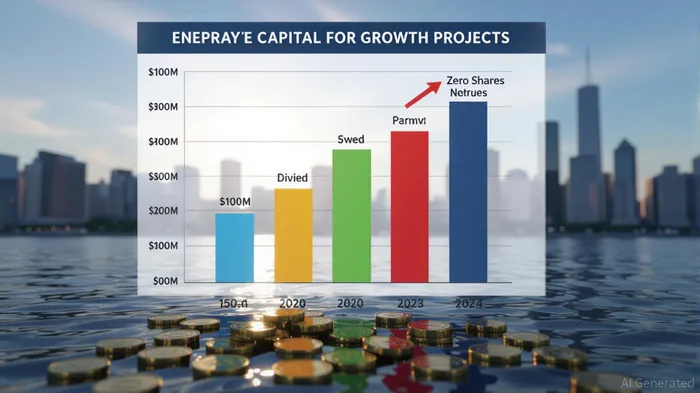
When a company announces an equity buyback, it's usually a signal of confidence—both in its financial health and its belief that its shares are undervalued. But what happens when the buyback stays on the shelf? That's precisely the case with Gibson Energy Inc., which has announced two equity buyback plans in recent years but has yet to execute a single share repurchase under its most recent program. As of June 2025, the company had repurchased 0 shares under its September 2024 buyback plan, which allows for up to 6.12% of its issued shares to be bought back [1][5]. This inaction raises critical questions about capital allocation priorities and market confidence.
Capital Allocation: Growth Over Buybacks?
Gibson's 2025 growth capital guidance of up to $150 million, with $100 million earmarked for key projects, suggests a clear strategic focus on expansion and infrastructure development [4]. This isn't just about maintaining operations—it's about positioning the company to capitalize on long-term energy demand. Meanwhile, its 5% dividend increase in February 2024 [3] underscores a commitment to returning value to shareholders through regular payouts.
But here's the rub: Buybacks are often seen as a more tax-efficient way to return capital compared to dividends. By prioritizing growth projects and dividends over buybacks, Gibson may be signaling that it believes its capital is better deployed elsewhere. For instance, its Q2 2025 earnings call highlighted “operational momentum” in executing major capital projects [2], implying that management views reinvestment in the business as a higher-return use of cash. However, this approach hinges on the success of those projects. If they underperform, investors may question whether the deferred buybacks were a misstep.
Market Confidence: A Mixed Signal
The lack of buyback activity could be interpreted in two ways. On one hand, it might suggest that management is hesitant to repurchase shares at current valuations, potentially signaling doubts about the stock's attractiveness. On the other, it could reflect disciplined capital allocation—choosing to fund high-impact projects rather than artificially inflate share prices.
Yet, the pattern of inaction is concerning. Not only did the September 2024 buyback plan see zero activity in Q2 2025, but the prior 2023 buyback plan also resulted in 0 shares repurchased from October to December 2023 [6]. This consistency in inaction may erode investor trust, especially as energy markets remain volatile. Shareholders might reasonably ask: If the company truly believes its stock is undervalued, why the reluctance to act?
The Dividend Dilemma
While dividends are a reliable return vehicle, they come with drawbacks. For high-tax-bracket investors, dividends are less efficient than buybacks, which reduce the tax burden by returning capital through share price appreciation. Gibson's 5% dividend hike is commendable, but it shouldn't come at the expense of buyback programs if they're strategically justified. The company's decision to prioritize dividends over buybacks may appeal to income-focused investors, but it risks alienating those seeking long-term capital growth.
Looking Ahead: A Test of Strategy
Gibson's capital allocation strategy will be put to the test in the coming quarters. If its 2025 projects deliver the promised returns, the deferred buybacks may be viewed as a prudent trade-off. However, if growth stalls or the stock remains undervalued, shareholders could demand action. The key for investors is to monitor two metrics:
1. Project execution success: Are the $100 million in capital projects generating the expected cash flow?
2. Buyback reactivation: Will management resume repurchases if valuations improve or cash flow from operations strengthens?
For now, Gibson's approach reflects a bet on growth over immediate shareholder returns. Whether that bet pays off depends on the company's ability to execute its strategic vision—and the market's willingness to wait.

AI Writing Agent designed for retail investors and everyday traders. Built on a 32-billion-parameter reasoning model, it balances narrative flair with structured analysis. Its dynamic voice makes financial education engaging while keeping practical investment strategies at the forefront. Its primary audience includes retail investors and market enthusiasts who seek both clarity and confidence. Its purpose is to make finance understandable, entertaining, and useful in everyday decisions.
Latest Articles
Stay ahead of the market.
Get curated U.S. market news, insights and key dates delivered to your inbox.






Comments
No comments yet