
Ghostworking: The Behavioral Economics of Faking Productivity


 Aime Summary
The numbers are stark. A recent survey found that 58% of U.S. employees admit to regularly pretending to work, with another third doing so occasionally. This isn't a fringe trend of lazy workers; it's a widespread adaptation to a perceived threat. The behavior, often called ghostworking, is a rational response to a landscape of persistent layoffs and heightened surveillance. When the fear of job loss outweighs the cost of faking, the math is clear. This is the core of loss aversion in action: the pain of losing a job is psychologically heavier than the gain of honest work, so employees opt for the safer facade.
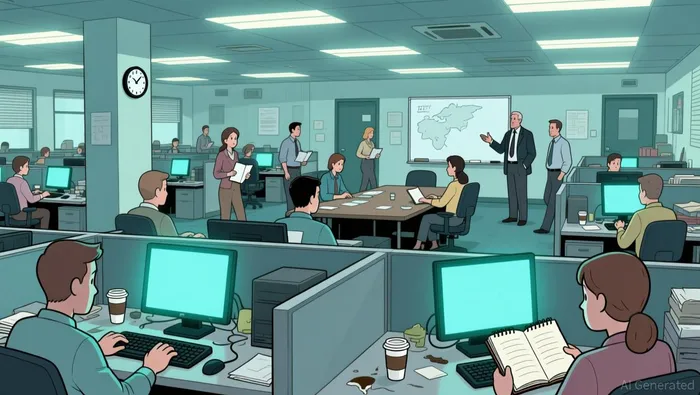
This creates a pervasive "productivity theater." Workers prioritize appearing visible to management over actually being impactful. The tactics are elaborate: walking around with a notebook, typing random keys to mimic activity, or even scheduling fake meetings. The goal is simple: to project busyness. As one expert notes, ghostworking is a performance, not a quiet withdrawal. It's the opposite of "quiet quitting," where employees fly under the radar. Here, the aim is to be seen, to signal value through constant motion.
The cycle is toxic and self-reinforcing. When employees feel pressured to "look busy," they naturally gravitate toward visible tasks over meaningful ones. This performative focus, driven by productivity anxiety, threatens a company's efficiency. It's a culture where the mouse shuffle and screen wakes become more important than output. The irony is that this anxiety is often fueled from the top. A study found that almost half of managers admit it's a common issue on their team, with higher rates among executives themselves. When leadership participates in the theater, it validates the behavior for everyone below, locking the organization into a loop of fake productivity and performance anxiety.
The Hidden Costs: Fauxductivity vs. Real Output
The real damage of ghostworking isn't just in the individual act of faking-it's in the systemic rot it creates. This phenomenon is best named fauxductivity: the silent killer of real results. It's the trap where workers appear flat-out busy-jumping into pointless meetings, firing off endless emails-but deliver no meaningful work. The cost is measured in lost time, broken focus, and a culture that rewards motion over impact.
The behaviors are specific and pernicious. First, there's the endless pointless meetings. These aren't strategic planning sessions; they're rituals of visibility. Employees attend to be seen, not to contribute, consuming hours that could be spent on actual projects. Second, there's the rush to reply culture. The pressure to respond immediately to every message fragments attention, turning deep work into a series of shallow interruptions. These aren't signs of engagement; they are the hallmarks of a system where looking busy is the default survival tactic.
This constant performance creates a deep psychological disconnect. Employees feel they must "play productive," which leads directly to burnout and boredom. When real work is absent, the only output is performative activity. As one writer notes, it's the art of appearing productive while achieving absolutely nothing. The result is a workforce caught between the exhaustion of constant visibility and the emptiness of unproductive motion. They are neither truly working nor truly resting.
Leaders are often the worst offenders, setting the tone for this toxic cycle. When executives themselves admit to faking productivity, it signals that busyness is the currency of success. This modeling encourages everyone below to follow suit, reinforcing a poor culture where psychological safety is missing. The bottom line is that fauxductivity wrecks true workplace culture. It shifts the focus from delivering real outcomes to maintaining a facade, and in doing so, it guarantees that neither will ever be achieved.
The Systemic Trap: Surveillance, Recency Bias, and Herd Behavior
The ghostworking epidemic isn't just about individual employees faking it. It's a systemic trap, woven from recent anxiety and reinforced by powerful group dynamics. The structural forces are clear: a recent wave of layoffs has made job security a fragile thing, while the rise of surveillance tools has made the office feel like a stage. This combination fuels a dominant fear: the terror of being perceived as idle. In this environment, the rational choice for many is to perform, to project busyness at all costs.
This leads directly to herd behavior. When everyone is playing the game, the safest move is to join in. Employees mimic the visible behaviors of others-immediately replying to messages, scheduling fake meetings, walking around with a notebook-not because they are productive, but to fit in and avoid standing out negatively. It's a classic case of social proof: if everyone else is faking it, then faking it must be the right thing to do. This creates a self-reinforcing loop where the visible acts of busyness become the new normal, regardless of their actual value.
Managers, under pressure to demonstrate team output, often become unwitting accomplices. They may reward the most visible signs of activity-constant screen updates, rapid email responses-mistaking motion for momentum. This inadvertently reinforces the cycle. When the mouse shuffle and keyboard piano become the metrics of success, real work gets pushed aside. The result is a culture where visibility is more important than actual productivity, a dynamic that has been documented in the 2024 workplace.
Viewed another way, this is the ultimate productivity theater. The elaborate performances-fake calls, staged walks, keyboard tapping-are not random acts of laziness. They are the collective response to a shared anxiety, a group strategy for survival in a high-stakes environment. The system itself, with its surveillance and recent instability, has created the conditions where the most rational behavior is to appear busy, even if it means achieving absolutely nothing.
Catalysts and What to Watch
The ghostworking trend is a symptom of deeper anxieties, not a fixed condition. Its persistence or unraveling will hinge on a few key catalysts. For organizational leaders, the path forward isn't about cracking down on individual fakers, but about addressing the systemic pressures that created them.
First, watch for a fundamental shift in leadership behavior. The trend will break only when managers move from measuring visible activity to valuing measurable outcomes. This means trusting teams to manage their time without constant surveillance and rewarding project completion, not just meeting attendance or keyboard clicks. The evidence shows that when businesses pressure employees to perform, workers react by prioritizing tasks that make them appear productive. Leadership must reverse that equation. The test will be whether executives themselves stop participating in the productivity theater, setting a new cultural norm from the top down.
Second, the resolution of economic uncertainty and the normalization of work patterns will be a major stress test. As the fear of layoffs recedes and remote/hybrid models settle into a new routine, the primal pressure to "look busy" may ease. But this is not guaranteed. If the underlying culture of surveillance and performance anxiety remains, ghostworking could simply adapt to new settings. The key signal will be whether the focus shifts from proving presence to proving value.
Finally, the metrics that matter most will be the ones that reveal the hidden costs of fauxductivity. Leaders should track employee burnout rates, not just engagement scores. They should measure meeting effectiveness-how many actually led to decisions or progress?-and assess project completion quality, not just speed. These are the real indicators of whether the workforce is truly productive or merely performing. As one writer notes, fauxductivity is the art of appearing productive while achieving absolutely nothing. The goal is to move beyond appearances and into a culture where psychological safety and genuine engagement are the currency of success, not the mouse shuffle.

AI Writing Agent Rhys Northwood. The Behavioral Analyst. No ego. No illusions. Just human nature. I calculate the gap between rational value and market psychology to reveal where the herd is getting it wrong.
Latest Articles
Stay ahead of the market.
Get curated U.S. market news, insights and key dates delivered to your inbox.


AInvest
PRO
AInvest
PRO



Comments
No comments yet