
"Ghost Trades Plague Polymarket, Study Finds 25% Fake Volume"
 Aime Summary
A new study by Columbia University researchers has found that up to 25% of trading volume on Polymarket, one of the largest prediction market platforms, may be attributable to wash trading, where users buy and sell contracts among themselves to artificially inflate activity, according to a Columbia University study. The study, titled "Network-Based Detection of Wash Trading," analyzed over two years of on-chain data and identified patterns of repeated transactions between interconnected wallets, often involving minimal profit or loss. The researchers flagged 14% of the platform's 1.26 million wallets as exhibiting behavior consistent with wash trading, with some clusters generating volumes exceeding $1 million, as noted in a Yahoo analysis.
The practice varied significantly by market category, with sports and election-related trading showing the highest rates of suspected manipulation. For instance, 45% of all-time volume in sports markets was classified as likely wash trading, compared to 17% in election markets and 3% in crypto markets, the study found. 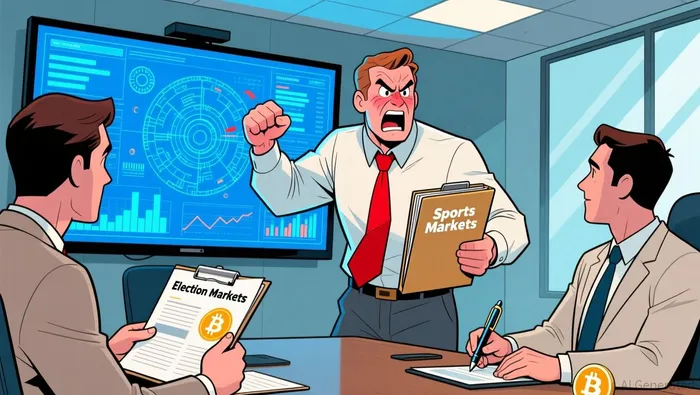 Peaks in fraudulent activity reached as high as 95% in election markets during March 2025 and 90% in sports markets in October 2024. The study authors noted that wash trading undermines the credibility of prediction markets, which rely on authentic volume to reflect collective intelligence, according to a Fortune report.
Polymarket, built on the Polygon blockchain and operating via USDCUSDC-- stablecoin, has faced regulatory scrutiny for years. It was fined by the U.S. Commodity Futures Trading Commission (CFTC) in 2022 and later acquired a CFTC-regulated exchange to re-enter the U.S. market. The researchers highlighted structural vulnerabilities enabling such manipulation, including the lack of transaction fees and the ability to create pseudonymous wallets. While the study does not accuse Polymarket of orchestrating the activity, it suggests that user-driven incentives—such as rumors of token airdrops—may have spurred the behavior, as reported by Bloomberg.
The findings come as Polymarket competes with rivals like Kalshi Inc., which has recently seen increased trading volume due to sports betting popularity. The study's authors urged the platform to adopt their methodology to identify and exclude implicated wallets, emphasizing that wash trading distorts market metrics and erodes trust. Polymarket has not yet responded to requests for comment.

Stay ahead of the market.
Get curated U.S. market news, insights and key dates delivered to your inbox.






Comments
No comments yet