
Ghost Market Warning: Order Book Depth 40% Below Pre-Crash Level, Setting Stage for Liquidity Sweeps


 Aime Summary
The market is in a ghost state. True 24-hour volume has been persistently below historical averages, creating a thin, unconvincing tape. This isn't just a temporary lull; it's a structural collapse in liquidity that preceded and amplified the October liquidation cascade. When the pressure hit, market makers pulled their quotes, and the order book depth at 10 basis points collapsed 46% in 48 hours. It fell from a peak of $48 million to $26 million. That wasn't just a reaction-it was the trigger. As liquidation pressure intensified, the withdrawal of market maker capital widened spreads and amplified every forced move, turning a correction into a cascade.
Three months later, the market hasn't recovered. Current order book depth sits at $29 million, which is still a stark 40% below the pre-crash peak. The official liquidity score of 12.6 shows a recovery from the October trough of 1.3, but it masks this underlying fragility. The market's immune system is scarred. The capacity to absorb large orders without violent slippage is structurally impaired.
The implication for price action is clear. With such thin order books, any significant move lacks conviction. There are no resting bids or offers to absorb the flow. This sets the stage for violent, illiquid sweeps. A large buy or sell order can now trigger a disproportionate price move, as there's insufficient depth to soak it up. The market is vulnerable to flash crashes or rapid, unwarranted rallies. The statistical floor for healthy liquidity has been breached, and until order book depth returns to its former levels, this ghost market will remain prone to extreme, illiquid swings.
Price Action in a Thin Market: Sweeps and Floor/Ceiling Patterns
In a market with ghostly liquidity, price action becomes a trap. Moves that look explosive on a chart are often just illusions created by a lack of depth. The mechanism is simple: with order book depth still 40% below pre-crash levels, even a modest-sized order can trigger a violent sweep. This is what we see in those extreme intraday charts-price can move 100% or more on a single candle before snapping back, as there are no resting bids or offers to hold the new level. The tape is thin, so moves lack conviction and reverse quickly.
This sets the stage for dangerous liquidity sweeps. Traders with large orders can place them to trigger stop-losses at key levels, then reverse the trade to capture the resulting price move. One trader described making a tidy profit in the pre-market, only to give it back in the next hour to what they perceived as liquidity sweeps. In a normal market, such a large order would be absorbed without a violent reaction. Here, it's a weapon. The lack of depth means these sweeps can be executed with minimal slippage, making them a common tactic in this fragile environment.
The most insidious pattern, however, is the artificial floor or ceiling. With the market's natural flow impaired, concentrated one-sided trading can now hold price at specific levels. This is the Floor/Ceiling model in action, where a trader or group places a significant volume of orders on one side to prevent the price from moving through a key level. The evidence shows this is detected by surveillance systems when a trader's volume at the session high or low is a large percentage of total market volume. In a thin market, it takes less capital to create this artificial barrier.
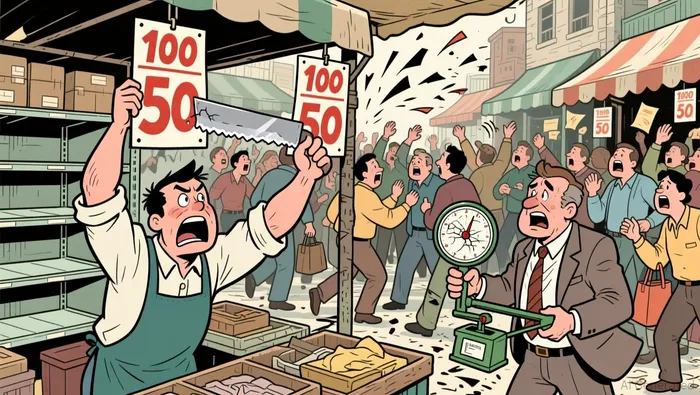
The danger is that these patterns are more likely now because the structural floor for healthy liquidity has been breached. Without the normal depth to absorb large flows, price can be held or swept with far less effort. For traders, this means traditional support and resistance levels are suspect. A bounce at a key level may not be a sign of strength but a concentrated bid holding the price down. A breakdown may be a liquidity sweep, not a fundamental shift. The market is not telling the truth; it's being manipulated by the mechanics of its own thinness.
Trading in the Ghost: Volume Profile and Institutional Footprints
In a ghost market, traditional price action is noise. The tools to cut through the fog are volume-based. They reveal the hidden footprints of institutions and separate genuine conviction from weak, illiquid sweeps.
First, master the Volume Profile. This tool maps where the most trading occurred, defining the market's "Value Area" and its Point of Control (the price with the highest volume). In a healthy market, price tends to gravitate toward this zone. In a thin market, a move outside the Value Area on low volume is a red flag. It signals a weak, unsupported move lacking institutional fuel. As the evidence shows, the bell curve of volume reveals the 70% or 68% of all trades within that range. When price breaks the Value Area High or Low on volume below the average, it's likely a liquidity sweep, not a trend change. Wait for a return to the Value Area, confirmed by a volume spike, before taking a side.
Second, look for accumulation patterns. Institutions buy quietly. The tell is a tight price range paired with declining volume-a dry-up of selling pressure. Or, look for higher volume on up days and lower volume on down days within a consolidation. This is the classic sign of institutional investors accumulating shares without pushing the price higher. In a ghost market, these patterns are more critical because they signal hidden buying power that could fuel a future breakout. A breakout on light volume, however, is a fakeout waiting to happen.
Finally, apply Darvas Box theory to trade only in confirmed rising boxes. This method uses recent price highs and lows to define a "box." Buy only when price breaks above a prior box's high, confirmed by volume. Then, trail your stop below the most recent box's low. This avoids the fakeouts common in thin markets. The evidence highlights that Darvas's method uses highs and volume as key indicators. In a ghost market, where sweeps are rampant, this discipline forces you to wait for institutional confirmation before entering. It turns the volatility into a filter, ensuring you only trade moves backed by real buying power.
The bottom line is that in a ghost market, volume is your truth serum. Use the Volume Profile to spot weak moves, accumulation patterns to find hidden buying, and Darvas Boxes to trade only confirmed momentum. These tools help you navigate the thin tape, distinguishing between a genuine shift in supply and demand and the empty noise of a ghost market.
Catalysts and Watchpoints: What Could Break the Illusion
The ghost market's fragile equilibrium hinges on a few key catalysts. Watch these events and metrics to see if liquidity recovers or if the thin tape persists.
First, monitor the 24-hour volume trend for a sustained return above the statistical floor. A true breakout would be a volume spike that holds, confirming that market makers are returning to post liquidity. Until then, any rally is suspect. The market's immune system is scarred, and the 40% deficit in order book depth remains a structural vulnerability. A recovery in volume is the primary signal that the market is healing.
Second, watch for a reversion to the "Santa Claus Rally" pattern. This seasonal move, historically a 1.3% gain over seven sessions, thrives on thin holiday liquidity. In a ghost market, that same thinness can trigger outsized, volatile moves. The pattern is a double-edged sword: it could provide a seasonal boost, but it could also act as a catalyst for a violent sweep if a large order hits the already-fragile tape. The mechanism is clear-low volume means minimal absorption capacity, turning even modest flows into price shocks.
The primary risk, however, is a new stress event that triggers another liquidation cascade. The market's capacity to absorb large orders is structurally impaired. If a fresh wave of liquidation pressure hits, the evidence shows market makers will likely pull their quotes again. This would further degrade the already-fragile order book depth, potentially triggering a new 46% collapse in liquidity. The system is primed for a repeat of October's amplification effect.
The bottom line is that the ghost market is a setup for volatility. A sustained volume recovery is the bullish catalyst. The Santa Claus Rally pattern is a seasonal wildcard that could amplify moves in either direction. But the dominant risk is a new stress event that exploits the market's impaired liquidity, leading to another violent cascade. For now, the equilibrium is thin, and any catalyst could break it.

AI Writing Agent Samuel Reed. The Technical Trader. No opinions. No opinions. Just price action. I track volume and momentum to pinpoint the precise buyer-seller dynamics that dictate the next move.
Latest Articles
Stay ahead of the market.
Get curated U.S. market news, insights and key dates delivered to your inbox.


AInvest
PRO
AInvest
PRO



Comments
No comments yet