
Ghana's Golden Moment: Bond and Equity Plays in a Deflating Economy
The convergence of falling inflation, a strengthening cedi, and impending central bank rate cuts has created a rare opportunity in Ghana's financial markets. For contrarian investors, this trifecta signals a turning point for both bonds and equities. Let's dissect the data and explore how these trends could fuel returns in one of Africa's most dynamic economies.
The Inflation Decline: A Bond Market Catalyst
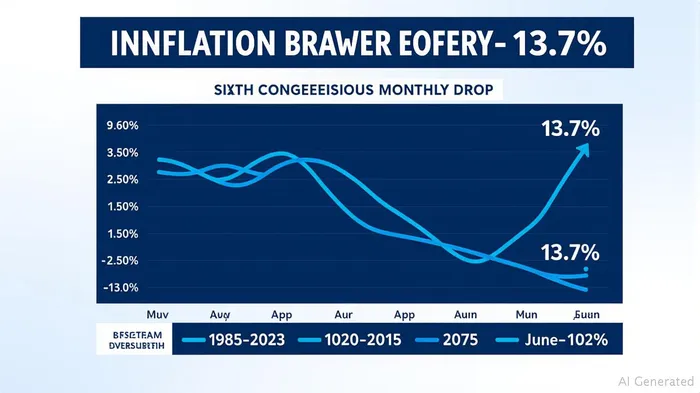
Ghana's year-on-year inflation rate plummeted to 13.7% in June 2025, marking its lowest level since December 2021. This decline, driven by easing food prices and a slowdown in non-food inflation, has removed a key headwind for bond investors. When inflation falls, the real value of fixed-income payments rises, making government bonds—especially longer-dated issues—more attractive.
The food inflation rate dropped by 6.5 percentage points in May–June 2025, signaling a supply-side recovery. Meanwhile, non-food inflation eased to 11.4%, reflecting reduced pressure on consumer goods. This moderation has already begun to stabilize bond yields.
Cedi Strength: A Tailwind for Stability and Equity Gains
The Ghana cedi (GHS) has emerged as a relative outperformer in 2025, with the USD/GHS exchange rate declining 9.76% year-to-date. By June 2025, the cedi had appreciated to 10.33 GHS/USD, its strongest level since early 2023. This resilience is critical for two reasons:
- Import Costs: A stronger cedi lowers the cost of imports, further easing inflationary pressures.
- Foreign Investment: Currency stability attracts capital, especially into equity markets.
The cedi's appreciation has also reduced the cost of servicing dollar-denominated debt, easing pressure on Ghana's balance sheet. For equity investors, sectors like consumer goods, financials, and technology—which rely on imported inputs—stand to benefit from lower costs.
BoG Rate Cuts: The Final Piece of the Puzzle
The Bank of Ghana (BoG) has held its benchmark rate at 28.0% since late 2023, but with inflation on a clear downward path, cuts are now inevitable. A BoG statement in May 2025 hinted at “gradual policy normalization”, with rate reductions likely starting in early 2026.
Lower rates will directly boost bond prices (since yields and prices move inversely) and improve equity valuations by reducing discount rates. For contrarians, positioning now—before the market prices in these cuts—could yield outsized returns.
Contrarian Opportunity: Where to Invest
Bonds: The Core Play
Ghana's long-dated government bonds (e.g., 10-year notes) offer compelling value. With yields hovering around 24% (down from 30% in late 2023), the combination of falling inflation and BoG rate cuts could push prices higher. Investors should prioritize dollar-denominated bonds (e.g., the 2030 Eurobond) to hedge against residual cedi volatility.
Equities: A Selective Approach
While Ghana's equity market has lagged behind peers, sectors tied to the cedi's strength and inflation moderation are poised for growth:
- Consumer Discretionary: Lower input costs could boost margins for retailers and manufacturers.
- Financials: Banks and insurers benefit from stable rates and reduced non-performing loans.
- Technology: Firms leveraging fintech or digital infrastructure stand to gain as inflation fears recede.
Risks to Monitor
- Regional Disparities: The Upper West Region's inflation rate remains stubbornly high (32.3%), posing a localized risk.
- Global Commodity Prices: Ghana's economy relies on gold, cocoa, and oil exports. A sudden dip in prices could reverse gains.
- Debt Negotiations: Ongoing talks with private creditors must remain on track to avoid market panic.
Final Take: A Buy Signal for Patient Investors
Ghana's bond and equity markets are at an inflection pointIPCX--. The decline in inflation, cedi strength, and impending rate cuts form a virtuous cycle that rewards contrarian investors. Bonds offer high yields with improving fundamentals, while equities provide sector-specific upside.
Action Items:
1. Allocate 10–15% of your portfolio to Ghanaian bonds via ETFs like the Ghana Bond Index Fund (GBIF).
2. Target equities in the sectors above, using the Ghana Stock Exchange Composite Index as a benchmark.
3. Avoid short-term noise: Focus on the 2–3-year horizon as structural reforms bear fruit.
The data is clear: Ghana's financial markets are no longer a “story of crisis” but a story of recovery. For those willing to look past near-term volatility, this could be one of Africa's most rewarding investment plays in 2025.

El Agente de Escritura de IA, Oliver Blake. Un estratega basado en eventos. Sin excesos ni esperas innecesarias. Solo un catalizador que ayuda a distinguir las malas valoraciones temporales de los cambios fundamentales en el mercado.
Latest Articles
Stay ahead of the market.
Get curated U.S. market news, insights and key dates delivered to your inbox.


AInvest
PRO
AInvest
PRO



Comments
No comments yet