
Gevo's Q3 2025: Contradictions Emerge on Carbon Capture Expansion, Ethanol Efficiency, DOE Loan Progress, and Ethanol-to-Olefins Tech
 Aime Summary
Date of Call: November 10, 2025
Financials Results
- Revenue: $43.6M combined operating revenue, interest and investment income for Q3 2025 (≈ $43M vs ≈ $2M in Q3 2024, +~$41M YOY)
- EPS: Net loss of $0.03 per share for Q3 2025
Guidance:
- Expect operating cash flows to normalize and trend toward breakeven in coming quarters.
- Remaining proceeds from $52M of 2025 Section 45Z tax-credit sales expected to be collected over the next 1–2 quarters.
- CDR sales projected to grow from $1M (Q2) to $3–5M by end of 2025 with further growth thereafter.
- Target closing ATJ-30 financing mid-2026; ATJ-30 estimated to add ~$150M adjusted EBITDA when built.
- Incremental debottleneck capex to optimize GND is ~ $15M; management sees a path to ~$110M adjusted EBITDA within ~18–24 months.
Business Commentary:
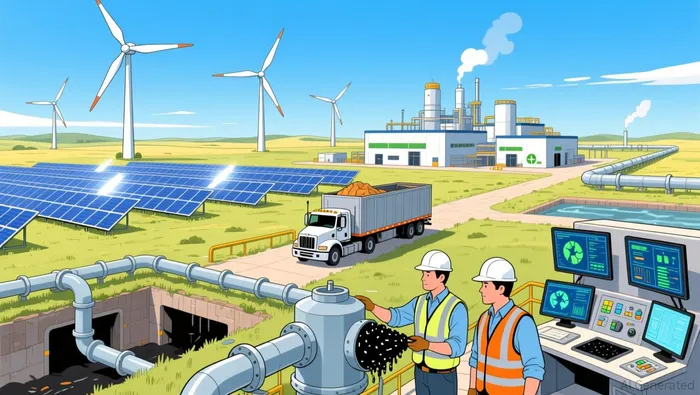 * Operational and Financial Performance at Gevo North Dakota: - Gevo's North Dakota site reported
 income from operations of $12.3 million and a positive non-GAAP adjusted EBITDA of $17.8 million for the quarter. - The growth was driven by consistent energy production, efficient carbon capture, and effective monetization of clean fuel production credits.- Carbon Management and Monetization:
- Gevo successfully sold
$52 millionworth of Section 45Z clean fuel production credits for 2025 production, with a net proceeds of approximately$29 millionreceived so far. The sale was facilitated by the company's ability to achieve low carbon intensity scores through efficient operations and carbon capture initiatives.
Strategic Partnerships and Carbon Credits:
- Gevo secured a
$26 million, 5-year agreementwith Biorecro for carbon dioxide removal credits and was recognized as a supplier of high-integrity durable carbon credits by NASDAQ. These partnerships underscore the company's ability to deliver quality carbon credits and its focus on expanding the market for carbon dioxide removal products.
Ethanol and RNG Production and Sales:
- Gevo North Dakota produced and sold
over 16 million gallonsof ethanol and46,000 tonsof animal feed, with42,000 tonsof carbon dioxide sequestered. - The site's high production and efficient operations contributed to stable financial performance and positioned Gevo for future growth.
Sentiment Analysis:
Overall Tone: Positive
- Management repeatedly highlighted strong operational progress and monetization: 'this acquisition turned out better than we ever expected,' Q3 non‑GAAP adjusted EBITDA was positive $6.6M, GND generated $17.8M adj EBITDA and management projects GND could generate >$100M adjusted EBITDA while ATJ‑30 could add ~$150M. Guidance emphasizes cash‑collection of $52M tax credits and near‑term growth in CDR sales.
Q&A:
- Question from Derrick Whitfield (Texas Capital Securities): Referencing Slide 12, could you elaborate on the incremental capital and steps required to optimize your operation and a reasonable timeline to achieve $110 million of EBITDA?
Response: Incremental debottleneck capex is roughly ~$15M to optimize ethanol throughput, energy use and CO2 capture; management expects to reach about $110M adjusted EBITDA over ~18–24 months, timing dependent on execution and carbon monetization.
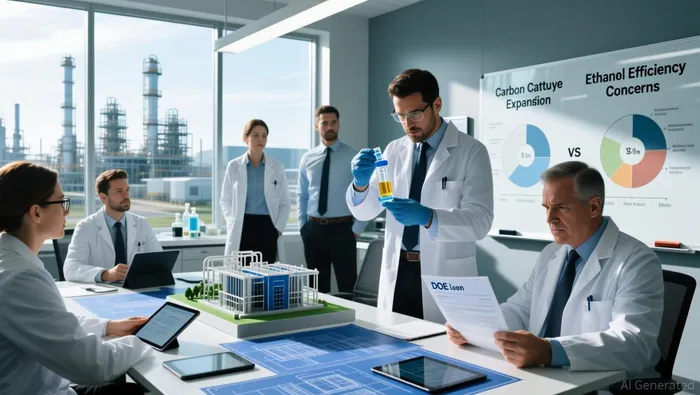
- Question from Derrick Whitfield (Texas Capital Securities): Could you elaborate on how the DOE loan extension and change of scope increases the likelihood of DOE financing?
Response: Shifting the DOE commitment to Gevo North Dakota improves financing odds because the site is derisked (operating ethanol plant with CCS and positive cash flow), requires less external financing and better fits the DOE's interest.
- Question from Amit Dayal (H.C. Wainwright & Co): On EBITDA drivers for next year, is growth primarily from sequestration capacity expansion or debottlenecking efforts?
Response: Primary near‑term driver is carbon monetization (both compliance and CDR markets) combined with debottlenecking; carbon sales are expected to scale materially and provide ratable revenue while debottlenecks drive incremental ethanol/CO2 volume.
- Question from Amit Dayal (H.C. Wainwright & Co): If you had to choose between ATJ‑30 and a much larger ethanol expansion, would you lean toward ATJ‑30 with or without DOE funding?
Response: Management views ATJ‑30 as highly attractive (estimated ~$150M EBITDA uplift) and not dependent on 45Z credits; plan is to first capture low‑hanging debottleneck gains (e.g., to 75M gal) then pursue ATJ‑30 while evaluating larger ethanol builds against market/credit duration.
- Question from Amit Dayal (H.C. Wainwright & Co): How much more development is needed before Verity can be commercialized more aggressively?
Response: Verity is being implemented at Gevo North Dakota and is nearing full functionality (anticipated by year‑end), enabling scale‑out as a commercial carbon‑tracking service for other biofuel producers.
- Question from Craig Irwin (ROTH Capital Partners): Update on conversations with potential customers using your Richardton well for sequestration — tolling customers or service provision?
Response: Actively engaging potential third parties to co‑locate or use the sequestration capacity via tolling and virtual‑pipeline/rail transport; management sees opportunities to monetize unused pore space and provide storage services.
- Question from Craig Irwin (ROTH Capital Partners): How should investors project the incremental CI improvements over the next quarters and link to your capital plan?
Response: Legislation (the Big Beautiful Bill) provides an expected ~ $0.10/gal uplift from CI changes next year; management is targeting an additional ~ $0.10/gal via onsite decarbonization measures, moving from ≈ $0.80/gal realized in 2025 toward ≈ $1.00/gal next year (subject to inflation adjustments).
- Question from Craig Irwin (ROTH Capital Partners): What did Red Trail do right on commissioning their Class VI well that enabled clean execution at your site?
Response: Successful execution attributed to experienced, boots‑on‑the‑ground leadership and contractors with local drilling expertise and focused, high‑quality project execution.
- Question from Peter Gastreich (Water Tower Research): Is Frontier a competitor to the Summit pipeline or complementary to it?
Response: Frontier is complementary — targeting plants stranded without pipeline access by offering rail‑based CO2 transport and sequestration options for facilities lacking geological/pipeline connections.
- Question from Peter Gastreich (Water Tower Research): Can you discuss the Haush partnership in Europe and strategy given SAF feedstock restrictions there?
Response: European strategy focuses on non‑crop carbohydrate feedstocks (waste/residue) that qualify under ReFuelEU; Haush is a hydrogen partner and management is evaluating feedstock availability, partners and economics for European ATJ opportunities.
Contradiction Point 1
Carbon Capture and Storage (CCS) Expansion Plans and Timelines
It involves differing timelines and expectations for expanding sequestration capacity, which could impact investors' perceptions of the company's strategic roadmap and financial prospects.
Can you update us on potential customers for carbon sequestration using your wells? - Craig Irwin(ROTH Capital Partners, LLC, Research Division)
2025Q3: We're using only 17% of our sequestration capacity. We're open to providing sequestration services to third parties and exploring options like CO2 by rail to Wyoming. - Patrick Gruber(CEO)
Can you describe the CDR market's depth and durability and its contract structures? - Derrick Whitfield(Texas Capital Securities, Research Division)
2025Q2: We're using only 17% of our sequestration capacity. We're open to providing sequestration services to third parties and exploring options like CO2 by rail to Wyoming. - Patrick R. Gruber(CEO)
Contradiction Point 2
Ethanol Production and Carbon Capture Efficiency
It involves differing statements on the production efficiency of ethanol and carbon capture, which could impact investor understanding of the company's operational capabilities and financial performance.
What incremental capital and steps are required to optimize operations and achieve $110 million EBITDA, and what is the reasonable timeline? - Derrick Whitfield(Texas Capital Securities, Research Division)
2025Q3: ERC incremental capital is in the range of $15 million-ish to debottleneck the ethanol plant. The goal is to produce more ethanol, capture more CO2, improve energy use, and leverage existing facilities to increase adjusted EBITDA to $110 million in the next 18-24 months. - Patrick Gruber(CEO)
Regarding CFPC monetization, ethanol credits have been monetized, but biogas has not. What is preventing the monetization of biogas credits, and when do you anticipate it will occur? - Whitney Motalema(Jefferies)
2025Q2: In terms of our ethanol business, we actually have more production than ethanol credit available. We're creating a lot of ethanol product. - Patrick R. Gruber(CEO)
Contradiction Point 3
DOE Loan Status and DOE Process
It involves updates and expectations regarding Gevo's DOE loan status and the DOE loan process, which are crucial for project financing and company growth.
How does the DOE loan extension and scope change increase the likelihood of securing DOE financing? - Derrick Whitfield(Texas Capital Securities)
2025Q3: The DOE sees the advantages of moving the project to North Dakota due to existing assets and a more straightforward financing process. The conditional commitment remains, but the move simplifies financing efforts, making it more attractive for the DOE. - Patrick Gruber(CEO)
What is delaying the DOE process for the ATJ60 plant, and what are the next steps? - Ethan Finger(OpCo)
2024Q4: The DOE process is being slowed down by environmental requirements and transition delays. The focus is on securing final commitments for equity and project financing. - Patrick Gruber(CEO)
Contradiction Point 4
Ethanol-to-Olefins Technology Development
It pertains to Gevo's progress in developing ethanol-to-olefins technology, which could impact future revenue streams.
Can you outline the incremental capital and steps needed to optimize operations and the timeline to achieve $110 million in EBITDA? - Derrick Whitfield(Texas Capital Securities)
2025Q3: The focus is on low-hanging fruit like expanding ethanol and capturing more carbon. - Patrick Gruber(CEO)
What are the future milestones for the ethanol-to-olefins technology as it scales? - Nathaniel Pendleton(Texas Capital)
2024Q4: The technology is in the development phase with Axens, aiming to accomplish the scale-up within 12 to 18 months. - Paul Bloom(Chief Business Officer)

Discover what executives don't want to reveal in conference calls
Latest Articles
Stay ahead of the market.
Get curated U.S. market news, insights and key dates delivered to your inbox.
AInvest
PRO
AInvest
PRO



Comments
No comments yet