
Germany's Unemployment Divergence and Its Ripple Effects on the Crypto Market


 Aime Summary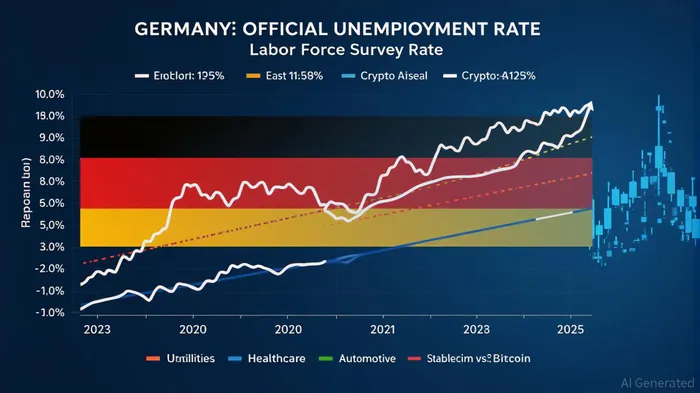
Germany’s labor market has become a paradox in 2025. While the labor force survey suggests a relatively healthy unemployment rate of 3.7% in June 2025 [1], the official statistics from the Federal Employment Agency paint a starker picture: 6.4% in August 2025, with 3.025 million jobless individuals—the highest since February 2015 [2]. This divergence stems from methodological differences: the 3.7% rate excludes seasonal adjustments and part-time workers, while the 6.4% figure reflects broader economic strain, including the summer break and U.S. tariff pressures [3]. The contradiction underscores a fragmented economic reality, where Germany’s industrial heartland grapples with stagnation while its service sectors show resilience.
This duality has profound implications for the crypto market. As traditional investors rotate into defensive sectors like utilities and healthcare—industries insulated from trade volatility and aligned with energy transition goals [4]—crypto investors are recalibrating their strategies. The European Central Bank’s Financial Stability Review highlights heightened volatility in global markets, driven by policy uncertainty and trade tensions [5]. In this environment, stablecoins and energy-efficient cryptocurrencies like EthereumETH-- are gaining traction as hedging tools. For instance, USD-based stablecoins dominate 90% of Europe’s market capitalization, serving as liquidity anchors in decentralized finance (DeFi) and cross-border transactions [6].
However, the regulatory landscape complicates these dynamics. The EU’s Markets in Crypto-Assets Regulation (MiCA), enacted in December 2024, has forced 75% of Europe’s 3,167 Virtual Asset Service Providers (VASPs) to exit the market by mid-2025 [7]. This regulatory tightening contrasts with the U.S.’s pro-blockchain policies, including a proposed National BitcoinBTC-- Reserve, creating a transatlantic divergence that amplifies fragmentation [8]. For German investors, this means navigating a dual challenge: hedging against domestic unemployment-driven inflation while complying with MiCA’s stringent compliance costs, which have surged sixfold [7].
Strategic sector rotation in crypto mirrors traditional markets. Energy transition-related assets, such as hybrid ETFs combining renewables and battery storage, are attracting capital as Germany’s automotive sector falters under U.S. tariffs and EV transition costs [9]. Meanwhile, Bitcoin’s role as a hedge against macroeconomic volatility is being reevaluated. While its price remains correlated with U.S. Federal Reserve policy, its appeal in Europe is tempered by the ECB’s preference for a digital euro over private crypto assets [10].
The path forward requires a nuanced approach. Investors must balance short-term defensive positioning in stablecoins and energy-efficient crypto with long-term exposure to EU fiscal initiatives, such as green bonds and energy transition funds. For Germany, where youth unemployment remains at 6.4%—far below the EU average of 14.7% [3]—targeting sectors with robust balance sheets and regulatory alignment will be critical. The OECD projects Germany’s unemployment rate to peak at 3.6% by Q4 2025 before stabilizing [11], suggesting a window for strategic entry into undervalued crypto assets tied to industrial recovery.
In a fragmented European economy, the key to resilience lies in adaptability. As Germany’s labor market diverges from its peers, investors must leverage both traditional and crypto tools to hedge against macroeconomic headwinds while capitalizing on sectoral imbalances. The crypto market, though volatile, offers a unique lens to navigate this complexity—provided one can decode the interplay between policy, inflation, and innovation.
Source:
[1] Europe June 2025: EU unemployment rate at 5.9% [https://www.destatis.de/Europa/EN/Topic/Population-Labour-Social-Issues/Labour-market/EULabourMarketCrisis.html]
[2] German unemployment rises above 3 million [https://www.dw.com/en/german-unemployment-rises-above-3-million/a-73808583]
[3] Navigating the German Economic Slowdown: Implications for Investors in European Equities [https://www.ainvest.com/news/navigating-german-economic-slowdown-implications-investors-european-equities-2508/]
[4] Financial Stability Review, May 2025 - European Central Bank [https://www.ecb.europa.eu/press/financial-stability-publications/fsr/html/ecb.fsr202505~0cde5244f6.en.html]
[5] Global Economics Intelligence Executive Summary, July 2025 [https://www.mckinsey.com/capabilities/strategy-and-corporate-finance/our-insights/global-economics-intelligence]
[6] The 2025 crypto policy landscape: Looming EU and US divergences [https://www.atlanticcouncil.org/blogs/econographics/the-2025-crypto-policy-landscape-looming-eu-and-us-divergences/]
[7] Europe Crypto Report 2025 [https://coincub.com/ranking/europe-crypto-report-2025/]
[8] OECD Employment Outlook 2025: Germany [https://www.oecd.org/en/publications/2025/07/oecd-employment-outlook-2025-country-notes_5f33b4c5/germany_2d76c931.html]
[9] Navigating the Energy Transition Amid Geopolitical Uncertainty [https://www.ainvest.com/news/navigating-energy-transition-geopolitical-uncertainty-strategic-asset-allocation-sanctions-driven-world-2508/]
[10] Euro Area Unemployment Rate [https://tradingeconomics.com/euro-area/unemployment-rate]
[11] Germany Unemployment Rate [https://tradingeconomics.com/germany/unemployment-rate]

Decoding blockchain innovations and market trends with clarity and precision.
Latest Articles
Stay ahead of the market.
Get curated U.S. market news, insights and key dates delivered to your inbox.






Comments
No comments yet