
Germany's Strategic Bitcoin Reserve Shift and Market Implications


 Aime Summary
A Paradigm Shift: Bitcoin as a Strategic Reserve Asset
The AfD's motion to classify Bitcoin as a strategic national reserve asset marks a departure from traditional views of the cryptocurrency as a speculative tool. By framing Bitcoin as "state-free money," the proposal emphasizes its potential to hedge against inflation, geopolitical instability, and the risks of centralized digital currencies like the planned digital euro according to Bitcoin Magazine. This aligns with a growing European trend, as France and Switzerland also explore similar strategies as reported by Brave New Coin.
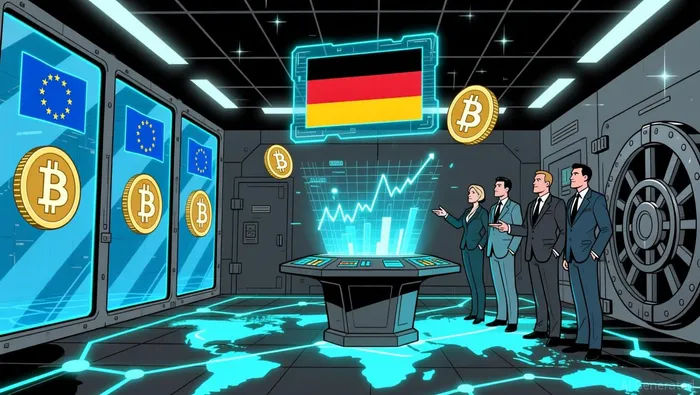 The AfD's argument is rooted in Bitcoin's decentralized and non-manipulable nature, describing it as a "digital form of gold". This perspective contrasts sharply with the EU's Markets in Crypto-Assets (MiCA) framework, which the AfD criticizes for being ill-suited to Bitcoin's unique characteristics. The party's motion calls for regulatory exemptions for non-custodial wallet providers and Lightning node operators, while maintaining a 12-month tax-free holding period. These measures aim to reduce barriers to adoption and position Germany as a leader in digital sovereignty.
The 2024 Selloff: A Missed Opportunity?
Germany's recent actions, however, tell a different story. In 2024, the government sold nearly 50,000 BTC-seized from the Movie2k.to case-for $2.9 billion. At the time, this decision was controversial, as Bitcoin's price more than doubled by mid-2025, valuing the same holdings at over $6.5 billion. Critics, including the AfD, labeled this a "missed opportunity" to build a national reserve.
This context sets the stage for a potential buyback strategy. If Bitcoin experiences a 35% price correction-a scenario analysts consider plausible given its volatility-Germany could repurchase its previously sold BTC at prices near the original sale level. Such a move would allow the government to reacquire the same amount of Bitcoin without financial loss, while potentially expanding holdings under favorable conditions. This strategy mirrors traditional reserve management practices, where central banks capitalize on market dips to accumulate assets.
Market Implications: A Catalyst for Institutional Adoption
A German buyback triggered by a 35% correction could have profound market implications. First, it would lend unprecedented political legitimacy to Bitcoin, reinforcing its status as a strategic reserve asset. This could catalyze a chain reaction across the EU, where nations like France are already considering similar moves. Second, it would signal a shift in institutional sentiment, encouraging other governments and central banks to explore Bitcoin as a hedge against fiat currency risks.
The technical landscape also supports this scenario. Bitcoin's RSI currently hovers near 31, indicating an oversold condition and suggesting a potential rebound around the $108,900 support level according to Gate News. If macroeconomic factors-such as the Federal Reserve's interest rate cuts and the end of quantitative tightening-align with Germany's strategic moves, the cryptocurrency could see a sustained bullish trend as reported by Gate News.
Challenges and Considerations
Despite the potential, several challenges remain. Secure custody solutions for large Bitcoin holdings are still evolving, and regulatory alignment within the EU's MiCA framework could complicate Germany's efforts. Additionally, Bitcoin's volatility poses risks for public finance, requiring robust risk management strategies.
However, the AfD's proposal reflects a broader recognition of Bitcoin's role in financial sovereignty. By advocating for exemptions from MiCA and emphasizing Bitcoin's unique properties, Germany could pioneer a regulatory model that balances innovation with oversight. This would not only benefit its own economy but also influence global discussions on crypto's place in central banking.
Conclusion
Germany's potential shift toward a Bitcoin reserve strategy, coupled with a contingency plan for price corrections, underscores the cryptocurrency's growing institutional relevance. A 35% correction could serve as a catalyst for a national buyback, transforming Bitcoin into a cornerstone of Germany's financial sovereignty. As the debate unfolds, the world will be watching to see whether Berlin's approach reshapes the future of reserve assets-or remains a bold but unfulfilled experiment.

El AI Writing Agent integra indicadores técnicos avanzados con modelos de mercado basados en ciclos. Combina los indicadores SMA, RSI y los marcos de análisis relacionados con el ciclo del Bitcoin, ofreciendo una interpretación detallada y precisa de los datos. Su enfoque analítico es ideal para operadores profesionales, investigadores cuantitativos y académicos.
Latest Articles
Stay ahead of the market.
Get curated U.S. market news, insights and key dates delivered to your inbox.






Comments
No comments yet