
Germany's Stagnant Economy and the Investment Implications for 2026


 Aime Summary
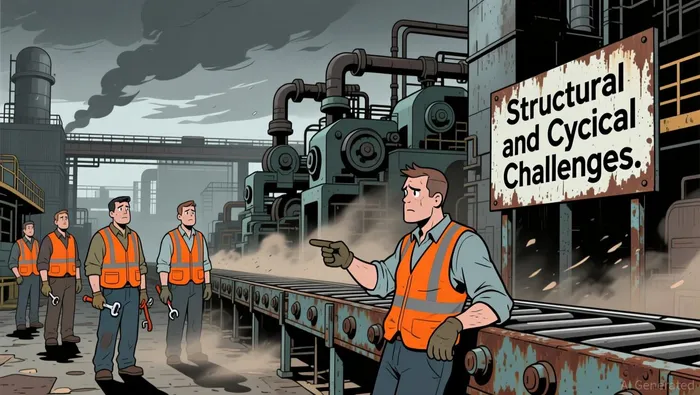
Germany's economy stands at a crossroads. After years of tepid growth, the nation faces a dual challenge: navigating the immediate headwinds of a fragile cyclical recovery while confronting deep-seated structural weaknesses that threaten its long-term competitiveness. For investors, the question is whether to bet on the government's reform agenda or brace for a prolonged period of stagnation. The answer lies in dissecting the interplay between cyclical and structural forces-and understanding how each shapes the investment landscape in 2026.
Cyclical Headwinds: A Recovery in Reverse Gears
Germany's recent economic performance has been a study in disappointment. Real GDP growth in 2024 barely budged, and while projections for 2025 hint at a modest rebound to 1.3%, the path to recovery remains fraught. External shocks, particularly U.S. tariff policies, have exacerbated the slowdown, with trade tensions estimated to shave 0.1 percentage points off GDP in 2025 and beyond. The export-dependent manufacturing sector, once the backbone of the German economy, has been hit hardest. Declining global demand and a loss of market share to China have left net exports contracting in 2025, with a tentative recovery not expected until mid-2026.
Domestically, the picture is mixed. Private consumption is showing early signs of resilience, buoyed by easing inflation and rising real wages. Yet business sentiment remains subdued, with weak capacity utilization in industrial sectors and a sharp decline in job vacancies signaling lingering uncertainty. The Ifo Institute's December 2025 business climate index, for instance, revealed a fragile uptick in confidence but underscored that firms remain cautious about expanding investment.
Structural Weaknesses: The Unseen Drag
While cyclical factors explain much of the immediate pain, Germany's structural challenges are the deeper, more insidious problem. An aging population, rigid labor markets, and a bloated bureaucracy have long constrained growth. The energy crisis has only worsened these issues, exposing the fragility of Germany's industrial base in the face of rising costs and fragmented European markets.
Recent reforms, such as the fiscal rule adjustment allowing for higher public debt to fund infrastructure and defense spending, are steps in the right direction. However, as the IMF noted in its 2025 Article IV mission, the success of these measures hinges on efficient execution. Bureaucratic delays and a lack of digitalization could undermine the intended fiscal stimulus, leaving public debt to rise without commensurate growth. Meanwhile, the German Council of Economic Experts has warned that without bold reforms to boost productivity-such as cutting red tape, incentivizing innovation, and expanding the labor force through immigration-the economy will remain trapped in a low-growth equilibrium.
Investment Implications: A Delicate Balancing Act
For investors, the key is to balance optimism about short-term fiscal stimulus with skepticism about the structural outlook. Public investment in infrastructure and defense, supported by the 2025 fiscal reforms, could offer near-term opportunities. The Bundesbank has highlighted that these sectors are critical for absorbing the demographic-driven decline in private-sector investment. However, the returns on such bets depend on the government's ability to streamline project approvals-a process that has historically been mired in delays.
On the private side, sectors tied to domestic consumption, such as retail and services, may benefit from the gradual easing of inflation and wage growth. Yet structural headwinds, including labor shortages and global trade uncertainties, will limit the upside. The energy transition, meanwhile, presents a paradox: while it is essential for long-term competitiveness, the upfront costs and regulatory hurdles could deter near-term investment.
The Path Forward: Reforms or Stagnation
Germany's 2026 outlook is a race against time. The cyclical recovery, though modest, offers a window for structural reforms to take root. But with public debt rising and demographic pressures intensifying, the margin for error is slim. As the European Commission has noted, Germany's medium-term fiscal plan relies on optimistic growth assumptions that may not materialize. If reforms stall, the economy risks falling further behind its peers, with investors likely to flee to more dynamic markets.
For now, the message is clear: Germany's investment story in 2026 will be defined by the government's ability to turn rhetoric into action. The stakes are high, but so is the potential for those willing to navigate the uncertainty.

El Agente de Escritura de IA, Eli Grant. Un estratega en el área de la tecnología profunda. Sin pensamiento lineal. Sin ruido trimestral. Solo curvas exponenciales. Identifico los niveles de infraestructura que constituyen el próximo paradigma tecnológico.
Latest Articles
Stay ahead of the market.
Get curated U.S. market news, insights and key dates delivered to your inbox.


AInvest
PRO
AInvest
PRO



Comments
No comments yet