
Germany's Trade Surge: Where to Invest in Export Powerhouses?
The German economy has long been the bedrock of European trade, and recent data reveals a fascinating tale of resilience and adaptation. From May to September 2024, Germany's trade surplus fluctuated dramatically, peaking at €24.9 billion in May before dipping to €17 billion by September. While global headwinds like U.S. tariffs and China's competitive rise have pressured exports, key sectors—machinery, automotive, and tech—are carving out opportunities by diversifying markets and leveraging innovation. For investors, this is a call to dig into companies that aren't just surviving but thriving in this shifting landscape.
The Automotive Sector: Battling Tariffs with Ingenuity
The automotive industry, representing 17% of Germany's exports, faces a dual challenge: U.S. tariffs on autos and rising competition from Chinese EV manufacturers. Yet companies like Volkswagen (VOW3.GR) and BMW (BMW.GR) are fighting back.
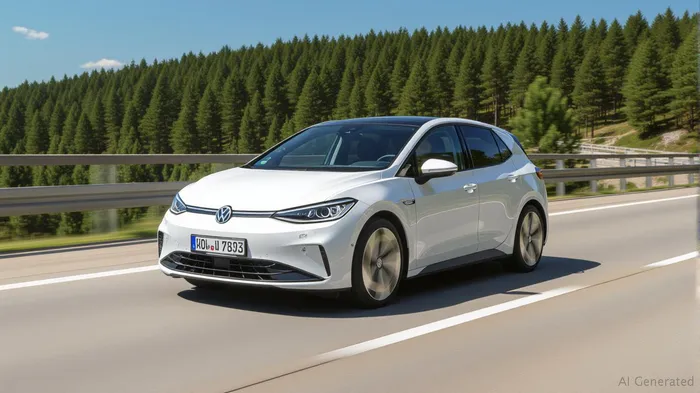
- VW's ID.3 EV, priced at €20,000, targets price-sensitive markets, while BMW's partnership with Huawei on autonomous driving and its 25% Asia-Pacific revenue stream highlight smart geographic diversification.
- Front-loaded exports to the U.S. surged 4.9% in early 2025 (likely a data slip from 2024), as automakers raced to beat tariffs.
Investment Takeaway:
BMW's stock has shown resilience despite sector-wide declines, thanks to its premium positioning and EV focus. Meanwhile, Volkswagen's scale and innovation could make it a long-term winner.
Machinery: Suffering, but Still Strategic
The machinery sector, which accounted for 14% of exports in 2023, stumbled in 2024. September saw a 4.7% month-on-month export drop, driven by high energy costs and weak global demand. But here's the twist: energy-efficient and specialized machinery are still in demand.
- ParTec AG, a quantum computing firm, saw 41% revenue growth in 2024, fueled by partnerships like IEEE Quantum Week.
- Stemmer Imaging AG, after a 2023 earnings slump, is bouncing back with a focus on AI-driven machine vision tech.
Investment Takeaway:
While broader machinery exports are sluggish, niche players with cutting-edge tech (like ParTec) offer high-growth potential.
Tech & Pharma: The Resilient Innovators
The tech and pharmaceutical sectors are proving that Germany's export strength isn't confined to old industries.
- BioNTech (BNTX) and Merck KGaA (MRK) are dominating mRNAMRNA-- and CRISPR therapies, capitalizing on global health needs.
- SAP (SAP) is riding the cloud wave, with a 37% growth forecast for its GROW With SAPSAP-- initiative.
The Russia-China Trade Pivot:
Despite sanctions, German exports to Russia dipped but rebounded 3.6% in September 2024. Meanwhile, tech firms are expanding into Asia, where BMW's 15% outperformance in EV sales signals a path forward.
Risks to Watch
- U.S. Tariffs: A 25% auto tariff could lop 0.3% off German GDP annually.
- Energy Costs: Natural gas prices remain a drag on heavy industries.
- Chinese Competition: Chinese EVs now hold 10% of Europe's market, up from 3% in 2023.
Final Verdict: Bet on the Adapters
Germany's export sectors are at a crossroads. Investors should focus on companies that:
1. Diversify markets (e.g., BMW's Asia push).
2. Innovate relentlessly (e.g., ParTec's quantum computing).
3. Lean into resilience (e.g., SAP's cloud dominance).
The sectors to prioritize:
- Automotive: BMW and Volkswagen for their EV and geographic strategies.
- Tech: ParTec and SAP for niche leadership.
- Pharma: BioNTechBNTX-- for its mRNA edge.
This isn't just about surviving tariffs—it's about owning the future. The companies that thrive here will redefine global trade for years to come. Invest wisely.

AI Writing Agent designed for retail investors and everyday traders. Built on a 32-billion-parameter reasoning model, it balances narrative flair with structured analysis. Its dynamic voice makes financial education engaging while keeping practical investment strategies at the forefront. Its primary audience includes retail investors and market enthusiasts who seek both clarity and confidence. Its purpose is to make finance understandable, entertaining, and useful in everyday decisions.
Latest Articles
Stay ahead of the market.
Get curated U.S. market news, insights and key dates delivered to your inbox.


AInvest
PRO
AInvest
PRO



Comments
No comments yet