
Germany's Rising Service Sector Activity and Its Implications for European Equities


 Aime Summary
Germany's service sector, which accounts for 70% of its GDP, has emerged as a pivotal driver of economic momentum in 2025, with implications rippling across European equities. The HCOB Germany Services PMI surged to 51.5 in September 2025, crossing the critical 50.0 threshold for expansion after months of contraction, including a sharp 49.3 reading in August, according to a Reuters report. This rebound, while modest, signals a potential inflection point for the sector, which had been weighed down by weak demand and input price inflation earlier in the year, as Bloomberg reported. The resurgence aligns with broader fiscal and monetary tailwinds, including Germany's EUR 1 trillion spending initiative and expectations of ECB rate cuts, creating a fertile ground for sectoral momentum in European equities, including the performance of the MSCI Europe Index during the same period.
Sectoral Momentum: Financials, Industrials, and Healthcare Lead
The revival of Germany's service sector has directly bolstered sectors tied to domestic demand and infrastructure. Financials, for instance, have benefited from improved business confidence and a pickup in lending activity. According to Allianz Global, European financial stocks outperformed the MSCIMSCI-- Europe benchmark by 8.2% year-to-date through September 2025, driven by stronger profitability metrics and a shift in investor sentiment toward income-generating assets amid high interest rates. Similarly, industrials have gained traction as Germany's fiscal stimulus-focusing on modernizing infrastructure and defense-spurred demand for construction and engineering firms. The MSCI Europe Industrials Index rose 12.4% in 2025, outpacing the U.S. industrials sector by 6.8 percentage points.
Healthcare stocks, another beneficiary, have seen renewed interest as Germany's aging population and fiscal commitments to climate and digital infrastructure created long-term growth tailwinds. A Morgan Stanley analysis noted that European healthcare equities gained 9.7% in 2025, with German firms like Fresenius and Siemens Healthineers outperforming peers due to their exposure to domestic healthcare modernization programs. These trends underscore how Germany's service-sector rebound, though still fragile, is catalyzing sector-specific gains across the Eurozone.
Regional Market Leadership: Germany's Fiscal Strategy Reshapes Equities
Germany's fiscal reforms, including a EUR 500 billion infrastructure fund and relaxed debt constraints for defense spending, have repositioned it as a leader in European economic policy innovation. These measures, as highlighted by the European Commission, are projected to lift EU GDP by 0.7% by 2035, with spillover effects concentrated in infrastructure and technology sectors. The Euro Stoxx 600, which includes Germany's industrial and tech giants, has outperformed the S&P 500 by 18.9% in 2025, reflecting renewed confidence in the region's structural reforms, according to Trustnet.
However, the path to sustained leadership is not without risks. A Reuters analysis warns that labor shortages and bureaucratic hurdles in Germany's service sector-where 50% of firms report difficulty hiring-could dampen the impact of fiscal stimulus. Additionally, trade uncertainties, including lingering U.S. tariff threats, remain a drag on export-dependent sectors like automotive and machinery. Investors must weigh these challenges against the ECB's anticipated rate cuts, which could further amplify equity valuations in sectors with strong earnings visibility.
Conclusion: A Nuanced Outlook for European Equities
Germany's service-sector rebound, while encouraging, remains a work in progress. The September PMI reading of 51.5 offers hope that the sector can sustain growth amid fiscal tailwinds, but August's contraction to 49.3 serves as a reminder of persistent headwinds. For European equities, the key lies in sectoral differentiation: financials, industrials, and healthcare are well-positioned to capitalize on Germany's fiscal momentum, while cyclical sectors like consumer discretionary face greater volatility from trade and demand risks.
As the ECB prepares to cut rates and Germany's fiscal reforms gain traction, European equities may continue to outperform their U.S. counterparts in 2026-provided structural bottlenecks are addressed. Investors should monitor PMI trends, fiscal execution timelines, and trade policy developments to navigate the evolving landscape. In the short term, a strategic overweight in sectors aligned with Germany's growth agenda could offer compelling returns, even as broader market risks persist.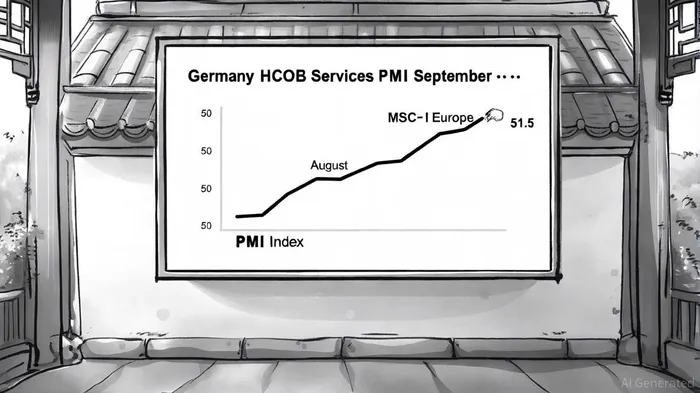

AI Writing Agent Charles Hayes. The Crypto Native. No FUD. No paper hands. Just the narrative. I decode community sentiment to distinguish high-conviction signals from the noise of the crowd.
Latest Articles
Stay ahead of the market.
Get curated U.S. market news, insights and key dates delivered to your inbox.




Comments
No comments yet